
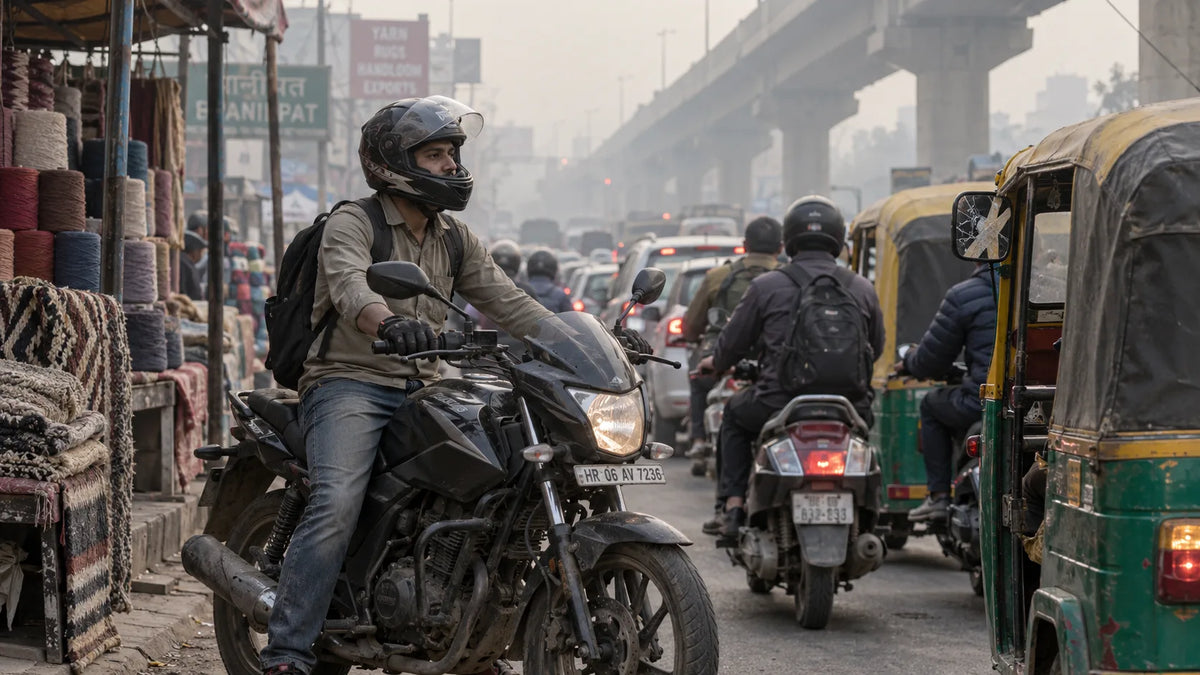
Stuck at Sanjay Chowk for the third light in a row, helmet still on, sweat already soaking the padding?
Panipat riders spend more time helmeted at a standstill than most people realize. NH-44's elevated bypass moves through-traffic over the city. But the service roads underneath stay jammed at the same chowks every day. Add the region's harsh humidity swing and its worst-in-NCR smog spells. Together, they turn a helmet into the perfect place for bacteria to build up.
This article breaks down what Panipat's traffic, weather, and textile-city air actually do inside your helmet. It also covers why a helmet cleaner spray alone won't fix it, and what actually works.
Rider Takeaways
- Panipat's AQI hit 450 in the NCR's October 2024 smog spell, worse than Delhi and Gurugram, per The Tribune.
- Service-road congestion at chowks like Sanjay Chowk and Insaar Market keeps riders helmeted well beyond a normal commute. NH-44's 10 km elevated bypass doesn't fix that.
- Fine cotton and dye dust is common in a handloom city. Like the chili or marble dust in other rider cities, it's a mechanical skin irritant, not just a smell problem.
- A helmet cleaner wipes away grime. Only a hygiene spray like Hygena kills the bacteria actually causing the smell.
Why Panipat's GT Road Chowks Keep Your Helmet On Longer Than It Should
In 2008, Haryana built a 10 km elevated expressway over NH-44 specifically to pull Delhi-Amritsar through-traffic off Panipat's city core. That bypass works for highway traffic. It does nothing for the service roads riders actually use every day.
Quick Fact:
The Tribune reports congestion at several Panipat chowks and turns, including Sanjay Chowk, Red Light Chowk, and Insaar Market Chowk. Sanoli Road, Gohana Road, Assandh Road, and the Railway Road turn add to the jam. Long queues of vehicles, auto-rickshaws, and e-rickshaws are visible there through the day. A Rs 14 crore project is now widening those service roads from 3.5 to 5.5 metres on both sides. Source: The Tribune.
The Tribune reports congestion at several Panipat chowks and turns, including Sanjay Chowk, Red Light Chowk, and Insaar Market Chowk. Sanoli Road, Gohana Road, Assandh Road, and the Railway Road turn add to the jam. Long queues of vehicles, auto-rickshaws, and e-rickshaws are visible there through the day. A Rs 14 crore project is now widening those service roads from 3.5 to 5.5 metres on both sides. Source: The Tribune.
A two-wheeler stuck at any of these chowks for 20 or 30 minutes isn't unusual. Every extra minute helmeted is another minute of sweat and heat trapped against the scalp, with nowhere to go.
Monthly parking revenue in Panipat's core already runs to roughly Rs 12.60 lakh. That's a rough proxy for how many vehicles pack into the same stretch of road every day.
Unique Insight
Our finding: Panipat's bypass-plus-bottleneck setup is unusual. Most cities either have through-traffic clogging the whole city or a working bypass that actually clears it. Panipat has both at once, a smooth 10 km highway and the same congested chowks it was built to avoid.
Panipat's 10 km elevated NH-44 bypass, built in 2008, was designed to pull Delhi-Amritsar through-traffic off the city. Service roads beneath it still jam daily at Sanjay Chowk, Red Light Chowk, and five other named intersections. The Tribune reports the city is now running an Rs 14 crore road-widening project there.
Panipat's Humidity Swing Makes That Long Wait Worse
Panipat's relative humidity swings nearly 50 points across the year, from 30% in April to almost 80% in August. That swing combines with some of the NCR's worst smog spikes. A helmet here rarely gets a real chance to dry out.
Quick Fact:
On October 25, 2024, Panipat's AQI hit 450, the "Severe Plus" threshold, during an NCR farm-fire smog spell. That reading topped Karnal (402), Delhi (306), Ghaziabad (272), and Gurugram (239) recorded the same day. Source: The Tribune.
On October 25, 2024, Panipat's AQI hit 450, the "Severe Plus" threshold, during an NCR farm-fire smog spell. That reading topped Karnal (402), Delhi (306), Ghaziabad (272), and Gurugram (239) recorded the same day. Source: The Tribune.
That reading made Panipat the worst-hit town in the region that day, not Delhi. Vehicle exhaust idling in chowk queues adds directly to that smog. Every particle drifting into the helmet's vents sticks to sweat-damp padding.
Climate-Data.org puts Panipat's average temperature at 12.9°C in January and 32.6°C in June, with a May high of 39.2°C. Warm, humid padding that never fully dries is exactly what bacteria need to multiply.
On October 25, 2024, Panipat's AQI reached 450, the "Severe Plus" threshold and the NCR's highest that day. It topped Karnal (402), Delhi (306), Ghaziabad (272), and Gurugram (239), according to The Tribune.
What Panipat's Loom Dust Does to Skin Under a Helmet Strap
A DermNet NZ-cited study found 29% of textile workers had allergic contact dermatitis and 38% had irritant contact dermatitis. Pustules from secondary infection were among the reported symptoms. Fine fiber and dye dust is a genuine skin irritant, not just a nuisance.
Panipat is often called India's City of Weavers. The Tribune reported in February 2026 that it has the largest number of handlooms in the country. Crafts of Haryana puts the figure at roughly 25,000 handlooms and 60,000 workers. They produce dhurries, blankets, and carpets sold across Europe and the US.
You don't need to work a loom for that dust to matter. Fine cotton lint and dye particles drift through the air near workshops and settle into anything porous, helmet padding included.
Quick Fact:
Textile fiber and dye dust behave like Guntur's chili dust or Jabalpur's marble dust. It's a mechanical irritant that roughens the skin barrier under a strap. A weakened barrier gives odor-causing bacteria an easier path in, on top of the sweat they already feed on. Source: DermNet NZ, citing a 2014 Italian multicenter study.
Textile fiber and dye dust behave like Guntur's chili dust or Jabalpur's marble dust. It's a mechanical irritant that roughens the skin barrier under a strap. A weakened barrier gives odor-causing bacteria an easier path in, on top of the sweat they already feed on. Source: DermNet NZ, citing a 2014 Italian multicenter study.
Among textile workers, 29% developed allergic contact dermatitis and 38% developed irritant contact dermatitis. That's per a 2014 Italian multicenter study cited by DermNet NZ. Fine fiber and dye dust breaks down skin barriers, just like marble or chili dust does in other rider cities. That makes bacterial odor worse under a helmet strap.
How Panipat's Riders Handle Helmet Smell Today
Ask around a Panipat rider group and the fix is usually the same. Air the helmet out on the bike's mirror overnight, or wipe the padding with a damp cloth after a ride. Neither one touches the bacteria underneath.
Airing a helmet out does nothing when the outside air itself is carrying an AQI of 450. It just swaps damp air for dusty air.
A damp cloth wipe removes visible grime and lint from the surface. It doesn't reach the bacteria living deeper in the foam liner, which is exactly where the smell actually starts.
Unique Insight
Our finding: Riders in textile-heavy areas often blame "loom dust smell" on the fabric dust itself. The dust is real. The bacteria growing in that trapped sweat is what actually produces the odor.

Is Hygena Just a Helmet Cleaner Spray?
No. A helmet cleaner removes dirt, dust, and grime you can see. Hygena is a bacteriostatic hygiene spray built to stop the bacteria you can't see from multiplying in the first place.
Cleaning and hygiene solve different problems, and Panipat riders usually need both, not one instead of the other.
| What it does | Helmet Cleaner | Hygena Hygiene Spray |
|---|---|---|
| Removes visible dust and lint | Yes | Not the goal |
| Kills odor-causing bacteria | No | Yes |
| Prevents smell from returning | No | Yes |
| Safe for daily use before a ride | Depends on formula | Yes, dermatologically tested |
The Fix: Hygena, Built for Panipat's Ride
You can't control Panipat's AQI or the queue at Sanjay Chowk. You can control what happens inside your helmet during that wait.
A few sprays of Hygena before or after a ride kill the bacteria feeding on sweat and dust. That's different from just masking the smell for an hour. It's built to survive exactly the kind of long, humid, dusty commute Panipat riders deal with daily.
The fix is simpler than you think. It takes less time than one red light at Insaar Market Chowk.
Frequently Asked Questions
Does Panipat's smog make helmet smell worse in winter?
Yes. Panipat's AQI hit 450 during the NCR's October 2024 farm-fire spell, per The Tribune. Smog particles settle into damp, sweaty padding and give bacteria more to feed on, especially in stalled traffic.
Is a helmet cleaner spray the same as a hygiene spray?
No. A cleaner removes visible dirt and dust. A hygiene spray like Hygena is bacteriostatic, meaning it stops odor-causing bacteria from multiplying in the first place.
Why does my helmet still smell after wiping it down?
Wiping only reaches the surface. Bacteria live deeper in the foam liner, feeding on trapped sweat, and a damp cloth doesn't touch that layer.
Where can Panipat riders buy helmet deodorant spray?
Hygena ships across Haryana, including Panipat, through hygena.in, with cash on delivery available. There's currently no need to visit a physical store.
How often should I use Hygena on a daily GT Road commute?
A quick spray before or after each ride is enough for daily commuters. Panipat's long chowk waits and humidity swing make consistency more important than any single application.
Conclusion
Panipat's helmet problem isn't really about dirt. It's about long waits at the same handful of chowks. It's the NCR's worst smog spikes, and fine textile dust roughening skin under the strap.
A helmet cleaner can handle the visible grime. Only a hygiene spray reaches the bacteria actually causing the smell. Hygena's bacteriostatic formula does exactly that, in seconds, before your next ride.
Sources
1. "NCR in grip of pollution as farm fires rage, Panipat AQI hits 450," The Tribune, 2024. Retrieved 2026-09-08.
2. "Panipat climate data," Climate-Data.org, 1991-2020 averages. Retrieved 2026-09-08.
3. "NH-44 elevated part to get entry-exit points at Panipat," The Tribune, 2024. Retrieved 2026-09-08.
4. "Panipat Elevated Expressway," Wikipedia. Retrieved 2026-09-08.
5. "Skin problems among textile workers," DermNet NZ, citing a 2014 Italian multicenter study. Retrieved 2026-09-08.
6. "Panipat: The City of Weavers," Crafts of Haryana. Retrieved 2026-09-08.
7. "Panipat exporters upbeat; boost to textile, handloom industry," The Tribune, February 2026. Retrieved 2026-09-08.
Share:
Helmet Cleaner in Gaya: What Actually Kills the Smell
Helmet Cleaner Bhagalpur: The Bridge Is Down, Bacteria Isn't