
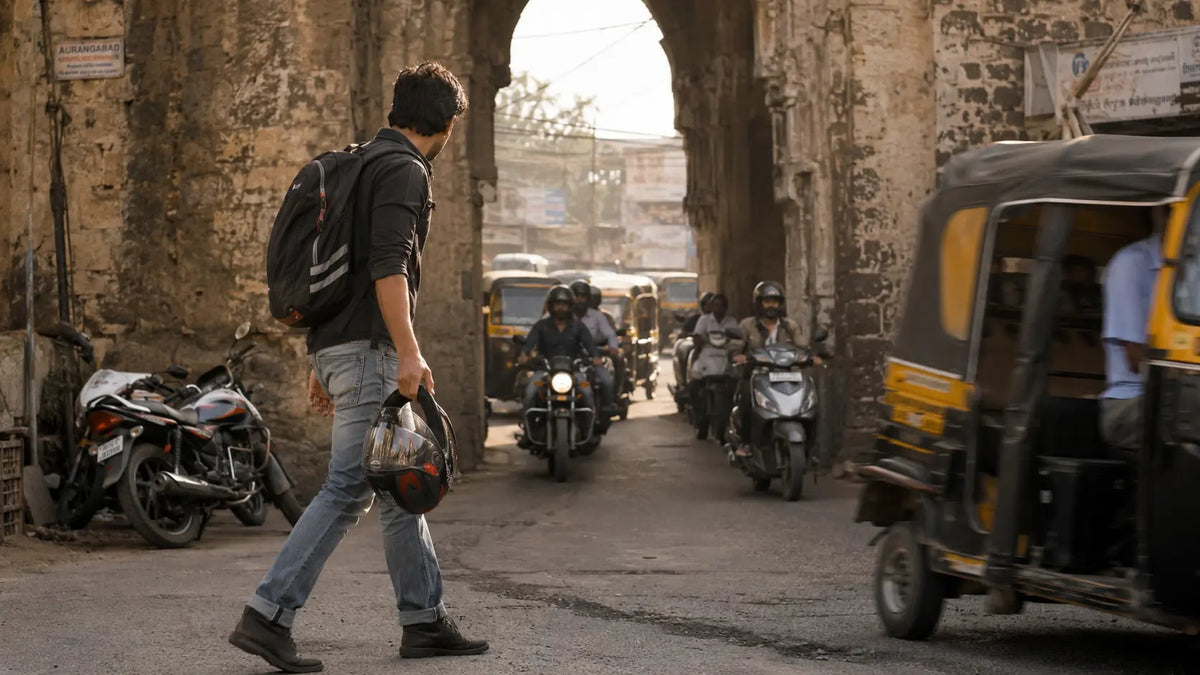
Six hours at Ellora, then a slow crawl through the old city gate to get home.
Most riders searching "helmet cleaner Aurangabad" want their lid to look fresh again by evening. Dust wipes off easy. What's actually breeding inside the liner doesn't.
Aurangabad's helmet problem comes from three directions at once. A heritage-tourism boom packs riders into hours-long cave visits. A road network still squeezed by 400-year-old gates adds daily traffic jams. Dry heat does the rest. Here's what that combination does to your helmet, and what actually fixes it.
Rider Takeaways
- Domestic tourist footfall at Aurangabad's ASI monuments nearly halved between March-November 2023 and the same months in 2024. It dropped from 50.50 lakh to 24.9 lakh. Source: ThePrint/PTI, January 2025.
- Chhatrapati Sambhaji Nagar Municipal Corporation demolished around 4,000 properties for a road-widening project near the historic Naubat Darwaja gate. The project is still stalled after two years. Source: Free Press Journal, July 2025.
- The city gets just 777mm of rain a year under a semi-arid steppe climate. Humidity still swings from 24% in April to 81% in August.
- A helmet cleaner wipes off dust. Only a bacteriostatic spray like Hygena stops the bacteria actually causing the smell.
What Makes Aurangabad's Ajanta-Ellora Rides Different?
Aurangabad isn't just a stopover city. It's the base for two UNESCO World Heritage cave complexes, Ajanta and Ellora. Both draw riders into day-long trips that keep a helmet sealed for hours.
That pull briefly made Aurangabad one of Maharashtra's fastest-growing tourism markets. Domestic visits to five ticketed ASI monuments jumped from 22 lakh to over 50 lakh between 2022 and 2023. Then the numbers fell hard.
Between March and November 2024, domestic footfall dropped to 24.9 lakh, nearly half of the year before. Tourism officials blamed bad roads and pricier flights. Riders heading to Ellora on two wheels kept going anyway.
Quick Fact:
Domestic tourist footfall at Aurangabad's five ticketed ASI monuments fell from 50,50,071 (March-November 2023) to 24,94,570 in the same months of 2024, a drop of nearly 50%. Ellora Caves alone still drew 10,60,741 visitors. Source: ThePrint/PTI, January 7, 2025
Domestic tourist footfall at Aurangabad's five ticketed ASI monuments fell from 50,50,071 (March-November 2023) to 24,94,570 in the same months of 2024, a drop of nearly 50%. Ellora Caves alone still drew 10,60,741 visitors. Source: ThePrint/PTI, January 7, 2025
Unique Insight
Our finding: most helmet-hygiene advice targets short daily commutes. Aurangabad's real risk group is the day-tripper doing six-plus sealed hours between Ajanta, Ellora, and the highway back, sealed helmet time most city guides never account for.
Why Do Aurangabad's Historic Gates Choke Modern Traffic?
Aurangabad earned the nickname "City of Gates" centuries ago. Fifty-two gateways once ringed the old city. Only four main gates and nine smaller ones survive today.
Those surviving gates now sit in the middle of daily traffic. The Chhatrapati Sambhaji Nagar Municipal Corporation has spent two years on one road-widening project. It still hasn't reached Naubat Darwaja gate.
The corporation has knocked down roughly 4,000 properties blocking the project so far. Traffic through the historic Naubat Darwaja gate itself was rerouted after locals warned it was damaging the monument. Residents say the jam is worst during morning and evening office hours. That's exactly when helmets are already sweating through a commute.
Quick Fact:
Chhatrapati Sambhaji Nagar Municipal Corporation has demolished around 4,000 properties to widen the road from City Chowk to the historic Naubat Darwaja gate, a project still stalled two years in, with residents reporting daily jams during office hours. Source: Free Press Journal, July 20, 2025
Chhatrapati Sambhaji Nagar Municipal Corporation has demolished around 4,000 properties to widen the road from City Chowk to the historic Naubat Darwaja gate, a project still stalled two years in, with residents reporting daily jams during office hours. Source: Free Press Journal, July 20, 2025

What's Actually Living Inside a Sealed Helmet?
Dust is easy to see. Bacteria isn't, and that's the part a quick wipe-down never touches.
In 2020, researchers tested 130 motorcycle helmets and isolated 392 bacteria. Staphylococcus aureus topped the list at 22.7%. A third of those isolates, 33.7%, came back as MRSA, a drug-resistant strain.
None of that bacteria cares whether the outside of your helmet looks freshly cleaned. It feeds on sweat and skin oil trapped in warm foam, dust or no dust.
Quick Fact:
A 2020 study of 130 motorcycle helmets isolated 392 bacteria, led by Staphylococcus aureus at 22.7%, with 33.7% of those isolates confirmed as MRSA. Source: Sapkota et al., International Journal of Microbiology, 2020
A 2020 study of 130 motorcycle helmets isolated 392 bacteria, led by Staphylococcus aureus at 22.7%, with 33.7% of those isolates confirmed as MRSA. Source: Sapkota et al., International Journal of Microbiology, 2020
Does Chhatrapati Sambhaji Nagar's Dry Heat Make It Worse?
Yes, in its own way. Aurangabad sits under a semi-arid steppe climate, drier than Nashik or Pune. The city gets just 777mm of rain a year.
May is the hottest month, averaging 31.5°C with highs touching 38.5°C. Humidity bottoms out at 24% in April, the driest stretch, then climbs to 81% by August once the monsoon arrives.
That swing matters inside a closed-face helmet. Dry heat pulls sweat out fast and bakes dust into the padding. Monsoon humidity then stops that same padding from drying between rides.
Quick Fact:
Aurangabad's relative humidity ranges from 24% in April, the driest month, to 81% in August, the monsoon peak, while the city receives only about 777mm of rain a year under a semi-arid steppe classification. Source: Climate-Data.org, Aurangabad, climate averages 1991–2021
Aurangabad's relative humidity ranges from 24% in April, the driest month, to 81% in August, the monsoon peak, while the city receives only about 777mm of rain a year under a semi-arid steppe classification. Source: Climate-Data.org, Aurangabad, climate averages 1991–2021
Unique Insight
Our finding: Aurangabad's low annual rainfall hides the real risk. Riders assume a dry city means a drier helmet, but the same padding that bakes dry in April traps monsoon moisture for days come August, with no season in between to reset it.
Is a Helmet Cleaner Enough for Aurangabad's Dust?
Search "helmet cleaner Aurangabad" and most results are sprays built for scuffed shells and dusty visors. They lift dirt off the outside.
None of them touch what's living in the padding against your scalp. Cleaning removes what you can see. Hygiene deals with what you can't.
Hygena isn't a cleaner. It's a bacteriostatic spray that stops odor-causing bacteria from multiplying. That's true whether your helmet just came off a dusty highway or a humid August commute.
The Fix for Aurangabad's Heritage-and-Heat Combo
Wash your liner and it looks fresh for a few rides. That doesn't stop bacteria from rebuilding before your next Ellora run or your next crawl through City Chowk.
That's the gap Hygena fills, between washes, not instead of them. A few sprays after a dusty highway stretch or a sweaty gate-side traffic jam keep bacterial buildup down.
The routine that holds up through Aurangabad's dry season and its monsoon:
- Wash the liner every two to three weeks, more often during peak touring season.
- Spray a bacteriostatic deodorant like Hygena after every ride, cave day or city commute included.

Frequently Asked Questions
Does Aurangabad's dry climate mean I can clean my helmet less often?
No. Aurangabad gets just 777mm of rain a year, but humidity still climbs to 81% by August. Dry months bake dust into the padding instead of washing it out, so the liner needs the same regular attention.
Is a helmet cleaner enough for a full-day Ajanta or Ellora ride?
No. A cleaner lifts dust off the shell and visor. A 2020 study found Staph aureus in 22.7% of bacteria isolated from motorcycle helmets. A cleaner does nothing about it. Source: Sapkota et al., 2020.
Why is traffic near Aurangabad's old city gates so bad?
The road-widening project from City Chowk to Naubat Darwaja has been stalled for two years. Around 4,000 properties have been demolished to clear the way. Source: Free Press Journal, July 2025. Riders sit through it daily.
Where can I buy helmet hygiene spray in Aurangabad?
Hygena ships to Aurangabad directly from hygena.in, with cash-on-delivery available. There's no dedicated helmet-hygiene counter in the city's markets yet.
Does a helmet deodorant spray replace washing the padding?
No. Hygena works between washes to slow bacterial buildup. It isn't a substitute for washing the liner on a regular schedule.
Conclusion
Aurangabad's helmet problem isn't really about dust. It's about hours: long cave-complex rides and slow crawls through 400-year-old gates. A dry season never fully lets the padding reset before monsoon humidity takes over.
A helmet cleaner Aurangabad search gets you halfway. It deals with what you can see. Wash your liner on a schedule. Use a bacteriostatic spray like Hygena between washes to handle the bacteria a cleaner never touches.
Sources
1. "Tourist footfall decreases at Ellora, other ASI sites in Chhatrapati Sambhajinagar," ThePrint/PTI, January 7, 2025. Retrieved 2026-07-30.
2. "Chhatrapati Sambhajinagar: Road Widening From City Chowk To Naubat Darwaja Stalled For Two Years," Free Press Journal, July 20, 2025. Retrieved 2026-07-30.
3. "Aurangabad Climate," Climate-Data.org, climate averages 1991–2021. Retrieved 2026-07-30.
4. Sapkota, A. et al., "Microbial Diversity and Antibiotic Susceptibility Pattern of Bacteria Associated with Motorcycle Helmets," International Journal of Microbiology, 2020. Retrieved 2026-07-30.
5. "Gates in Aurangabad," Wikipedia. Retrieved 2026-07-30.
Share:
Helmet Deodorant Spray Pune: Dust, Heat, Then Monsoon
Helmet Cleaner Ghaziabad: Why Smog Changes the Answer