
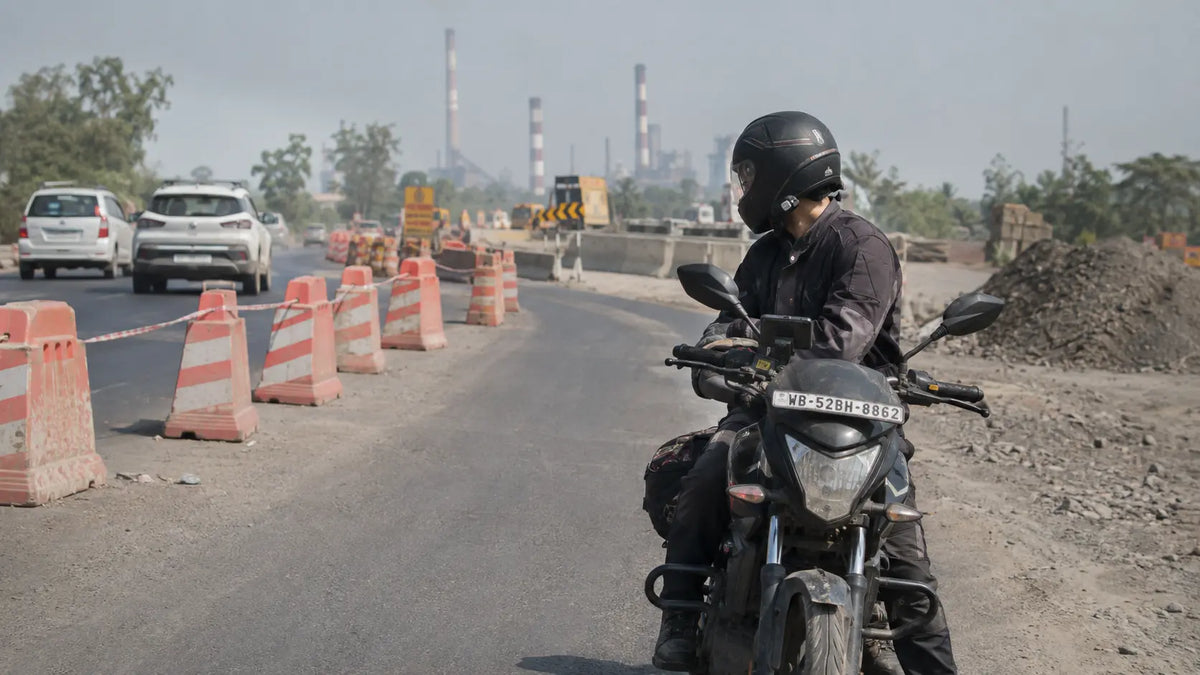
You cross from Bidhan Nagar's wide, tree-lined avenue onto a Benachity side lane, and your ride changes completely. So does your helmet's day.
Durgapur was built in two layers. One half is a planned steel township with grid roads and proper junctions. The other grew up around it, narrow and unplanned. Most riders here reach for a "helmet cleaner" to deal with the grime from both halves. That's only part of the job.
Here's what actually happens inside your helmet on a Durgapur commute. Wiping it down isn't the same as fixing it.
Rider Takeaways
- Durgapur runs on 1,780 km of roads: 480 km of planned arterial routes, 1,300 km of older collector lanes, per Wikipedia.
- A 2025 textile-odor review found synthetic fabric, the same material in most helmet padding, holds odor more stubbornly than cotton.
- City humidity swings from 48% in March to 85% in September, a 37-point jump, per Climate-Data.org.
- A cleaner wipes construction dust and road grime off the shell. It does nothing to the bacteria multiplying in the padding underneath.
Why Does a Planned City Still Trap Your Helmet in Traffic?
Durgapur wasn't supposed to have this problem. Chief Minister Bidhan Chandra Roy commissioned architect Joseph Allen Stein and planner Benjamin Polk to lay the city out in 1955. DSP Township, SEPCO, MAMC, and Bidhan Nagar all got grid roads and proper junctions by design.
That plan covers roughly 480 km of the city's 1,780 km road network. The rest, nearly 1,300 km of collector and local roads, grew up organically around the planned core. It's narrower and far less predictable.
Quick Fact:
Durgapur's road network runs to roughly 1,780 km total: about 480 km of arterial and sub-arterial routes through planned townships, and 1,300 km of narrower collector roads elsewhere. Source: Wikipedia, Durgapur.
Durgapur's road network runs to roughly 1,780 km total: about 480 km of arterial and sub-arterial routes through planned townships, and 1,300 km of narrower collector roads elsewhere. Source: Wikipedia, Durgapur.
What Does National Highway 19 Add to Your Helmet-On Hours?
NH19, the old Grand Trunk Road, runs straight through Durgapur as part of Asian Highway 1. A toll plaza sits right in the city. This isn't a quiet bypass town.
Part of that stretch, the Panagarh-Palsit-Dankuni corridor that runs past Durgapur toward Kolkata, is mid six-laning. Ashoka Buildcon holds a ₹1,567.45 crore contract for the work, awarded in 2021.
Six-laning means barricades, single-lane squeezes, and dust that wasn't there a year ago. The Asansol-Durgapur Police Commissionerate runs five Highway Mobile units on this stretch, Muchipara to Duburdihi Check Post. They patrol 8 am to 8 pm daily just to keep it moving.
West Bengal's without-helmet fine runs ₹1,000 with a three-month licence disqualification. Nobody idling through a barricade squeeze risks going bare-headed to cool off early.
Unique Insight
Our finding: Durgapur's helmet problem isn't a single traffic story. It's two: smooth, fast riding through planned grid roads, then a sudden squeeze through construction-zone highway lanes or a narrow unplanned side street. Your helmet spends the same hour absorbing two completely different kinds of grime.
Is Durgapur's Industrial Dust the Same Problem as Asansol's?
Not quite, and the difference matters. Asansol grew up around 200-year-old coal mining. Durgapur was engineered from scratch as a steel township, starting with the Damodar Valley Corporation's Durgapur Barrage in 1948.
Durgapur Steel Plant followed in 1955, built with UK collaboration under SAIL. A second Alloy Steels Plant came in 1965, also under Hindustan Steel Ltd. The city earned the nickname "Ruhr of India" for it.
Industrial units here grew from 46 in 1951 to 430 by 2019. That's not a mining town's organic sprawl. It's a planned industrial base that kept expanding on schedule.
Quick Fact:
Durgapur Steel Plant was established in 1955 with UK collaboration under SAIL, followed by a second Alloy Steels Plant in 1965 under Hindustan Steel Ltd. The city's industrial base grew from 46 units in 1951 to 430 by 2019. Source: Wikipedia, History of Durgapur.
Durgapur Steel Plant was established in 1955 with UK collaboration under SAIL, followed by a second Alloy Steels Plant in 1965 under Hindustan Steel Ltd. The city's industrial base grew from 46 units in 1951 to 430 by 2019. Source: Wikipedia, History of Durgapur.
Why Does Sweat Sit Longer Inside a Durgapur Helmet?
Durgapur's humidity swings from 48% in March to 85% in September, a 37-point jump. Average temperatures run from 17.7°C in January to 30.8°C in May, with an annual average of 25.5°C. Rainfall lands around 1,391mm a year.
That's close to what Asansol sees 45 km down the road, but not identical. Asansol peaks in August at 85%. Durgapur's peak humidity holds a month longer, into September, and its dry-season floor sits three points higher.
Does Your Helmet Padding Make This Worse?
Most helmet liners are synthetic foam and moisture-wicking mesh, the same fibre family behind a lot of your gym kit. A January 2025 review in the Textile Research Journal looked at exactly this problem.
Cotton and wool hold odor far less stubbornly than polyester once bacteria are established. Wool can absorb up to 33% of its weight in moisture without even feeling damp. Polyester doesn't get that grace period.
The same review found only 11% of people wash clothing mainly because it smells. For regular wear, 61-76% of people said odor rarely drives the decision to wash at all. That number flips for sweat-heavy gear: over 70% wash it specifically for odor.
Your helmet padding sits in that second category. It's sweat-heavy synthetic gear. Most riders still treat it like a T-shirt they'll get to eventually.
Unique Insight
Our finding: the same synthetic padding that keeps a helmet lightweight is the fabric type research shows holds bacterial odor longest. Durgapur's humidity gives that fabric more time to stay damp between rides than most Indian cities allow.
Is a Helmet Cleaner the Same as a Helmet Hygiene Spray?
No, and in a city split between construction dust and industrial haze, that mix-up costs riders. A cleaner lifts dirt: road grime, six-laning construction dust, sweat stains on the padding fabric. It makes no claim about bacteria.
Hygena isn't a cleaner. It's a bacteriostatic hygiene spray. It stops odor-causing bacteria from multiplying in synthetic padding rather than just lifting visible grime off the surface.
| What you need | A cleaning spray | Hygena hygiene spray |
|---|---|---|
| Removes visible dust and grime | Yes | Partial, not its main job |
| Stops bacteria from multiplying | No | Yes, bacteriostatic action |
| Safe on synthetic foam padding daily | Varies by formula | Yes, dermatologically tested |
| Addresses the odor source | Masks it temporarily | Yes, targets bacteria directly |

What Actually Fixes This for a Durgapur Rider
You can't rebuild the city's other 1,300 km of roads or finish the six-laning early. What you can control is your helmet routine after every ride.
Two steps, about two minutes, right after you park:
- Wipe the shell and visor down to clear construction dust or road grime, whichever half of the city you rode through.
- Spray Hygena's bacteriostatic formula into the padding to stop bacteria feeding on sweat trapped by synthetic foam. It's built to hold up through Durgapur's long, humid stretch from June to September.

Frequently Asked Questions
Does Durgapur's industrial dust affect helmet hygiene the same way Asansol's does?
Not quite. Asansol's dust comes from 200-year-old coal mining. Durgapur's comes from a planned steel township built from 1955 onward, plus fresh six-laning construction on NH19. Both feed bacteria in damp padding, but the source and timeline differ.
Is a helmet cleaner spray the same thing as a hygiene spray?
No. A cleaner removes visible dirt and dust. A hygiene spray like Hygena is bacteriostatic. It stops odor-causing bacteria from multiplying in the padding, something cleaning alone doesn't do.
How often should riders in Durgapur spray their helmet?
Treat it as a post-ride habit through the humid stretch from June to September, when humidity holds near 85%. Outside that window, spray every few rides. The city's 25.5°C annual average keeps sweat production fairly steady year-round.
Can I use Hygena on a helmet shared across a DSP Township carpool or family?
Yes, and shared helmets need it more, not less. A shared helmet doubles the sweat and skin contact one person's helmet sees, exactly the setup bacteria multiply fastest in.
Where can I buy helmet deodorant spray in Durgapur?
Hygena ships pan-India, including Durgapur and the wider Paschim Bardhaman district, through hygena.in.
Conclusion
Durgapur's helmet problem isn't one story, it's two. Half your ride runs through a planned steel township with wide, gridded roads. The other half runs through 1,300 km of narrower streets and, right now, a highway mid six-laning.
A cleaner handles whichever dust you picked up. It won't touch the bacteria multiplying in synthetic padding that stays damp through a 37-point humidity swing. Spray Hygena into your padding after every ride, especially through the June-to-September stretch. Grab a bottle and make it as routine as checking your mirrors before you pull out of DSP Township.
Sources
1. "Durgapur," Wikipedia. Retrieved 2026-08-25.
2. "History of Durgapur," Wikipedia. Retrieved 2026-08-25.
3. "Durgapur Steel Plant," Wikipedia. Retrieved 2026-08-25.
4. "National Highway 19 (India)," Wikipedia. Retrieved 2026-08-25.
5. "Panagarh-Palsit-Dankuni Six-Laning Road Contract," ProjectX India. Retrieved 2026-08-25.
6. "Traffic Details," Asansol-Durgapur Police Commissionerate. Retrieved 2026-08-25.
7. "Durgapur Climate Data," Climate-Data.org. Retrieved 2026-08-25.
8. "Asansol Climate Data," Climate-Data.org. Retrieved 2026-08-25.
9. Waqar, S. et al., "Textile laundering and body odor: a comprehensive review," Textile Research Journal, January 2025. Retrieved 2026-08-25.
10. "Without Helmet Fine in West Bengal," TATA AIG. Retrieved 2026-08-25.
Share:
Wild Camping Bike Trips India: Is It Safe?
Best Lightweight Camping Gear for Motorcycle Touring