
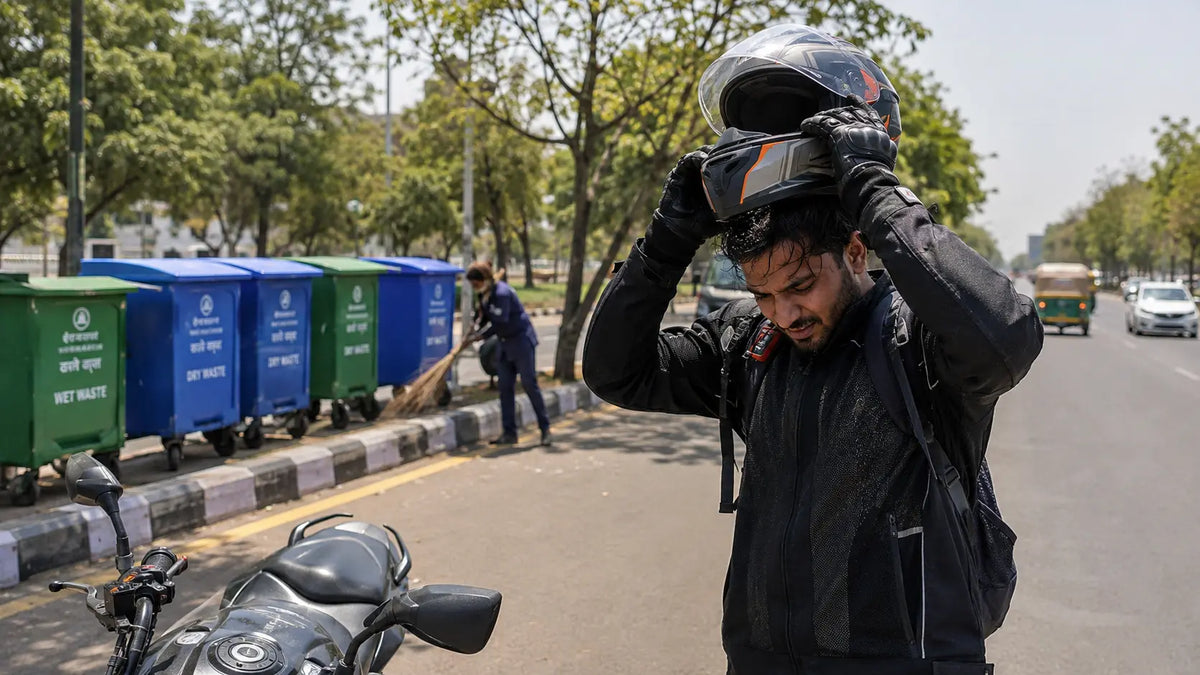
Your visor fogs up in a Jawahar Marg jam at 39°C, and your helmet's already trapping the sweat.
Indore's heat swings from a bone-dry April to an 86% humid August. Every commute in between soaks the padding a little more. A helmet cleaning spray sounds like the obvious fix. Most riders in India's most-awarded clean city still don't know cleaning and hygiene aren't the same thing.
This guide breaks down what's actually happening inside your helmet. It covers why Indore's climate and traffic make it worse, and which spray actually solves it.
Rider Takeaways
- Indore's relative humidity swings 66 points a year, from 20% in April to 86% in August. That's one of the widest ranges logged in this series.
- Two-wheelers make up 39% of Indore's road traffic, per the city's Comprehensive Mobility Plan, cited by Down To Earth.
- Synthetic helmet padding grows more odor-causing bacteria than cotton would. A 2014 Applied and Environmental Microbiology study confirmed the pattern.
- A cleaning spray removes visible dirt. It doesn't kill the bacteria that actually cause the smell.
Indore's Cleanest-City Reputation Doesn't Reach Inside Your Helmet
Indore topped India's Swachh Survekshan cleanliness ranking for seven straight years, from 2017 through 2023. The 2024-25 results landed in July 2025. The government created a new "Super Swachh League" to let other cities compete, moving Indore into that separate tier. Ahmedabad took the overall top spot, and Indore won the new league for an 8th consecutive year.
The city sweeps its streets on schedule and sorts its waste by color-coded bins. Riders here still keep the same sweat-soaked padding inside their helmets for months. Cleanliness at the street level and hygiene inside your gear are two separate habits. Indore has only really built one of them.
Quick Fact:
Indore ranked India's #1 cleanest city for 7 straight years (2017-2023). In the 2024-25 Swachh Survekshan, announced July 2025, it topped the newly created Super Swachh League for an 8th year running, while Ahmedabad became the new overall #1. Source: Drishti IAS, Testbook
Indore ranked India's #1 cleanest city for 7 straight years (2017-2023). In the 2024-25 Swachh Survekshan, announced July 2025, it topped the newly created Super Swachh League for an 8th year running, while Ahmedabad became the new overall #1. Source: Drishti IAS, Testbook
Why Indore's Humidity Swing Makes Sweat Worse Than the Heat Alone
Indore's relative humidity runs from 20% in April to 86% in August, a 66-point swing across the year. That's a wider range than most north Indian cities in this series. Heat alone drives sweat. Humidity stops that sweat from evaporating off your scalp.
May is the hottest month, averaging 39.2°C. By August, the heat drops but humidity climbs to 86%. That means your helmet padding barely gets a dry month. Sweat sits in the foam through summer, then again through monsoon, feeding bacteria on both ends of the calendar.
Why Your Helmet's Foam Padding Smells Worse Than a Cotton Cap Ever Would
A 2014 study in Applied and Environmental Microbiology had 26 people wear polyester or cotton T-shirts for one cycling session. Researchers then compared how each shirt smelled. The polyester shirts smelled noticeably worse.
The researchers traced it to Micrococcus bacteria, which showed up almost exclusively on the synthetic fabric. Your helmet's sweatband and cheek pads are the same kind of synthetic foam and microfiber. Every ride in Indore's heat gives that material more sweat to hold onto. It also gives Micrococcus more time to build up.
Unique Insight
Our finding: the same material choice that makes polyester gym shirts smell worse than cotton is built into every helmet on the market. There's no cotton-lined helmet option, so the bacteria buildup isn't a bad-luck problem. It's a design constraint every rider in Indore is stuck with, wiping or not.

Indore's Traffic Keeps You Inside the Helmet Longer Than You'd Choose
Two-wheelers make up 39% of all road traffic in Indore, the largest single share of any vehicle type. That figure comes from the city's Comprehensive Mobility Plan. It means a lot of riders spend real time in a closed helmet every day.
Registered vehicles jumped from roughly 9 lakh in 2008 to 2.4 million by 2020. That's a 166% rise in just over a decade. A 2024 case study of Jawahar Marg, one of the city's busiest roads, found evening traffic hitting gridlock. Level of Service hit F, the technical term for full gridlock.
One resident told Down To Earth her commute used to take 30 minutes. After the BRTS corridor shut down, it stretched to over an hour. That's an hour of sweat with nowhere to go.
Cleaning Spray vs. Hygiene Spray: What's the Actual Difference?
A cleaning spray lifts dirt, oil, and grime off a surface. That's it. It's built to make something look and feel clean, not to kill what's living in the padding underneath.
A hygiene spray, like Hygena's, is bacteriostatic. It stops odor-causing bacteria such as Micrococcus and Staphylococcus from multiplying in the first place. Cleaning removes what you can see. Hygiene addresses what you can't.
| Question | Cleaning Spray | Hygiene Spray |
|---|---|---|
| Removes visible grime? | Yes | Sometimes, not the main job |
| Stops bacteria multiplying? | No | Yes, that's the point |
| Fixes the smell long-term? | Masks it briefly | Yes, at the source |
What Actually Works for Indore's Heat-Then-Humidity Cycle
Hygena's spray uses tea tree extract, neem, and hydrogen peroxide to kill odor-causing bacteria on contact. Then it keeps them from rebuilding between rides. It's built for exactly the cycle Indore puts your helmet through: hot and dry, then hot and soaked.
A few sprays on the liner after a Jawahar Marg crawl or a monsoon ride make the difference. The padding doesn't get the head start bacteria need. It's dermatologically tested, and riders don't need to wait for it to dry before the next ride.
Unique Insight
Our finding: Indore's 66-point humidity swing means there's no single "problem season" here, unlike cities with one dominant monsoon spike. Riders need a hygiene routine that holds up across both a dry 39°C May and an 86%-humid August, not a seasonal fix.

Frequently Asked Questions
Does Indore's humidity make helmet smell worse than a drier city?
Yes. Indore's humidity climbs to 86% in August, one of the widest swings in this series (Climate-Data.org). High humidity keeps sweat from evaporating off your scalp, so it sits in the padding longer and feeds bacteria growth.
Where can I buy a helmet cleaning spray in Indore?
Hygena ships pan-India, including Indore, through hygena.in. Most riders order it online rather than hunting for it at a local accessories shop.
Is a helmet cleaning spray the same as a helmet deodorant?
Not quite. A cleaning spray targets visible dirt on the shell or padding. A deodorant like Hygena targets the bacteria causing the smell, which a cleaning spray alone won't stop from coming back.
How often should I use a helmet hygiene spray in Indore's climate?
After every ride longer than 30 minutes in summer heat or monsoon humidity works well for most commuters. Daily two-wheeler riders, who make up 39% of Indore's traffic, should treat it as a daily habit.
Can I use Dettol or Savlon instead of a helmet-specific spray?
General antiseptics aren't formulated for foam padding or synthetic liner material and can degrade it over repeated use. A helmet-specific bacteriostatic spray is built to be safe on that material, ride after ride.
Conclusion
Indore keeps its streets spotless enough to top a national cleanliness ranking for eight years running. Inside most riders' helmets, none of that discipline shows up. The city's 66-point humidity swing and its 39% two-wheeler traffic load both push in the same direction. More sweat, more time trapped against synthetic padding, more bacteria.
A cleaning spray handles what you can see. It won't touch what's actually causing the smell. Hygena's bacteriostatic spray is built for that gap, tested against exactly the kind of heat-then-humidity cycle Indore runs every year. Grab a bottle at hygena.in and give your helmet the same standard your city already holds itself to.
Sources
1. "Indore Climate," Climate-Data.org, 1991-2020 averages. Retrieved 2026-09-03.
2. "Indore Traffic Woes: Rising Costs and Limited Commute Options Challenge Residents," Down To Earth, 2025. Retrieved 2026-09-03.
3. "Study of Traffic Congestion Analysis on Urban Road: A Case Study of Indore City," IJRASET, 2024. Retrieved 2026-09-03.
4. "Swachh Survekshan 2024-25 Awards," Drishti IAS, 2025. Retrieved 2026-09-03.
5. "Swachh Survekshan 2025 Rankings: Indore Declared Cleanest City in India for 8th Consecutive Time," Testbook, 2025. Retrieved 2026-09-03.
6. Callewaert, C., et al. "Microbial Odor Profile of Polyester and Cotton Clothes after a Fitness Session," Applied and Environmental Microbiology, 2014, Vol. 80(21). Retrieved 2026-09-03.
Share:
Helmet Cleaner Bikaner: What Desert Dust Does to It
Why Riding Jackets Cause Bra-Line Chafing (And the Fix)