
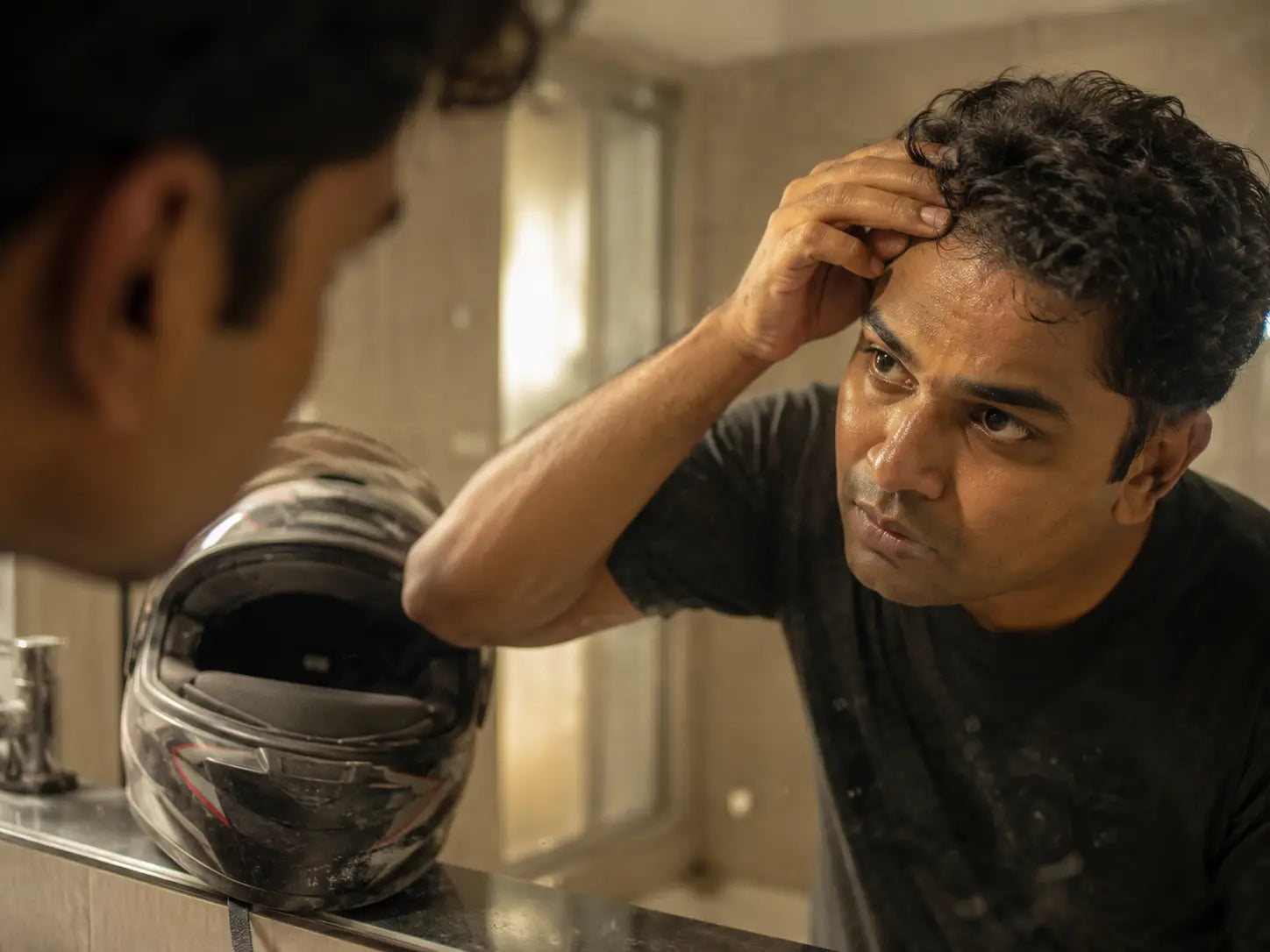
You pull on your helmet, feel that familiar damp lining, and ride off anyway.
Most riders notice the smell first. Few connect it to the breakout on their forehead, the itchy patch near the strap, or the red bumps along their jaw. That padding pressed against your skin for hours isn't neutral. It's a warm, sweaty surface where bacteria live and multiply.
So can a dirty helmet actually cause skin infections? This article breaks down what's growing in there, how it reaches your skin, and what riders can do about it.
Rider Takeaways
- A 2020 study of 130 helmets found Staphylococcus aureus in 22.7% of bacteria isolated, the same bug linked to boils and skin infections.
- Helmet bacteria reach your skin through sweat, friction, and trapped heat, triggering acne mechanica and folliculitis.
- Cleaning the liner helps, but bacteria return fast, so a bacteriostatic spray like Hygena keeps growth down between washes.

What's Actually Growing Inside Your Helmet?
In 2020, researchers swabbed 130 motorcycle helmets and recovered 392 separate bacterial isolates. The study, published in the International Journal of Microbiology, found Staphylococcus aureus as the most common, at 22.7%. That's not a harmless germ. It's the bug behind boils, abscesses, and wound infections.
The same study found Staphylococcus epidermidis at 19.6% and E. coli at 13.8%. Add fungi to the mix. Another 346 fungal isolates came off those same helmets. Your liner isn't just sweaty. It's a small ecosystem.
Why does so much grow in there? Three reasons: warmth from your scalp, moisture from sweat, and oil from your skin. Bacteria need exactly those three things. Your helmet hands them over every single ride.
Quick Fact:
A 2020 study published in the International Journal of Microbiology swabbed 130 motorcycle helmets and isolated 392 bacteria. Staphylococcus aureus was the most common at 22.7%, followed by S. epidermidis at 19.6%. S. aureus is a known cause of boils and skin infections. Source: Sapkota et al., 2020
A 2020 study published in the International Journal of Microbiology swabbed 130 motorcycle helmets and isolated 392 bacteria. Staphylococcus aureus was the most common at 22.7%, followed by S. epidermidis at 19.6%. S. aureus is a known cause of boils and skin infections. Source: Sapkota et al., 2020
How Does Helmet Bacteria Reach Your Skin?
Bacteria don't need an open wound to cause trouble. Studies on athletes show that constant friction plus sweat plus pressure is enough to push bacteria into your skin's pores and hair follicles. Your helmet supplies all three for hours at a stretch.
Think about what happens on a normal commute. Your scalp sweats. The liner soaks it up. That damp foam presses tight against your forehead and the sides of your face. With every bump and head turn, it rubs.
This is occlusion: skin sealed off from air, sitting in its own moisture. Dermatologists know occluded, sweaty skin is where bacteria thrive. The helmet basically incubates your own germs and presses them back into your face. Bhai, that's the part nobody tells you.
Unique Insight
Our finding: Most riders blame their skin or their soap for breakouts near the strap and forehead. But the pattern follows the helmet's contact points, not your face wash. If bumps appear exactly where the padding presses (brow, cheeks, jawline), the liner is the suspect, not your skincare.
Which Skin Infections Can a Dirty Helmet Cause?
Dermatology sources link prolonged helmet contact to three skin problems: acne mechanica, folliculitis, and contact dermatitis. All three start the same way: bacteria, sweat, and friction on skin that can't breathe. The fix for each begins with cutting the bacterial load.
Acne mechanica is friction acne. Those small bumps along your jaw and forehead after a long ride? That's it. The strap and padding rub, pores clog, and bacteria do the rest.
Folliculitis goes a step deeper. Here bacteria infect the hair follicles, often on your scalp. It shows up as itchy red bumps, sometimes with a whitehead. A sweaty liner full of S. aureus is a textbook trigger.
Contact dermatitis is irritation and rash from the liner material plus trapped sweat. It itches, flakes, and won't settle until the helmet stops re-exposing your skin.
Quick Fact:
Dermatology specialists report that the friction, heat, and trapped sweat from sports and motorcycle helmets can cause acne mechanica, scalp folliculitis, and contact dermatitis. These conditions cluster exactly where the padding contacts skin. Reducing bacteria and moisture at the contact points is the first line of prevention. Source: U.S. Dermatology Partners
Dermatology specialists report that the friction, heat, and trapped sweat from sports and motorcycle helmets can cause acne mechanica, scalp folliculitis, and contact dermatitis. These conditions cluster exactly where the padding contacts skin. Reducing bacteria and moisture at the contact points is the first line of prevention. Source: U.S. Dermatology Partners
Why Are Indian Riders More at Risk?
Heat and humidity speed bacteria up. Across most of India, riders face 30°C-plus temperatures and sticky monsoon air for much of the year. That's the climate bacteria love, and the reason a helmet here gets funky faster than one in a cold country.
Add a long commute, dust, and pollution to a tight helmet, and you've got constant sweat with nowhere to go. The liner stays damp between rides. Each morning you put a wet, bacteria-loaded pad back onto clean skin. Phir wahi cycle, every day.
Washing the liner helps, but it dries slowly and bacteria return within days. That gap between washes is the problem. This is where Hygena fits in. It's a bacteriostatic helmet deodorant, built to stop bacteria from multiplying inside the padding between cleans.
A few sprays after a ride and your helmet stays cleaner for tomorrow — no scrubbing, no waiting for foam to dry. The fix is simpler than you think.
Frequently Asked Questions
Is helmet bacteria actually harmful to my skin?
It can be. A 2020 study found Staphylococcus aureus in 22.7% of helmet bacteria, a known cause of boils and skin infections. Combined with sweat and friction, it can trigger acne mechanica and folliculitis at the helmet's contact points. Source: Sapkota et al., 2020.
Can a dirty helmet cause scalp folliculitis?
Yes. Folliculitis happens when bacteria infect hair follicles. Dermatology sources link the trapped heat, sweat, and friction of helmet wear directly to scalp folliculitis. A damp liner carrying S. aureus is a common trigger, especially in hot, humid riding conditions.
Does washing my helmet padding fix the problem?
It helps, but only temporarily. Liners dry slowly and bacteria return within days. The 2020 helmet study found 39% of bacteria were multidrug-resistant, so they're hard to clear fully. A bacteriostatic spray between washes keeps growth down day to day. Source: Sapkota et al., 2020.
How often should I clean my helmet interior?
Deep-wash the liner every 2–4 weeks with regular use, sooner in summer. Because bacteria regrow fast in humid conditions, treat the inside between washes too. A few sprays of a bacteriostatic helmet deodorant after each ride keeps the contact points cleaner for the next day.
Conclusion
A dirty helmet isn't just smelly. It's a warm, sweaty home for bacteria like S. aureus that can push acne, folliculitis, and rashes onto the exact spots your padding touches.
You can't stop sweating on a ride. But you can stop bacteria from building up between washes. That's the whole point of Hygena — a quick spray that keeps your helmet bacteria-free for tomorrow's ride, no scrubbing required. Give your skin one less thing to fight.
Sources
1. "Microbial Diversity and Antibiotic Susceptibility Pattern of Bacteria Associated with Motorcycle Helmets," Sapkota et al., International Journal of Microbiology, 2020. Retrieved 2026-06-27.
2. "Acne from Sports Helmets: Skincare Tips for Athletes," U.S. Dermatology Partners, 2023. Retrieved 2026-06-27.
3. "Motorcycle Helmets as Potential Fomites in Transmission of Pathogenic Micro-organisms," Asian Journal of Biological and Life Sciences, 2022. Retrieved 2026-06-27.
4. "Athletes and Acne Mechanica," Dermatology Times, 2022. Retrieved 2026-06-27.
Share:
5 Best Products for Cleaning Motorcycle Gear (Fresh Fix)
Dhaba Food Stops for Bikers in India: Eat, Rest, Freshen Up