
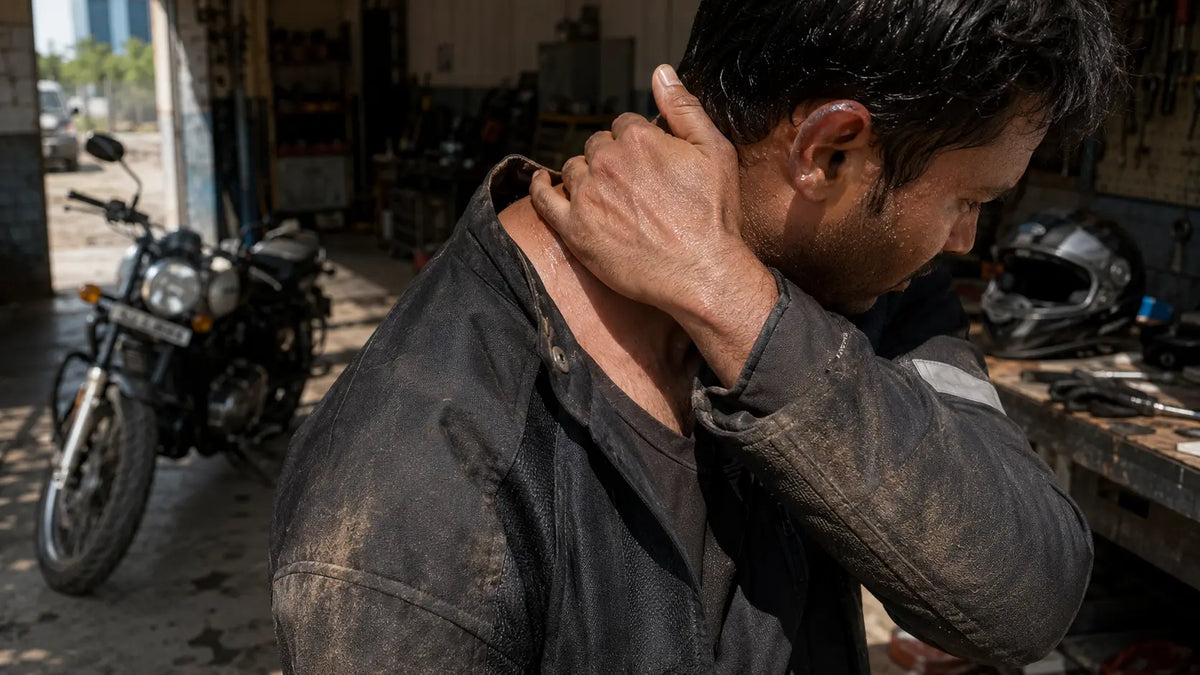
You pull into work, take off your helmet, and catch a whiff of yourself before anyone else does. Sound familiar, bhai? Fifteen minutes on a bike in Indian traffic does more damage to how you smell. It beats an hour at the gym, easily.
It's not really about how hard you rode. It's sweat trapped under gear, heat trapped inside a full-face helmet, and bacteria doing their thing. They don't care whether you were commuting or touring. The good news: smelling good after a ride is a routine, not a mystery.
Rider Takeaways
- Sweat itself is odorless. Skin bacteria break it down into smell within roughly an hour, per the International Hyperhidrosis Society.
- A 2024 study in Scientific Reports traced most underarm odor to one bacterium, Staphylococcus hominis. The culprit: an enzyme it uses to break down sweat.
- Antiperspirant reduces sweat at the source; deodorant works on the bacteria and the smell. Riders often need both, at different times.
- Your helmet runs its own bacteria problem in parallel. In 2020, a study found bacterial growth in 86.7% of helmets that were never disinfected.
Why Does Every Ride Leave You Smelling Worse Than a Gym Session?
In 2024, a study published in Scientific Reports identified Staphylococcus hominis as the bacterium mainly responsible for underarm odor. It uses an enzyme called PatB to convert odorless sweat compounds into the smell you actually notice. Sweat isn't the smell. Bacteria eating it is.
A gym session ends and you shower. A ride doesn't work that way. Your body keeps sweating under a jacket and helmet for the length of the commute. None of it evaporates properly. The gear traps heat and moisture against your skin the entire time.
India makes this worse. Delhi hit 43.4°C on May 19, 2026, its hottest day of the year, per the India Meteorological Department. That's not a gym with air conditioning. That's the temperature your gear is sealing against your skin at 2 pm in traffic.
Quick Fact:
A 2024 study in Scientific Reports found Staphylococcus hominis uses a specific enzyme, PatB, to convert odorless compounds in sweat into the volatile molecule behind most underarm odor. Source: Nature Scientific Reports, 2024
A 2024 study in Scientific Reports found Staphylococcus hominis uses a specific enzyme, PatB, to convert odorless compounds in sweat into the volatile molecule behind most underarm odor. Source: Nature Scientific Reports, 2024
How Long Do You Actually Have Before Sweat Starts to Smell?
Not long. According to the International Hyperhidrosis Society, the full cycle takes about one hour to complete. Sweat hits skin, bacteria consume it, and waste products create the odor.
A short errand ride might beat that clock. A 45-minute commute usually doesn't. And once the smell starts, it doesn't reset just because you've stopped moving. It builds until you actually wash or freshen up.
This is why riders who feel fine leaving home can still walk into a meeting smelling like the ride. The one-hour window isn't a suggestion. It's roughly how much time you have to do something about it.
Unique Insight
Our finding: Riders sitting in Indian traffic for 30-45 minutes are already past the halfway point of the sweat-to-odor cycle. They haven't even arrived yet. Stop-and-go traffic doesn't just add time on the bike. It adds time for bacteria to work.
Deodorant or Antiperspirant: Which One Actually Works for Riders?
Deodorant neutralizes the bacteria causing odor and masks what's left with fragrance. Antiperspirant blocks sweat glands with aluminum salts. That means less sweat reaches the skin in the first place, per the Cleveland Clinic. Less sweat means less bacteria, which means less odor.
For a short commute, deodorant is usually enough. For a long tour or a peak-summer ride, antiperspirant does more work. It cuts off the sweat that feeds the bacteria before it starts.
Timing matters more than most riders realize. Cleveland Clinic notes antiperspirant works best applied at night, when sweating is at its lowest. That gives it six to eight hours to set before you wash it off.
What About Your Gloves and Riding Jacket?
Your jacket and gloves aren't innocent bystanders. A study in Applied and Environmental Microbiology scored polyester's post-workout smell at -2.04 on a pleasantness scale. Cotton scored -0.61. Testers rated polyester more sour and more musty too.
Most riding jackets, glove liners, and base layers are synthetic for a reason: they're durable and dry fast. That same fabric is where Micrococcus bacteria grow almost exclusively, the same study found. It barely showed up on cotton at all.
You don't need to swap your gear for cotton. You do need to actually wash gloves and base layers on a schedule, not just air them out between rides. Airing dries the moisture. It doesn't remove the bacteria feeding on it.
Quick Fact:
A study in Applied and Environmental Microbiology found Micrococcus bacteria grew almost exclusively on polyester fabric after exercise. Cotton showed barely any growth at all. Polyester's post-workout smell also scored -2.04 on a pleasantness scale, well below cotton's -0.61. Source: Applied and Environmental Microbiology
A study in Applied and Environmental Microbiology found Micrococcus bacteria grew almost exclusively on polyester fabric after exercise. Cotton showed barely any growth at all. Polyester's post-workout smell also scored -2.04 on a pleasantness scale, well below cotton's -0.61. Source: Applied and Environmental Microbiology
Your Helmet Is Part of the Smell Problem Too
Think your body routine covers everything? Your helmet has other plans. In 2020, a study of 130 helmets found bacterial growth in 86.7% of the ones never washed or disinfected. Regularly disinfected helmets showed growth in just 20%, per Sapkota et al., International Journal of Microbiology. You can smell good everywhere else and still put on a helmet that undoes it.
Deodorant and antiperspirant work on your skin. Neither reaches the foam padding against your forehead and scalp for the length of every ride. That's a separate hygiene problem with its own bacteria buildup.
This is where washing the liner and using something between washes both matter. Hygena's bacteriostatic spray was built specifically for that gap. A few sprays after a ride keep bacteria from rebuilding while the liner dries and resets for tomorrow.
Unique Insight
Our finding: Riders who nail their body routine (deodorant, antiperspirant, quick wipe-downs) still get comments about their helmet. The smell just moves to a different spot. The two problems don't cancel each other out. Both need a fix.
The 5-Minute Post-Ride Routine That Actually Keeps You Fresh
You don't need a full shower after every ride to smell good. You need a routine you'll actually repeat, every single time, without thinking about it.
Here's what fits in five minutes, based on everything above:
- Wipe your neck, underarms, and face with a wet wipe the moment you park. You're beating the one-hour clock, not racing it.
- Spray Hygena into your helmet before you set it down, so bacteria don't get a head start.
- Change out of a sweat-soaked base layer if you're stopping for more than twenty minutes.
- Reapply deodorant if you're heading straight into work or a meeting.
- Save antiperspirant for the night before a long ride, not a last-minute scramble.
None of these takes long by itself. Stacked together, they close most of the gap between a 40-minute ride and walking in smelling fine.

Frequently Asked Questions
Why do I smell worse after riding than after a workout?
Gear traps sweat and heat against your skin for the whole ride. A gym session ends in a shower; a ride doesn't. A 2024 Scientific Reports study found bacteria, not sweat itself, cause most of that smell.
How often should I wipe down after a ride?
Every time, ideally within the first hour. That's roughly the window before sweat bacteria produce noticeable odor, per the International Hyperhidrosis Society. Keep a wet wipe or small towel within reach so you actually do it.
Can I use both deodorant and antiperspirant?
Yes. Many riders apply antiperspirant at night before a long ride, then deodorant in the morning for extra coverage. The two work through different mechanisms, so combining them doesn't cancel either one out.
Does a clean body routine mean I can skip helmet hygiene?
No. A 2020 study found bacterial growth in 86.7% of never-disinfected helmets. Your skin routine and your helmet routine solve two separate problems, and skipping one undoes the other.
What's the fastest fix if I have zero time between rides?
Wipe your neck and underarms, then spray your helmet before you head in. It's not a full routine, but it beats doing nothing before the one-hour smell window closes.
Conclusion
Smelling good after a ride isn't about riding less hard or buying one miracle product. It's a stack of small habits: a wipe-down within the hour, the right product at the right time. And a helmet that isn't quietly working against you.
Get the body routine right, and your helmet is often the piece still holding you back. That's the gap Hygena's bacteriostatic spray was built to close. A few seconds after every ride, and tomorrow's helmet doesn't start where today's left off.
Sources
1. "Interplay of human ABCC11 transporter gene variants with axillary skin microbiome functional genomics," Nature Scientific Reports, 2024. Retrieved 2026-08-24.
2. "Sweat and Odor," International Hyperhidrosis Society, sweathelp.org. Retrieved 2026-08-24.
3. "Antiperspirant vs. Deodorant: What's the Difference?," Cleveland Clinic. Retrieved 2026-08-24.
4. "Microbial Diversity and Antibiotic Susceptibility Pattern of Bacteria Associated with Motorcycle Helmets," Sapkota et al., International Journal of Microbiology, 2020. Retrieved 2026-08-24.
5. "Delhi Records Hottest Day Of 2026 At 43.4°C As IMD Issues Heatwave Warning," The Hans India, 2026. Retrieved 2026-08-24.
6. "Microbial Odor Profile of Polyester and Cotton Clothes after a Fitness Session," Applied and Environmental Microbiology, 2014. Retrieved 2026-08-24.
Share:
Helmet Deodorizer Coimbatore: Why the Smell Returns
How to Prevent Helmet Hair on Long Rides