
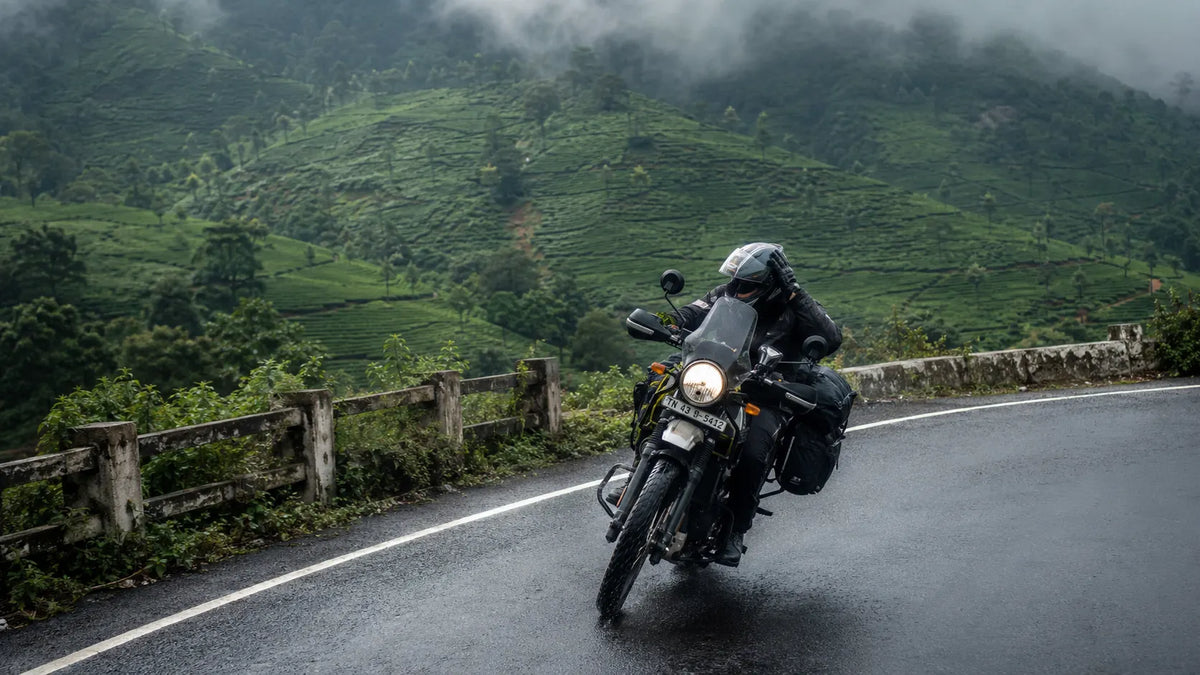
You crack your visor at a Trichy Road signal. Today's helmet smell is worse than yesterday's.
Coimbatore has a reputation as one of Tamil Nadu's more pleasant cities to ride in. It's cooler than Chennai, greener than most. That reputation hides what's actually happening inside your helmet. The Western Ghats wind, a growing accident count, and long hours in the saddle all add up. Your helmet works harder than Coimbatore's mild-weather image suggests. This article breaks down why the smell keeps coming back, and what actually stops it.
Rider Takeaways
- Coimbatore district recorded 485 road deaths in the first half of 2025, more than any other Tamil Nadu district. Helmet-related crashes are a named fatality hotspot there (The South First, 2025).
- The Palakkad Gap is a 32km break in the Western Ghats. It funnels wind into Coimbatore at 18-22 km/h year-round, keeping the air moist long after the rain stops (Wikipedia, Palakkad Gap).
- A 2025 study sampled Coimbatore's own outdoor air. Near commercial roads, bacterial counts hit 880 CFU per cubic metre in winter, some strains already resistant to common antibiotics (Ho et al., Frontiers in Environmental Science, 2025).
- Airing your helmet out on the balcony doesn't touch what's actually breeding inside the foam.
Coimbatore's Roads Are Getting More Dangerous for Riders
Start with the number that should worry you more than the smell does. In the first six months of 2025, Coimbatore district recorded 1,810 road accidents and 485 deaths. That's the highest death toll of any district in Tamil Nadu, 5.61% of the state's total (The South First, 2025). Helmet-related fatalities were flagged as a specific hotspot in the district, with 50 deaths tied to helmet non-use or failure.
Quick Fact:
Tamil Nadu recorded 34,611 accidents and 8,562 deaths in the first half of 2025 alone. Coimbatore district led every other district with 485 of those deaths. Two-wheelers accounted for 3,725 deaths statewide, and 21.56% of those involved riders without helmets. Source: The South First, 2025
Tamil Nadu recorded 34,611 accidents and 8,562 deaths in the first half of 2025 alone. Coimbatore district led every other district with 485 of those deaths. Two-wheelers accounted for 3,725 deaths statewide, and 21.56% of those involved riders without helmets. Source: The South First, 2025
What does this have to do with helmet smell? Everything, once you think it through. A district with this much two-wheeler traffic means more riders in helmets, for more hours, every single day. That's true whether you're commuting to a TIDEL Park office or navigating the RS Puram market crowd. More helmet-on hours mean more sweat and more trapped heat. The liner gets a shorter window to ever fully dry out.
There's no rail alternative coming to ease that load, either. In November 2025, the Union Housing Ministry returned Coimbatore's metro rail proposal. The city's 2011 Census population of 15.84 lakh falls short of the 20-lakh threshold national policy requires, even though current estimates run well above that mark (Deccan Herald, November 2025). For the foreseeable future, Coimbatore keeps moving on two wheels.
Why the Palakkad Gap Keeps Coimbatore's Air So Humid
Coimbatore doesn't get Mumbai-style monsoon flooding or Delhi-style smog. Its climate problem is quieter, and it comes from geography most riders have never heard of.
Quick Fact:
The Palakkad Gap is a 32km-wide break in the Western Ghats between the Nilgiri and Anaimalai hills. Moisture-laden wind from both the Arabian Sea and the Bay of Bengal funnels straight through it, at an average of 18-22 km/h. Source: Wikipedia, Palakkad Gap
The Palakkad Gap is a 32km-wide break in the Western Ghats between the Nilgiri and Anaimalai hills. Moisture-laden wind from both the Arabian Sea and the Bay of Bengal funnels straight through it, at an average of 18-22 km/h. Source: Wikipedia, Palakkad Gap
Most Indian cities get hit by one monsoon system at a time. Coimbatore sits right at the mouth of this gap. It catches wind and moisture funneling in from both coasts, all year. Local humidity swings from a dry 31% in March to a sticky 68% in July. October brings the heaviest rain, 185mm (Weather and Climate, historical averages). That's not extreme by Indian standards, but it's constant, and constant is exactly what a helmet liner can't shake off.
Ride to Valparai or Ooty on a weekend and you'll feel the gap's wind directly. It's a steady push against your helmet on every hairpin. That wind carries moisture, not dryness. It doesn't evaporate sweat out of your liner so much as keep replacing it with more of the same.

What's Actually Living in the Air You Breathe on Every Ride
Here's where it stops being a weather story and becomes a science story, one specific to Coimbatore. In 2025, researchers sampled outdoor air at four Coimbatore microenvironments near Karunya Institute. One was a commercial stretch along Siruvani Main Road. They sampled across both winter and summer (Ho et al., Frontiers in Environmental Science, 2025).
Quick Fact:
The commercial site recorded 880 CFU per cubic metre of bacteria in winter, the highest of any site tested. The domestic site jumped from 410 to 720 CFU per cubic metre between winter and summer. Source: Ho et al., Frontiers in Environmental Science, 2025
The commercial site recorded 880 CFU per cubic metre of bacteria in winter, the highest of any site tested. The domestic site jumped from 410 to 720 CFU per cubic metre between winter and summer. Source: Ho et al., Frontiers in Environmental Science, 2025
Bacillus and Staphylococcus species dominated, alongside Aspergillus and Penicillium fungi, with near-total resistance to erythromycin and amphotericin B. That study measured open air, not helmet interiors directly. Still, the implication is hard to miss. Every ride through a commercial stretch means hours of exposure to air already carrying hundreds of bacterial CFUs per cubic metre. Some of that settles on your visor. Some settles on the vents and foam padding your scalp presses against for the rest of the ride.
Unique Insight
Our finding: the same study found near-complete resistance to erythromycin, and universal fungal resistance to amphotericin B, across Coimbatore's air samples. That rules out the lazy fix. A mild antiseptic wipe-down isn't fighting garden-variety germs here. It's up against strains that have already shrugged off common antimicrobials once.
So what actually works? Sweat itself barely smells. Bacteria feeding on that sweat inside a warm, closed helmet is what produces the odor. Airflow across the outside shell never reaches the foam where they're multiplying. That's true in any city, but it matters more here. Coimbatore's ambient air is already seeding the helmet with a fresh supply on every commute.
How Coimbatore Riders Handle It Today
Ask around Coimbatore's riding groups and you'll find a community that takes safety seriously, even if helmet hygiene rarely comes up. The Coimbatore Bikers Community was founded in 2018 and rebranded in 2024. It now counts 1,000-plus riders and calls itself "India's Most Responsible Riding Community," running road safety rallies, blood donation camps, and a zero-tolerance policy on riding under the influence (Coimbatore Bikers Community, verified live fetch).
Quick Fact:
The Coimbatore Bikers Community has grown to 1,000-plus registered riders since its 2018 founding, running regular road safety rallies alongside weekend touring rides. Source: Coimbatore Bikers Community
The Coimbatore Bikers Community has grown to 1,000-plus registered riders since its 2018 founding, running regular road safety rallies alongside weekend touring rides. Source: Coimbatore Bikers Community
Coimbatore is also the launch point for some of South India's most popular touring routes. The climb to Valparai's tea estates, and onward to Ooty and Kodaikanal, tops that list. A weekend rider heading up those ghats spends four or five hours in the same helmet. That's often longer than an entire work week's commute combined. They come back down with a liner that's absorbed a full day of hill-climate humidity in one go.
Ask a Coimbatore rider what they do about helmet smell, and most say the same thing: nothing, until it gets bad enough to notice. A splash of talcum powder, an old cologne spritz, or just riding with the visor cracked open. None of it touches the bacteria actually causing the problem.
The Fix: A Helmet Deodorizer Built for Coimbatore's Air
Hygena's bacteriostatic helmet deodorizer spray isn't a perfume, and it isn't a cleaner. It targets the bacteria causing the smell directly, instead of just covering it up or wiping the shell down.
For a Coimbatore rider, that means a helmet that survives a humid TIDEL Park commute, or a Sunday climb to Valparai through the Palakkad Gap's wind. It means an ordinary week of Trichy Road traffic without turning into something you dread putting on. No scrubbing, no soaking, no waiting on a balcony for the humidity to lose.
The routine itself takes under a minute:
- Remove the helmet and hold it liner-side up.
- Spray 3-4 pumps directly onto the foam padding and chin strap.
- Let it sit for 60 seconds before wearing again or storing.
A few sprays after each ride, and the bacteria never get the runway Coimbatore's air keeps trying to hand them.
Try it: free shipping, COD available across Coimbatore.

Frequently Asked Questions
Does Coimbatore's weather really make helmet odor worse, even though it's known for milder heat?
Yes. Coimbatore's temperatures run milder than most Tamil Nadu cities, but the Palakkad Gap keeps humidity swinging from 31% to 68% year-round (Weather and Climate). Mild heat with steady humidity still gives bacteria the damp, warm conditions they need to multiply inside a liner.
How dangerous is it to skip a helmet on Coimbatore's roads?
Very. Coimbatore district logged 485 road deaths in the first half of 2025 alone, the highest of any Tamil Nadu district (The South First, 2025). Wearing a helmet consistently means more hours of helmet-on time, and more reason to keep it hygienic.
Where can I buy a helmet deodorizer spray in Coimbatore?
Hygena's bacteriostatic helmet deodorizer ships across Coimbatore with cash-on-delivery available, so there's no need to hunt down a specialty store. Order online and it reaches you directly.
Is a helmet deodorizer different from a perfume spray or Febreze?
Yes. A fabric freshener or perfume masks smell temporarily. A bacteriostatic deodorizer targets the bacteria producing the odor in the first place, so the smell doesn't just reappear a few hours later.
How often should I use a helmet deodorizer in a humid city like Coimbatore?
Treat the liner after every humid ride, and at minimum a few times a week even outside monsoon season. Coimbatore's humidity rarely drops low enough to let a liner fully dry between rides.
Conclusion
Coimbatore's reputation for mild weather hides a real helmet hygiene problem. A wind corridor keeps humidity high year-round. A rising accident count puts more riders in helmets for more hours. Outdoor air is already carrying antibiotic-resistant bacteria before you even climb on the bike. None of that shows up in the city's postcard image, but all of it shows up in your helmet.
Hygena's bacteriostatic spray was built for exactly this gap between reputation and reality. A few seconds after every ride, and the bacteria never get the foothold Coimbatore's air keeps offering them. Order online with COD available across the city.
Sources
1. "Overspeeding and unsafe roads behind Tamil Nadu's high road accident toll," The South First, 2025. Retrieved 2026-08-21.
2. "Cities do not meet population criteria: Centre returns DPRs of Coimbatore and Madurai metros," Deccan Herald, November 18, 2025. Retrieved 2026-08-21.
3. "Coimbatore Weather by Month," Weather and Climate, historical averages. Retrieved 2026-08-21.
4. "Palakkad Gap," Wikipedia. Retrieved 2026-08-21.
5. Ho, C-H. et al., "Preliminary assessment of rural airborne microorganisms as emerging environmental hazards: seasonal variability and antimicrobial resistance in South India," Frontiers in Environmental Science, 2025. Retrieved 2026-08-21.
6. "Coimbatore Bikers Community," verified live fetch. Retrieved 2026-08-21.
7. "The 7 Most Scenic Motorcycle Rides To Take From Coimbatore With Friends," Travel India. Retrieved 2026-08-21.
Share:
Helmet Deodorant Spray Chennai: Why OMR Traffic Wrecks It
A Biker's Guide to Smelling Good After Every Ride