
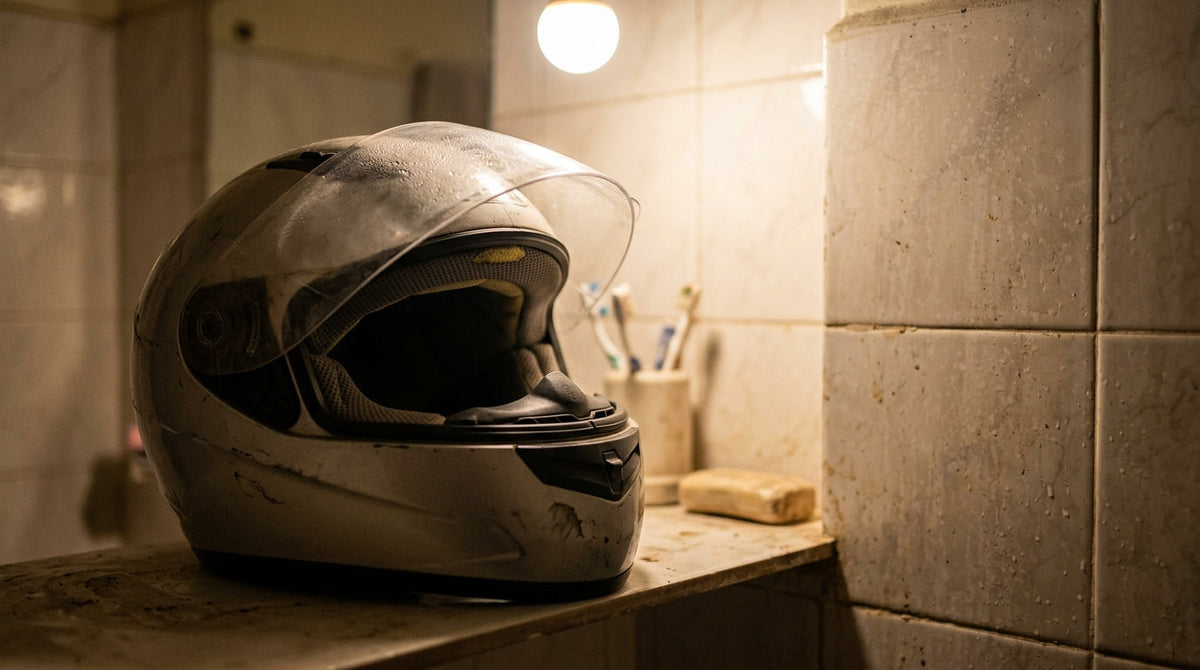
You sprayed it Monday. You washed the liner last weekend too. By Wednesday, wahi smell wapas aa gaya.
Most riders assume that means the product failed, or the wash wasn't thorough enough. Usually, it's neither. The real problem sits in the 24 to 48 hours right after every ride. In that window, a damp helmet either dries out properly, or it starts building the exact conditions bacteria and mold need.
This article breaks down why spraying or washing alone doesn't hold the smell off. It also lays out the short routine that keeps a helmet fresh for good, not just for a day.
Rider Takeaways
- Damp materials can start growing mold within just 24 to 48 hours if they aren't dried, per the US EPA.
- A 2020 study of 130 motorcycle helmets found bacterial growth in 73.9% to 80% of samples tested (Sapkota et al., International Journal of Microbiology).
- A helmet cleaner and a bacteriostatic spray solve two different problems, and using only one still leaves the smell a way back in.
- The fix isn't a better product alone. It's a routine: spray after every ride, wash on a schedule, and never seal a damp helmet away.
Why Does Your Helmet Still Smell After You Wash It?
In 2020, researchers publishing in the International Journal of Microbiology tested 130 motorcycle helmets. They found bacterial growth in 73.9% of samples from male riders and 80.0% from female riders (Sapkota et al., 2020). That's most helmets in regular use, not just the neglected ones.
We've covered exactly what's growing in there and why in detail before. Short version: sweat feeds bacteria. The foam shell under the removable liner rarely gets touched by a wash at all.
So a single wash or a single spray only interrupts the cycle for a moment. The moment your helmet goes damp again, on the next ride, the same bacteria start rebuilding. Ek baar clean karna kaafi nahi hai, dobara wahi cycle shuru ho jaata hai.
What's Actually Keeping the Smell Alive Between Rides?
Damp materials left untreated can start growing mold within 24 to 48 hours. That's per US EPA guidance on moisture and mold control. It's the window health authorities give homeowners to dry out a wet carpet before mold risk climbs.
A helmet almost never gets that window. A daily commuter rides again within a day. A weekend tourer zips a still-damp helmet into a top box for the drive home. Either way, the liner stays warm, sealed, and moist well past the point where mold and bacteria start multiplying.
Quick Fact:
The US Environmental Protection Agency advises drying wet or damp materials within 24 to 48 hours, since mold can begin growing on damp surfaces after that window. A helmet liner that stays sealed inside a closed helmet bag or top box after a sweaty ride routinely sits damp far longer than that. Source: US EPA, A Brief Guide to Mold, Moisture and Your Home, updated 2026.
The US Environmental Protection Agency advises drying wet or damp materials within 24 to 48 hours, since mold can begin growing on damp surfaces after that window. A helmet liner that stays sealed inside a closed helmet bag or top box after a sweaty ride routinely sits damp far longer than that. Source: US EPA, A Brief Guide to Mold, Moisture and Your Home, updated 2026.
Is a Helmet Cleaner Actually the Fix?
A helmet cleaner lifts road grime, oils, and visor smudges off the shell and padding surface. What it doesn't change is how fast the liner dries. That's the part deciding whether the EPA's 24-to-48-hour mold risk window closes or stays open.
What it doesn't do is stop what regrows in the foam after you've cleaned it. Think of it like a deodorant versus soap. One removes what's already there. The other manages what comes back in between. Riders searching "helmet cleaner" usually need both, not one instead of the other.
We've written a longer answer to "isn't Hygena just a cleaner spray" before, if you want the full comparison. Here, the short version matters more. A cleaner alone still leaves the 24-to-48-hour moisture window wide open.
The Routine That Actually Stops the Smell For Good
No single product closes that window by itself. A routine does. Here's the sequence that keeps a helmet from ever getting back to day-one smell:
1. Spray the foam and contact points, not just the fabric liner, after every ride longer than 30 minutes.
2. Leave the visor fully open for at least 10 minutes before storing the helmet anywhere.
3. Wash the removable liner every 1-2 weeks if you ride daily, every 2-3 weeks for weekend rides.
4. Never zip a damp helmet into a sealed bag or top box. That recreates the exact window mold needs.
5. Store the helmet somewhere ventilated overnight, not inside a closed cupboard.
None of these steps take long on their own. What actually stops the smell is doing all five, every time, instead of picking whichever one feels easiest that day.
Unique Insight
Our finding: Riders who treat spraying as a post-ride habit, the same way they'd check tyre pressure, report the smell doesn't come back the way it does with occasional use. The routine beats the strength of any single product.
This is where Hygena fits into the routine. Not as a replacement for washing. Not a substitute for a cleaner either. It's the daily step that closes the gap between the two. Ten seconds after every ride, and the foam never gets the chance to rebuild.

What Mistakes Undo the Routine, and How Should It Change in India's Heat?
The most common mistake isn't skipping the spray. It's sealing a freshly sprayed or freshly washed helmet away before it's actually dry. That recreates the same 24-to-48-hour moisture window all over again, right after you did the work to close it.
Indian summer heat and monsoon humidity both push against that same EPA-defined 24-to-48-hour window from opposite directions. Summer sweat loads the liner faster on every ride. Monsoon air keeps everything from drying properly even when the helmet is left open.
Daily riders in hot, humid cities get the most benefit from tightening the routine, not changing it. Spray after every single ride through peak summer and monsoon. Don't stretch the liner wash past a week if you're commuting daily in that weather.
Winter is the one season where the routine can relax slightly. Cooler, drier air slows both sweat production and mold growth, so a weekly spray and a two-to-three-week wash cycle usually holds the smell off just fine.

Frequently Asked Questions
How do I get rid of motorcycle helmet smell permanently?
No single wash or spray does it permanently. Spray after every ride, wash the liner every 1-2 weeks, and never seal a damp helmet away. That closes the moisture window mold and bacteria need, per US EPA guidance on the 24-48 hour risk window.
Will a helmet cleaner remove the smell on its own?
It removes surface dirt and grime, but not the bacteria regrowing in the foam once it's damp again. A 2020 study found bacterial growth in 73.9-80% of 130 helmets tested (Sapkota et al., International Journal of Microbiology), cleaned or not.
How often should I spray my helmet in Indian summer or monsoon?
After every ride during peak summer and monsoon months. Both push against the same 24-to-48-hour drying window the US EPA cites for damp materials, just from opposite directions. Summer speeds up sweat load. Monsoon slows down drying.
Is it bad to store a helmet in a sealed bag?
Yes, if it's still damp. A sealed bag traps moisture against the foam. That recreates the same 24-48 hour mold risk window the EPA warns about for any damp material left untreated.
Does lending my helmet to a friend make the smell worse?
It can. Sweat, oils, and any bacteria already growing in the foam transfer to whoever wears it next, then feed off their sweat too. Spraying before and after a lend keeps that handoff from restarting the cycle for both riders.
Conclusion
Your helmet doesn't smell because one product failed. It smells because of a window: the 24 to 48 hours after every ride that decide whether bacteria and mold get a foothold. Most storage habits hand that window right over.
Close it with a routine, not a single fix. Spray after every ride, wash the liner on schedule, and let it dry fully before it's ever sealed away. Hygena's spray is built to be the part of that routine you'll actually keep up, ten seconds, every ride. .
Sources
1. "A Brief Guide to Mold, Moisture and Your Home," US Environmental Protection Agency, updated 2026. Retrieved 2026-07-28.
2. Sapkota, A. et al., "Microbial Diversity and Antibiotic Susceptibility Pattern of Bacteria Associated with Motorcycle Helmets," International Journal of Microbiology, 2020. Retrieved 2026-07-28.
Share:
How Often Should You Really Clean Your Motorcycle Helmet?
7 Signs Your Motorcycle Helmet Needs Immediate Cleaning