
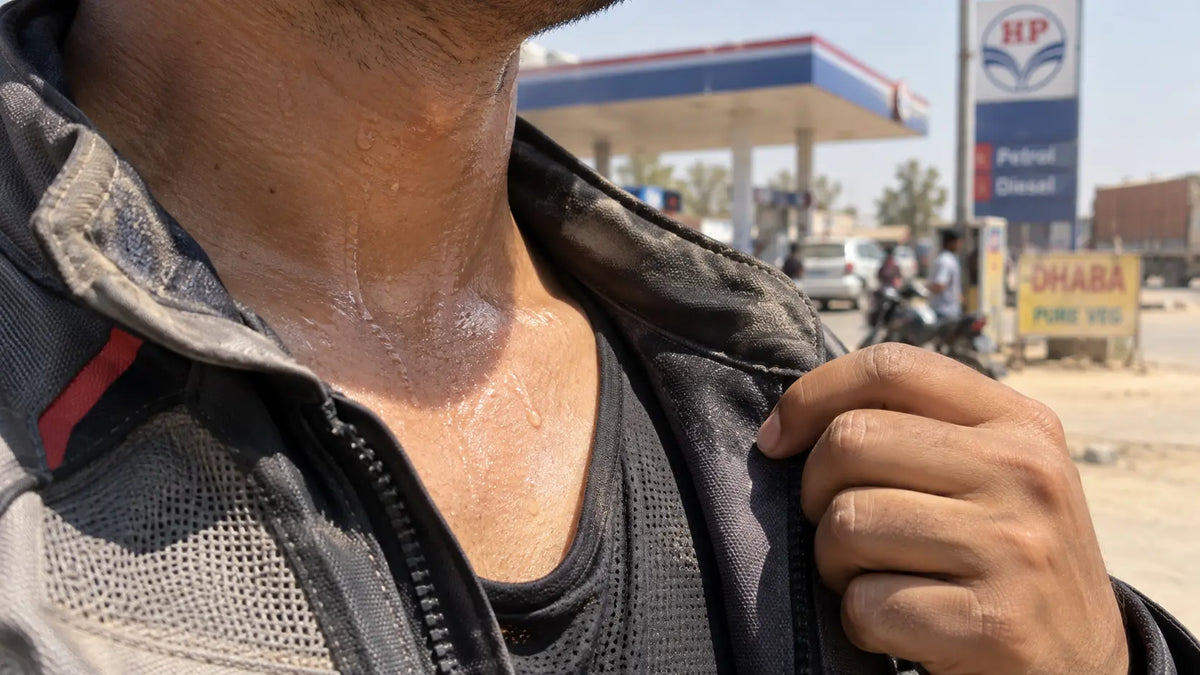
You reapplied deodorant before you left. By the second signal, it's already gone.
Bhai, it's not your fault, and it's not a bad deodorant either. Riding gear does something specific to sweat that most antiperspirants were never designed to survive.
Dermatology research shows exactly why this happens, and it has nothing to do with brand or price. Your jacket, your commute, and your sweat rate all work against the same mechanism that's supposed to keep you dry.
Here's the actual science behind why deodorant quits mid-ride. Plus what your gear is doing to make it worse, and what helps you stay fresh for the whole trip.
Rider Takeaways
- A 2021 Scientific Reports study found sweat overwhelms your antiperspirant's plug at high flow rates, exactly what riding gear causes.
- Motorcycle gear raises core body temperature and heart rate within the first hour, per a 2019 study.
- Deodorant masks smell. It doesn't stop the bacteria actually causing it.
- More product isn't the fix. Treating your gear and timing application right is.
Why Does Your Deodorant Quit Halfway Through a Ride?
In 2021, researchers used microfluidics and X-ray imaging to watch antiperspirant work in real time. Galey and colleagues, publishing in Scientific Reports, found the aluminum salts that plug your sweat ducts. Those salts stop plugging effectively once sweat flow rises too high. That's the mechanism failing on your ride, not the brand.
Antiperspirants work by forming a gel-like plug inside each sweat duct. Aluminum ions bind to proteins in your sweat and build a barrier that blocks the duct opening.
The study found this plug forms fine at normal sweat rates. Push the rate up, and the aggregate shifts toward the pore's outlet instead of settling deep inside. The plug never fully forms.
That's exactly the condition a motorcycle ride creates. Heat, humidity, and hours of movement send your sweat rate well past what a lab-temperature antiperspirant test usually accounts for.
This matters more on longer commutes. Riders in Delhi-NCR average a 60-minute one-way commute, per MoveInSync's 2019 pan-India travel time report. That's an hour of rising sweat rate before you've even reached your desk.
So why does it feel worse on a bike than on a walk to the metro? Because your sweat rate isn't gradual on a ride. It spikes.
Quick Fact:
Antiperspirants plug sweat ducts using aluminum salts that bind to sweat proteins. A 2021 Scientific Reports study (Galey et al.) found this plug is highly sensitive to sweat flow rate. Once flow climbs, the aggregate shifts toward the pore opening and plugging fails. Source: Scientific Reports, 2021.
Antiperspirants plug sweat ducts using aluminum salts that bind to sweat proteins. A 2021 Scientific Reports study (Galey et al.) found this plug is highly sensitive to sweat flow rate. Once flow climbs, the aggregate shifts toward the pore opening and plugging fails. Source: Scientific Reports, 2021.
Your Riding Jacket Is Turning Up the Heat
A 2019 study, cited in a 2022 review in the Journal of Industrial Textiles, measured riders wearing full protective gear. Core body temperature climbed 0.51°C in the first stage, then another 0.75°C and 0.74°C in the stages that followed. Heart rate rose by 27 beats per minute.
Riding jackets are built for abrasion resistance first, comfort second. That same 2022 review found this protective layering makes most motorcycle gear thermally inefficient in hot weather. The reason is low vapor permeability.
Sweat can't evaporate properly when vapor can't escape through the fabric. It just sits against your skin instead, soaking into whatever product you applied that morning.
None of this is really about your gear being "bad." It's a genuine design trade-off. Abrasion protection needs dense material, and dense material blocks airflow.
Add Indian summer humidity, and evaporation slows down even more. A 2023 study in Experimental Physiology found rising humidity increases thermal strain even when skin temperature stays the same. That's because sweat pools on skin instead of cooling it. Think Chennai in May, or Delhi before the monsoon breaks. That's when this problem peaks.
Quick Fact:
Motorcycle PPE traps heat by design. A 2019 study, reported in a 2022 Journal of Industrial Textiles review, tracked riders wearing full gear. Core temperature rose up to 0.75°C per stage, and heart rate climbed 27 bpm. That's a real physiological load your deodorant has to survive on top of. Source: Journal of Industrial Textiles, 2022.
Motorcycle PPE traps heat by design. A 2019 study, reported in a 2022 Journal of Industrial Textiles review, tracked riders wearing full gear. Core temperature rose up to 0.75°C per stage, and heart rate climbed 27 bpm. That's a real physiological load your deodorant has to survive on top of. Source: Journal of Industrial Textiles, 2022.

What's Actually Growing in All That Sweat?
Sweat itself doesn't smell. Bacteria breaking it down does. A 2023 review in the Indian Journal of Dermatology, Venereology and Leprology describes how heat, sweat, and friction combine. Together, they create exactly the conditions bacteria multiply fastest in. Riding gear produces those conditions for hours at a stretch.
Your deodorant's fragrance is built to compete with everyday bacterial activity. It's not built to out-mask hours of bacterial growth under a sealed, humid jacket.
This is the same pattern Hygena's own research into helmet bacteria points to. It's a bacteria problem, not a sweat problem. The smell is a symptom, not the cause.
Friction adds a second layer riders don't think about. Jacket seams and straps rub against damp skin for hours, which can strip away whatever product you applied that morning.
Delivery riders logging six to ten hours a day in gear face this hardest of all. The bacterial load never gets a break between shifts.
Quick Fact:
There's a real cost beyond the smell. A 2021 study in PLOS ONE found people could tell high from low self-esteem apart just from sweat samples, at accuracy well above chance. Odor isn't just unpleasant, it's something people actually register about you. Source: PLOS ONE, 2021.
There's a real cost beyond the smell. A 2021 study in PLOS ONE found people could tell high from low self-esteem apart just from sweat samples, at accuracy well above chance. Odor isn't just unpleasant, it's something people actually register about you. Source: PLOS ONE, 2021.
Unique Insight
Our finding: The reason deodorant "fails" isn't a weak formula. Your gear creates a bacterial load your skin-only product was never designed to fight alone.
So What Actually Helps You Stay Fresh?
The fix isn't a stronger deodorant. The American Academy of Dermatology recommends applying antiperspirant to dry skin before bed, not in the morning. That gives the product time to dry fully before your skin gets damp again.
Skip the reapply-mid-ride habit too. Layering more product onto already-damp skin doesn't rebuild a plug. It just sits on top, per the same mechanism above.
A breathable, moisture-wicking base layer under your jacket gives sweat somewhere to go instead of pooling against skin for hours. Merino wool or synthetic wicking fabric pulls moisture away from the exact spot where you applied product.
Shower and dry completely before applying. Damp skin stops the aluminum from binding properly, and it raises your irritation risk too, per the same AAD guidance.
None of this fixes the other half of the problem. Your helmet and gear collect the same bacteria your skin does, and re-seed it on every ride.
Quick Fact:
Even a working plug is temporary. The International Hyperhidrosis Society explains that sweat production continues behind the blockage, and normal function returns as skin renews itself. That's exactly why reapplication is needed at all. Source: International Hyperhidrosis Society.
Even a working plug is temporary. The International Hyperhidrosis Society explains that sweat production continues behind the blockage, and normal function returns as skin renews itself. That's exactly why reapplication is needed at all. Source: International Hyperhidrosis Society.
That's where treating your gear comes in. A few seconds of Hygena's bacteriostatic spray on your helmet liner and jacket keeps bacteria from rebuilding between rides. Your deodorant stops fighting a battle it was never going to win alone.
Treat gear once a week if you ride daily, more often in monsoon humidity. It takes seconds and breaks the bacterial cycle before it restarts.
Treat the gear side of the equation, and your deodorant can finally do its job.
Unique Insight
Our finding: Skin care and gear care are the same problem. Fix only one, and the other keeps re-infecting it every single ride.

Frequently Asked Questions
Why does deodorant wear off faster on a motorcycle than on a walk?
Riding gear traps heat and humidity. A 2019 study, cited in a 2022 Journal of Industrial Textiles review, tracked riders wearing full PPE. Core temperature climbed up to 0.75°C per stage. That spike in sweat rate overwhelms your antiperspirant's plug faster than everyday sweating does.
Does a stronger antiperspirant actually last longer on a ride?
Not necessarily. A 2021 Scientific Reports study found plug formation depends more on sweat flow rate than concentration. Once sweat volume climbs high enough, even strong formulas struggle to seal the duct properly.
Should I apply deodorant in the morning or the night before a long ride?
The American Academy of Dermatology recommends nighttime application, to dry skin, right before bed. That reduces irritation and gives the plug time to fully form before your morning ride begins.
Can gear hygiene actually make my deodorant work better?
Yes, indirectly. Bacteria from unwashed gear can re-colonize skin between rides. Treating your helmet and jacket with a bacteriostatic spray reduces the bacterial load your deodorant has to compete with.
Do natural or talc-free deodorants work better for riding?
Not automatically. What matters most is sweat volume, not formula type. A gel-based antiperspirant applied to dry skin the night before generally outperforms any formula applied mid-ride onto damp skin.
Does monsoon season make this worse?
Yes. Higher ambient humidity slows sweat evaporation further, per the Experimental Physiology findings above. Gear stays damp longer, and bacteria get more time to multiply.
Conclusion
Your deodorant isn't broken. Riding gear creates a heat, humidity, and bacteria problem it was never built to solve alone.
The real fix has two parts. Apply antiperspirant at night, wear a breathable base layer, and stop reapplying onto damp skin mid-ride. Then treat the gear side too, since your helmet and jacket are re-seeding the exact bacteria your deodorant is fighting.
Hygena's bacteriostatic spray handles that second half in seconds, on your helmet liner and gear. Your morning routine actually holds up by evening because of it.
Next time you gear up, remember: the smell isn't your deodorant giving up. It's your gear asking for the same treatment your skin gets.
Sources
1. Galey, L. et al., "Real time observation of the interaction between aluminium salts and sweat under microfluidic conditions," Scientific Reports, 2021. Retrieved 2026-09-08.
2. International Hyperhidrosis Society, "Aluminum Chloride," Topical Treatments. Retrieved 2026-09-08.
3. de Rome, L. et al., Accident Analysis & Prevention, 2019, as cited in Natarajan, G. & Rajan, P.T., "Review on the performance characteristics and quality standards of motorcycle protective clothing," Journal of Industrial Textiles, 2022. Retrieved 2026-09-08.
4. Jenkins, E.J. et al., "Effects of humidity on exercise-heat stress," Experimental Physiology, Vol. 108, No. 2, 2023. Retrieved 2026-09-08.
5. "Current understanding of frictional dermatoses: a review," Indian Journal of Dermatology, Venereology and Leprology, 2023. Retrieved 2026-09-08.
6. "Body odor and self-esteem signaling," PLOS ONE, 2021. Retrieved 2026-09-08.
7. MoveInSync, "An Office Travel Time Report: Pan-India IT Corridors," Q1 2019. Retrieved 2026-09-08.
8. American Academy of Dermatology, "Hyperhidrosis: Diagnosis and Treatment." Retrieved 2026-09-08.
Share:
How Often to Change Innerwear on a Multi-Day Bike Trip?
Helmet Deodorizer Visakhapatnam: Beating the Coastal Humidity