
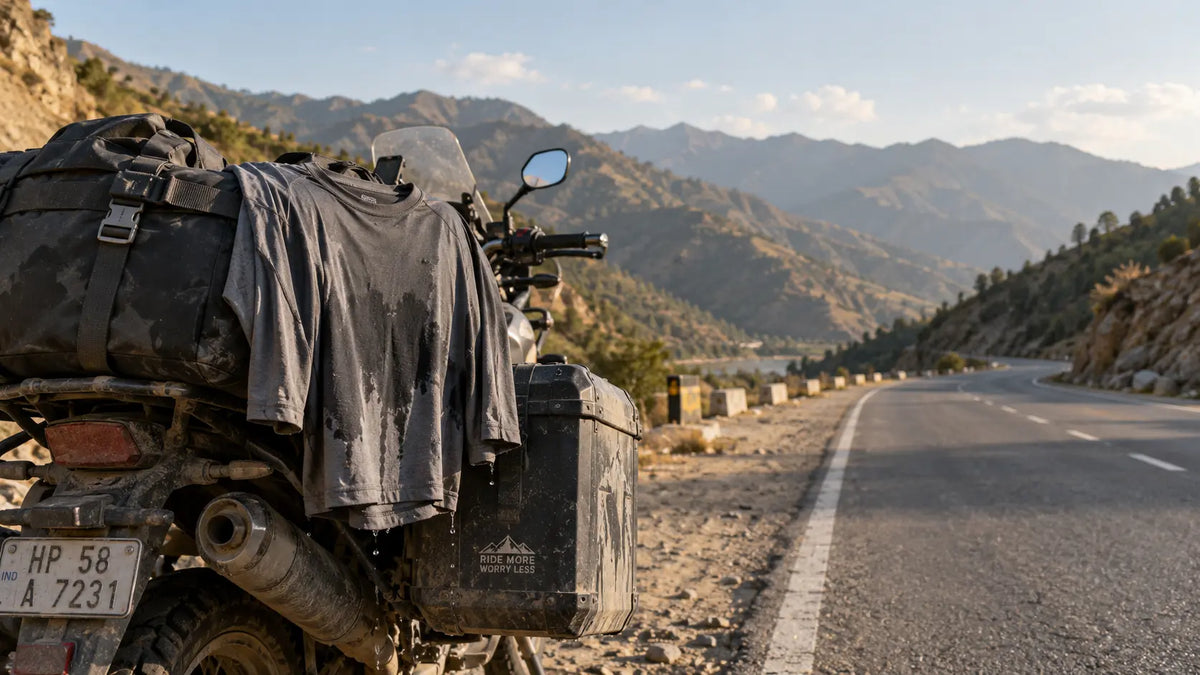
Day three of a Manali-Leh run, and you're still wearing the base layer you packed in Manali. Nothing feels wrong yet. But by the time you stop for chai, your thighs are raw and something under your riding pants smells off.
That's not bad luck. It's moisture sitting against your skin for two days straight. That single habit is the biggest reason multi-day riders deal with chafing, rashes, or worse on tour. This isn't about vanity. It's about what happens to skin that stays wet and warm inside riding gear for 10+ hours a day.
Here's how often you actually need to change riding innerwear on a multi-day trip. And how to pack light without running out.
TL;DR:
Change riding innerwear at least once every 24 hours on a multi-day trip. Sooner if it's soaked with sweat or rain. Pack one pair per riding day plus two spares for wash lag. Moisture, not dirt, is the real trigger behind chafing and the fungal infections that affect 20-25% of people worldwide.
Change riding innerwear at least once every 24 hours on a multi-day trip. Sooner if it's soaked with sweat or rain. Pack one pair per riding day plus two spares for wash lag. Moisture, not dirt, is the real trigger behind chafing and the fungal infections that affect 20-25% of people worldwide.
Rider Takeaways
- Change innerwear at least once every 24 hours on tour, sooner if it's soaked.
- Sweat is the top trigger behind fungal infections affecting 20-25% of people worldwide (StatPearls).
- Pack one pair per riding day, not three pairs for a week-long trip.
- Synthetics dry faster but grow more odor bacteria, so wash them daily where you can.
How Often Should You Change Riding Innerwear on a Multi-Day Trip?
In 2023, StatPearls named perspiration as the top trigger for groin fungal infections. Those infections affect 20 to 25% of people worldwide, per the NCBI's clinical reference. That's why riding innerwear needs to come off at least once every 24 hours on a multi-day trip. Sooner if it's soaked with sweat, rain, or after a water crossing.
Here's the simple test: if you can feel dampness against your skin, it's time to switch. On a hot NH48 stretch or through Konkan monsoon rain, that can happen well before the 24-hour mark. Riders doing 8-10 hour stints often need a mid-day change, not just an end-of-day one.
Quick Fact:
Cutaneous mycoses, including tinea cruris (jock itch), affect 20 to 25 percent of the world's population. The US alone logs an estimated 29.4 million cases a year with over 51 million physician visits. Perspiration and occlusive clothing are named as the leading risk factors. Source: StatPearls, NCBI Bookshelf
Cutaneous mycoses, including tinea cruris (jock itch), affect 20 to 25 percent of the world's population. The US alone logs an estimated 29.4 million cases a year with over 51 million physician visits. Perspiration and occlusive clothing are named as the leading risk factors. Source: StatPearls, NCBI Bookshelf
| Riding Condition | Change Innerwear |
|---|---|
| Dry riding day, moderate heat | Once every 24 hours |
| Heavy sweat or high humidity | Every 8-10 hours, mid-ride |
| Rain or a water crossing | Immediately, before it dries against skin |
| End of any riding leg | Always, before sleeping in it |
Why Does Sweaty Innerwear Cause More Trouble on Day 3 of a Ride?
In 2023, a review in the Indian Journal of Dermatology, Venereology and Leprology mapped the mechanism. Sweating raises skin moisture, and moisture raises friction between skin and fabric. IJDVL specifically named nylon and wool as the fabrics most linked to frictional dermatitis. That cascade gets worse every extra hour the same fabric stays against your skin.
Riding gear makes this worse than everyday wear. Jackets and pants trap heat and sweat for hours. Tight-fitting innerwear adds constant rubbing on top of that moisture. IJDVL's review flags this exact combination, tight clothes plus trapped moisture, as a direct trigger for skin breakdown.
Most riders notice it around day three of a tour, right when the "just one more day" mindset kicks in. That's usually when raw patches or a musty smell show up first.
Quick Fact:
Sweating raises the moisture content of skin, and moisture increases the coefficient of friction between skin and fabric. That's the core mechanism behind frictional dermatitis. Nylon and wool are the fabrics most commonly implicated. Source: IJDVL, 2023
Sweating raises the moisture content of skin, and moisture increases the coefficient of friction between skin and fabric. That's the core mechanism behind frictional dermatitis. Nylon and wool are the fabrics most commonly implicated. Source: IJDVL, 2023
Unique Insight
Our finding: The fabric matters less than the routine. Nylon and cotton both cause frictional dermatitis if left wet against skin for two straight days. The fix isn't a better fabric. It's a shorter interval between changes.
What Actually Happens If You Skip Changing for Days?
In 2026, a UK study of 20 competitive cyclists found nearly all of them dealt with saddle sores. That study also cites earlier research documenting rates of 39 to 89% among female cyclists generally. Riders on multi-day tours face the same risk, just with a helmet and a heavier bike added.
Chafed skin is only half the story. Sweat left sitting in fabric feeds bacteria like Micrococcus. It grows far more on polyester than cotton. A 2014 study in Applied and Environmental Microbiology confirmed this. That's the same bacterial process behind the smell on unwashed riding gear.
Quick Fact:
Micrococcus bacteria, the main driver of musty odor, grew up to 1.72 x 10^7 CFU per cm² on polyester in lab tests, versus no selective growth on cotton. Polyester shirts were also rated far less pleasant-smelling than cotton after the same workout. Source: Callewaert et al., 2014, Applied and Environmental Microbiology
Micrococcus bacteria, the main driver of musty odor, grew up to 1.72 x 10^7 CFU per cm² on polyester in lab tests, versus no selective growth on cotton. Polyester shirts were also rated far less pleasant-smelling than cotton after the same workout. Source: Callewaert et al., 2014, Applied and Environmental Microbiology

How Many Pairs of Innerwear Should You Actually Pack?
In 2024, a survey of 400 Indian motorcycle tourists found the average trip lasts 8.94 days. Most riders plan solo or with one partner, per the same study. Pack one pair of innerwear per riding day, plus two extra for washing lag. For a 9-day trip, that's roughly six to seven pairs, not nine.
Handwashing at a dhaba stop or guesthouse sink works fine if you carry a quick-dry pair. Rotate two pairs on wash days: one drying while you wear the other. Synthetics dry faster than cotton, which is why most touring riders default to them despite the odor trade-off.
Three steps get a pair dry before your next stop:
- Rinse and wring it out by hand, twisting until no more water drips.
- Clip it to your luggage strap or mirror, not inside a closed bag.
- Ride the next leg in direct sun rather than packing it away damp.
Quick Fact:
A 2024 survey of 400 Indian motorcycle tourists found the average trip lasts 8.94 days, with 57% planning their own route independently rather than through an agency or club. Longer trips mean more days your innerwear sits in a saddlebag, not less need to rotate it. Source: Kumari & Chugh, Journal of Management and Development Research, 2024
A 2024 survey of 400 Indian motorcycle tourists found the average trip lasts 8.94 days, with 57% planning their own route independently rather than through an agency or club. Longer trips mean more days your innerwear sits in a saddlebag, not less need to rotate it. Source: Kumari & Chugh, Journal of Management and Development Research, 2024
What's the Easiest Way to Stay Fresh Between Changes?
You can't always change innerwear mid-route, but you can cut the bacteria buildup between changes. The same bacteriostatic logic that works on helmet liners applies here: kill the bacteria, not just the sweat. Hygena's spray was built on exactly that principle for gear that's hard to wash daily.
Pick moisture-wicking synthetics or merino wool over plain cotton for the ride itself. They dry faster between changes, even if the trade-off is more bacteria to manage. A quick spray on your helmet liner and gloves at the same stop takes five seconds. It keeps the rest of your gear from adding to the problem.
Quick Fact:
Moisture is what turns ordinary friction into chafing. It makes fabric slip and rub against skin more easily. Moisture-wicking synthetics move sweat away faster than cotton, which soaks it up and stays wet. Source: Cleveland Clinic
Moisture is what turns ordinary friction into chafing. It makes fabric slip and rub against skin more easily. Moisture-wicking synthetics move sweat away faster than cotton, which soaks it up and stays wet. Source: Cleveland Clinic
Unique Insight
Our finding: Riders already spray their helmet without thinking twice about it. The same five-second habit works for anything on your body that traps sweat against skin. Innerwear is just the one nobody talks about.

Frequently Asked Questions
Can you skip a change if the ride is only two days?
Even a two-day ride carries risk if you're sweating heavily. StatPearls names perspiration as the top trigger for jock itch, and that risk doesn't wait for day three. If you've been in the same damp fabric for 24 hours, change it, even on a short trip.
Does merino wool need changing as often as cotton?
Merino resists odor better than cotton because it's naturally antimicrobial, but it still traps moisture against skin. The friction mechanism IJDVL describes applies to wool just as much as cotton. The change interval stays the same: at least once every 24 hours.
What's the fastest way to dry innerwear on the road?
Wring it out, then clip it to your bike's mirror or luggage strap in direct sun. Synthetic fabrics dry noticeably faster than cotton in most conditions. That speed is also why they trap more odor-causing bacteria, per the 2014 Callewaert fabric study. Plan to wash them sooner.
Is it fine to reuse innerwear if you shower every night?
Showering helps, but it doesn't fix fabric that's still damp with yesterday's sweat by morning. Moisture left in fabric raises the friction that IJDVL's 2023 review linked to skin breakdown. Wash or swap the fabric itself, not just your skin, between wears.
Conclusion
The rule is simple, even if packing for it takes planning. Change riding innerwear at least once every 24 hours on a multi-day trip, sooner if it's wet. Pack for the actual length of your tour, not a rounded-down guess. Rotate fabrics that dry fast, even if you wash them more often.
The gear you can't change as easily, your helmet liner and gloves, needs the same logic applied differently. That's where Hygena's spray comes in. It kills the bacteria feeding on trapped sweat in seconds, no water or wash cycle needed.
Pack smart, change on schedule, and let Hygena handle the gear you can't throw in a wash.
Sources
1. "Tinea Cruris," StatPearls, NCBI Bookshelf, 2023. Retrieved 2026-09-08. https://www.ncbi.nlm.nih.gov/books/NBK554602/
2. "Current Understanding of Frictional Dermatoses: A Review," Indian Journal of Dermatology, Venereology and Leprology, 2023. Retrieved 2026-09-08. https://ijdvl.com/current-understanding-of-frictional-dermatoses-a-review/
3. Callewaert, C. et al., "Microbial Odor Profile of Polyester and Cotton Clothes after a Fitness Session," Applied and Environmental Microbiology, 2014. Retrieved 2026-09-08. https://journals.asm.org/doi/10.1128/aem.01422-14
4. "Female cyclists' experiences of saddle sores and their effect on cycling," PMC, 2026. Retrieved 2026-09-08. https://pmc.ncbi.nlm.nih.gov/articles/PMC12908944/
5. Kumari, B. & Chugh, S.R., "Nature of Motorcycle Tourism in Trans-Himalayan Region of Spiti and Kinnaur," Journal of Management and Development Research, Vol. 1, Issue 2, 2024. Retrieved 2026-09-08. https://journals.stecab.com/index.php/jmdr/article/view/126
6. "Chafing: How It Happens & How To Treat It," Cleveland Clinic. Retrieved 2026-09-08. https://my.clevelandclinic.org/health/diseases/23517-chafing
Share:
The Truth About Helmet Cleaner Sprays for Bhopal Riders
Why Your Deodorant Stops Working Halfway Through a Ride