
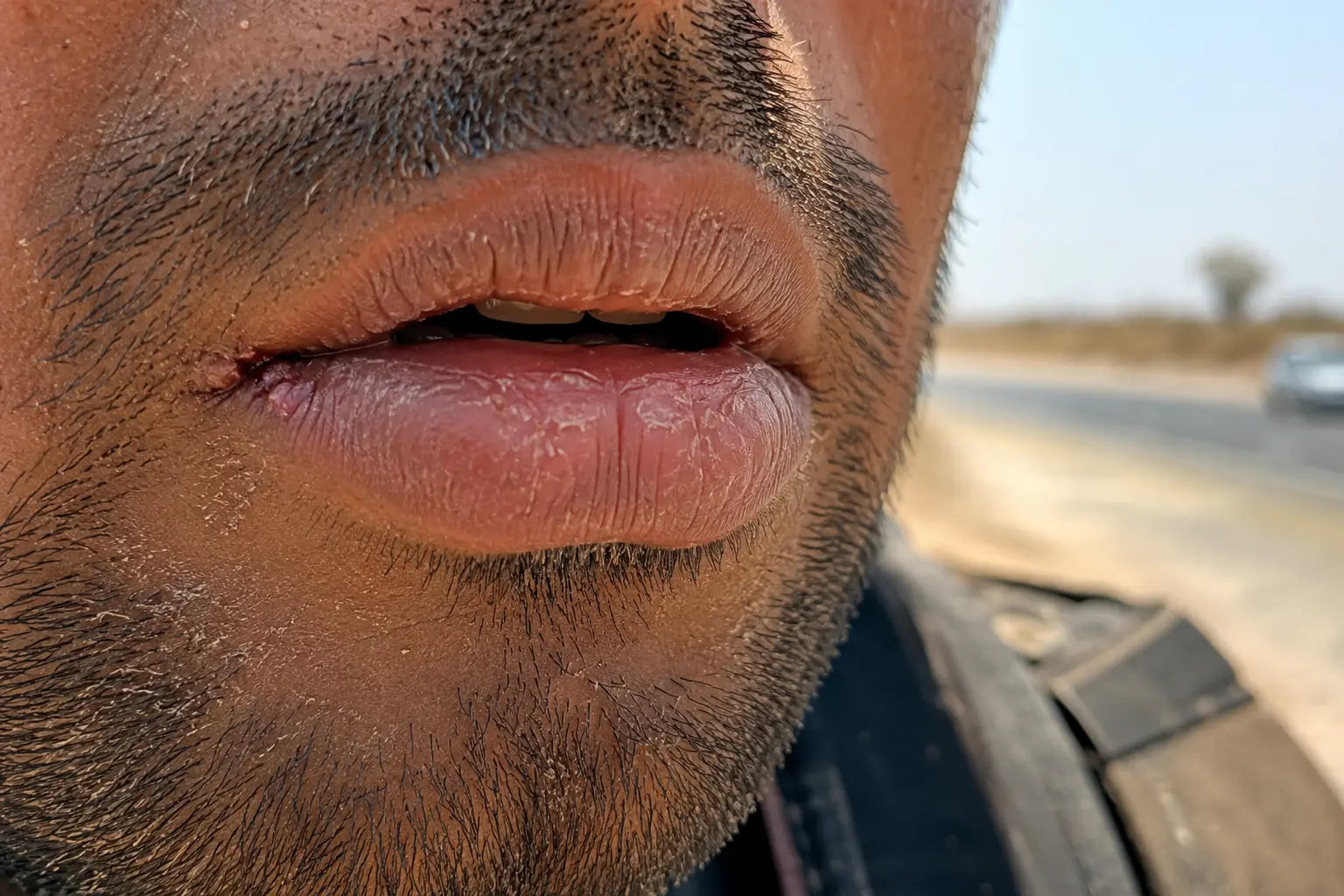
You finish a long highway run, pull off your helmet, and your lips sting.
By the next morning they're cracked, peeling, maybe bleeding at the corner. You drink water. You ignore it. It comes back after every ride. Most riders blame the heat. The real culprit is the wind hitting your face for hours, plus lip skin that was never built to handle it. This guide explains why a rider's lips crack before anyone else's, and how the right lip balm for motorcycle riders fixes it in seconds.
Rider Takeaways
- Riding wind speeds up evaporation so much that a rider in dry 95°F air can lose over a liter of water an hour without feeling sweaty (Riding Gear Warehouse).
- Your lips have no oil glands and a stratum corneum about 75% thinner than your face, so they dry out first.
- A petrolatum-based balm cut lip water loss by 54% in clinical testing, and SPF protects the lower lip where 90% of lip cancers form.

Why do riders get chapped lips more than everyone else?
Riding pushes dry air across your face for hours. That wind rips moisture off your skin far faster than still air does. A rider in dry 95°F heat can lose over a liter of water an hour without feeling sweaty (Riding Gear Warehouse, 2024). The evaporation is that fast. Your lips sit right in the airflow.
Think about a normal day. You walk, you sit, your skin stays in still air. Now think about a 60 kmph ride. The wind never stops. It pulls the thin film of moisture off your lips every second you're moving.
Helmet airflow makes it worse. Vents push air directly across your mouth, and an open-face or modular lid offers almost no shield. Bina chin bar ke, your lips take the full blast.
Quick Fact:
Wind across the skin evaporates moisture far faster than still air at the same temperature. A motorcycle rider in dry 95°F heat can lose more than a liter of water an hour without feeling sweaty, because the wind evaporates it instantly. Lips, sitting directly in that airflow, lose moisture first. Source: Riding Gear Warehouse
Wind across the skin evaporates moisture far faster than still air at the same temperature. A motorcycle rider in dry 95°F heat can lose more than a liter of water an hour without feeling sweaty, because the wind evaporates it instantly. Lips, sitting directly in that airflow, lose moisture first. Source: Riding Gear Warehouse
What makes lip skin so vulnerable?
Your lips are the weakest skin on your body for this job. Lip skin has no sebaceous (oil) glands. Its stratum corneum is roughly 75% thinner than the rest of your face (OneSkin dermatology research). With no oil glands, lips can't build the natural barrier that shields your cheeks from wind.
That thin barrier means high transepidermal water loss, or TEWL. TEWL is just water escaping through your skin into the air. Lips leak water faster than almost anywhere else on the body, even when you're sitting at home.
Now stack riding on top. Fast wind plus low humidity plus a barrier that can't hold moisture equals lips that crack within one ride. That's why drinking water alone never fixes it. The water leaves through the surface faster than you can replace it.
Unique Insight
Our take: Most "rider skincare" advice talks about sunscreen for the face and forgets the lips entirely. But lips are the one spot with no oil glands and the thinnest barrier. For a rider in constant wind, they're the first thing to fail, not the last.
Is the sun damaging your lips while you ride?
Yes, and your lower lip takes the worst of it. Lips contain little melanin and are only lightly keratinized, which leaves them exposed to UV damage (acne.org dermatology review). About 90% of lip cancers form on the lower lip, mostly from cumulative sun exposure over years.
In India, that risk runs high for half the year. UV radiation peaks from March to June. Bengaluru has recorded a UV Index near 13, which is extreme (Business Standard, 2026). A rider faces that sun head-on for hours, with no shade and no roof.
Chapped lips and sun damage feed each other. Cracked, dry lips have a broken barrier, which lets UV do more harm. So the same dryness that hurts today raises a bigger risk over years. Yeh sirf ek cosmetic problem nahi hai.
How do you prevent chapped lips on every ride?
The fix is a good lip balm, used before you ride, not after the damage shows. A petrolatum-based balm cut lip water loss by 54% versus no treatment in clinical testing (Journal of Clinical and Aesthetic Dermatology). That sealed barrier is exactly what your lips can't build on their own.
Here's what actually works for riders:
- Pick a balm with SPF 30+. It blocks the UV your lower lip can't handle on long sunny rides.
- Apply before you gear up. A sealed barrier loses far less water in the wind than bare lips.
- Reapply at fuel stops. Balm wears off as you eat, drink, and wipe your face.
- Look for petrolatum, beeswax, or shea. These seal moisture in. Skip menthol and camphor, which feel cool but dry lips out.
- Drink water through the ride. Lose 2% of your body water and your concentration drops (Riding Gear Warehouse).

At Hygena, we build rider hygiene around one idea: your gear and your skin take a beating most people never think about. Chapped lips are part of that same problem. Whatever balm you choose, treat it like helmet hygiene, a small habit you do every single ride. The fix is simpler than you think, and it lives in your tank bag.
Frequently Asked Questions
Why do my lips chap even when I drink lots of water?
Because lips lose water through the surface faster than they absorb it from inside. Lip skin has no oil glands and a barrier about 75% thinner than your face (OneSkin). Riding wind speeds that loss. A sealing balm holds water in better than drinking alone.
Do I really need SPF in my lip balm?
For riding in India, yes. UV peaks from March to June, with some cities hitting an extreme UV Index near 13 (Business Standard, 2026). About 90% of lip cancers form on the lower lip from sun exposure. SPF 30+ protects the spot you can't shade.
Is menthol lip balm bad for chapped lips?
It can make things worse. Menthol and camphor feel cooling but irritate and dry already-cracked lips. Dermatologists suggest plain sealing ingredients instead, like petrolatum, beeswax, or shea butter, which cut water loss without the sting.
How often should I reapply lip balm while riding?
Apply before you ride, then top up at every fuel or chai stop. Balm wears off as you eat, drink, and wipe sweat. On a long summer ride you lose moisture fast, so reapplying every 2 to 3 hours keeps the barrier intact.
Conclusion
Your lips crack first because they're the thinnest, oil-free skin sitting directly in the wind for hours. Drinking water won't fix what evaporation pulls off the surface.
The real fix takes ten seconds: an SPF lip balm before every ride, reapplied at stops. Treat it like Hygena treats helmet hygiene, a tiny habit that saves you real discomfort. Keep one in your tank bag and your lips stop being an afterthought.
Sources
1. "Hydration and Dehydration While Riding a Motorcycle," Riding Gear Warehouse, 2024. Link. Retrieved 2026-06-21.
2. "Lip Sunscreen: Do Lips Need SPF Protection?," OneSkin, 2024. Link. Retrieved 2026-06-21.
3. "Does the Sun Burn / Tan Your Lips and Do You Need to Protect Them?," Acne.org, 2023. Link. Retrieved 2026-06-21.
4. "What Is the UV Index? The Overlooked Number Behind Sun Damage Risks," Business Standard, 2026. Link. Retrieved 2026-06-21.
5. "Analysis of Clinical Presentations, Lip Transepidermal Water Loss and Associated Dermatological Conditions in Patients With Chronic Cheilitis," PMC, 2022. Link. Retrieved 2026-06-21.
Share:
Helmet Deodorizer Patna: Why Chhath Season Makes It Worse
The Grooming Routine Every Motorcycle Rider Needs