
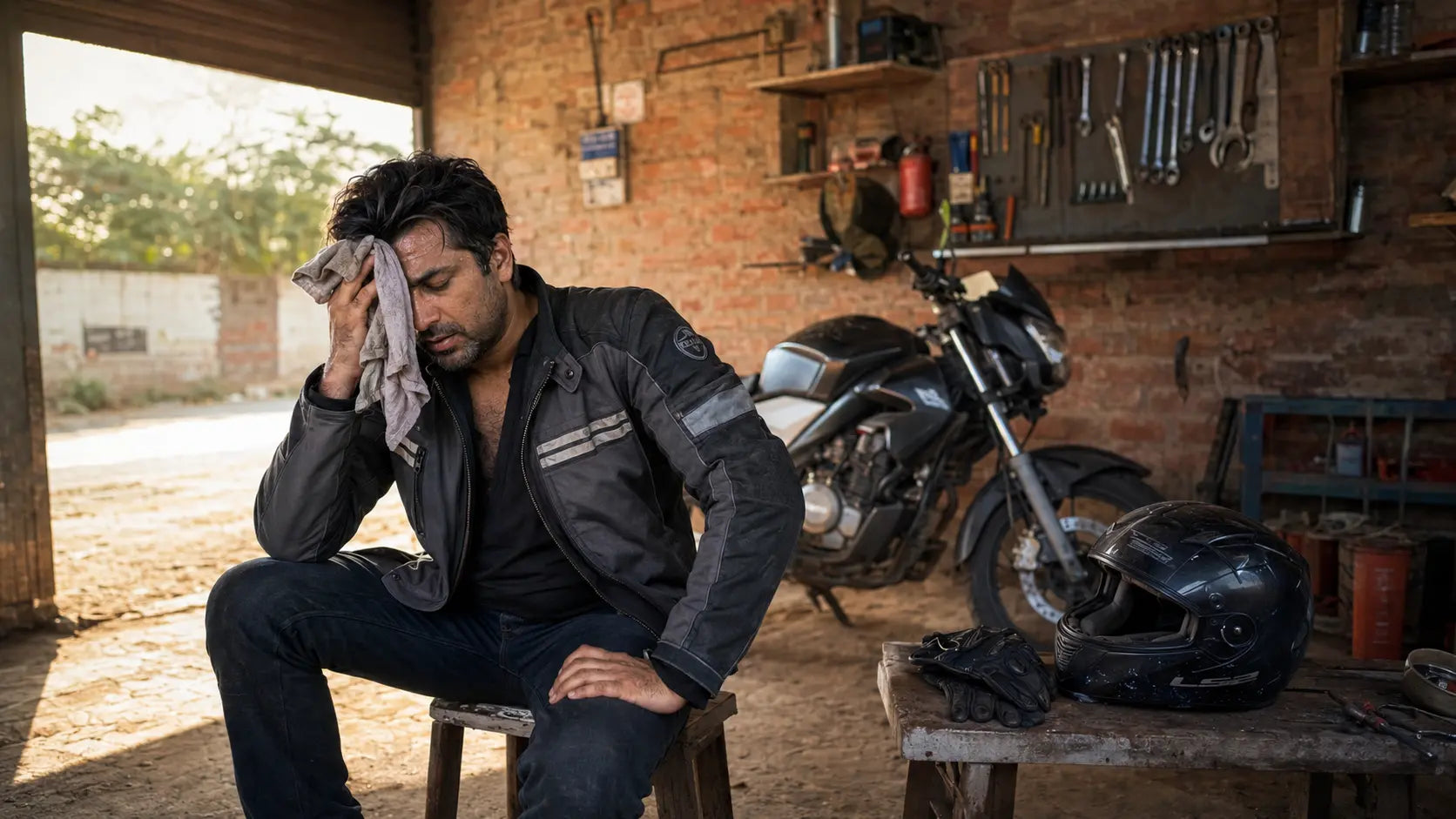
You shower, you use a decent face wash, you think you're sorted.
Then you ride two hours in summer traffic, pull off a sweaty helmet, and your forehead breaks out by the weekend. Most riders treat grooming like everyone else does. But you aren't everyone else. Your skin and scalp spend hours sealed inside hot gear, soaking in sweat and bacteria. This guide builds a real grooming routine for motorcycle riders, one that handles the stuff a normal bathroom shelf ignores.
Rider Takeaways
- A 2020 study of 130 helmets found Staphylococcus aureus made up 22.7% of the bacteria, and 33.7% of those were drug-resistant MRSA (International Journal of Microbiology).
- Sweat trapped under a helmet over-hydrates skin and narrows pores, which triggers breakouts along your hairline and forehead (PMC, 2020).
- A rider's routine needs three layers most people skip: pre-ride protection, post-ride cleanup, and gear hygiene, and the gear part is where Hygena fits.
What does a rider's grooming routine actually need?
It needs to cover what riding does to your body, not just daily wear. Riding seals your face and scalp inside hot gear for hours. That traps sweat, sun, dust, and bacteria against your skin. A normal grooming routine never accounts for any of that.
India's men's grooming market hit roughly ₹20,500 crore in 2024 (IBEF). Yet almost none of those products are built for a rider's specific problems. You're buying face wash made for an office worker, not someone in a helmet.
So what's different about a rider? Four things hit you that don't hit a desk job:
- Trapped sweat under your helmet and jacket, for the whole ride.
- Bacteria buildup inside helmet padding that touches your face.
- Sun and wind hitting exposed skin with no shade.
- Friction from straps and pads pressing on your forehead and jaw.
A good routine answers all four. Miss one, and it shows up on your skin within a week.
Quick Fact:
A motorcycle rider's grooming needs differ from the average person's because gear traps sweat, heat, and bacteria against the skin for hours. India's men's grooming market was worth around ₹20,500 crore in 2024, yet very few products target rider-specific issues like helmet acne and scalp odor. Source: IBEF
A motorcycle rider's grooming needs differ from the average person's because gear traps sweat, heat, and bacteria against the skin for hours. India's men's grooming market was worth around ₹20,500 crore in 2024, yet very few products target rider-specific issues like helmet acne and scalp odor. Source: IBEF
Why does riding damage your skin and scalp faster?
Because your helmet is a warm, sweaty box that bacteria love. In 2020, a study of 130 motorcycle helmets recovered 392 bacteria, with Staphylococcus aureus the most common at 22.7% (International Journal of Microbiology). That padding sits right against your forehead and cheeks.
The same study found 33.7% of the Staph aureus was MRSA, a drug-resistant strain. Nearly 39% of all the bacteria were multidrug-resistant. This isn't just smell. It's a real hygiene load pressing on your skin every ride.
Then there's the sweat problem. When sweat can't evaporate under your helmet, it over-hydrates your skin (PMC, 2020). Skin cells swell, pore openings narrow, and the pores clog. That's why breakouts show up along your hairline, forehead, and temples.
Unique Insight
Our take: Riders obsess over face wash and forget the helmet liner. But the liner is the dirtiest thing touching your face all day. You can scrub your skin perfectly, then press it straight back into a bacteria-loaded pad. Clean skin, dirty helmet — the breakout still wins.
How do you build a 5-minute pre-ride routine?
Your pre-ride routine is about protection, not cleaning. The goal is to put a barrier between your skin and the sweat, sun, and friction coming for the next few hours. It takes five minutes before you gear up.
Start clean and light. A heavy, oily face cream under a helmet just clogs pores faster. Use a lightweight, non-comedogenic moisturizer that won't block anything when you start sweating.
Here's the pre-ride order that works:
- Wash your face with a gentle cleanser, then pat dry.
- Apply a light moisturizer, non-comedogenic, so it won't clog pores.
- Sunscreen SPF 30+ on every exposed patch: face, neck, ears.
- Lip balm with SPF, because lips crack first in the wind.
- Fresh inner cap or balaclava to soak sweat before it hits the liner.
That last step is the one riders skip. A clean cotton inner layer keeps sweat off your helmet padding. Yeh chhoti si aadat saves you a lot of trouble later.

What should your after-ride routine include?
This is the half most riders ignore, and it's where the damage gets locked in. After-ride care has two jobs: clean your skin, and clean your gear. Skip the gear part, and tomorrow's ride undoes today's wash.
For your skin, keep it simple. Rinse off the sweat and dust as soon as you can. Sweat left on the skin keeps feeding bacteria and clogging pores long after you've parked.
For your gear, the helmet is priority one. Remember, that liner carries the Staph aureus and MRSA the 2020 study found. Letting it sit damp between rides just grows more of it. This is exactly where Hygena does its job.
A few sprays of Hygena inside the helmet after each ride targets the bacteria that cause odor, instead of masking it like a perfume. Its bacteriostatic formula stops bacteria from multiplying in the padding. Your helmet stays fresh for tomorrow, and your skin isn't pressed into a dirty pad.

How often should you do each grooming step?
Frequency is where routines fall apart, so keep it simple. Daily riders need the full pre-ride and post-ride steps every single day. Weekend riders can ease off on ride days they don't ride, but never skip gear care.
Skin steps are daily. Cleanse, moisturize, and protect before every ride, then rinse after. The helmet spray is also daily, because bacteria regrow fast in damp padding (International Journal of Microbiology, 2020).
Deep gear cleaning is weekly. Pull out the liner, wash it, and let it dry fully. Between those washes, the daily spray is what keeps the bacteria load down. Think of it like brushing versus a dentist visit, both matter.
Unique Insight
Our take: The reason rider grooming routines fail isn't laziness, it's that washing a helmet liner is a 40-minute job nobody does daily. A 5-second daily spray bridges the gap between weekly washes. That single habit is what makes the rest of the routine actually hold up.
Frequently Asked Questions
What's the most important step in a rider's grooming routine?
Helmet hygiene, because the liner touches your face every ride. A 2020 study found Staph aureus made up 22.7% of helmet bacteria, with a third of it drug-resistant (International Journal of Microbiology). Clean skin pressed into a dirty pad still breaks out, so the gear comes first.
Why do I break out only on my forehead and hairline?
That's helmet acne, also called acne mechanica. Sweat trapped under the helmet over-hydrates skin and narrows pores, which clogs them (PMC, 2020). The padding presses hardest on your forehead, temples, and hairline, so breakouts cluster exactly where the helmet sits.
Do I really need sunscreen if I ride with a full-face helmet?
Yes. Your neck, jaw, and the gap around the visor still catch direct sun for hours. UV exposure adds up over years of riding. A non-greasy SPF 30+ under the helmet protects skin without clogging pores when you sweat.
Can I just use perfume or deodorant inside my helmet?
No, that only masks the smell. Deodorants and sprays don't stop bacteria from multiplying in the padding. A bacteriostatic helmet spray targets the bacteria causing the odor, so it stays fresh instead of smelling like perfume over sweat.
Conclusion
A rider's grooming routine isn't your average bathroom shelf. Your skin and scalp spend hours sealed in sweat, bacteria, and sun, so your routine has to answer all three.
Cover the basics before you ride, rinse off after, and treat your helmet like part of your skin. The one habit that ties it together is a daily spray of Hygena inside the lid, the same way you'd never skip brushing. Build the routine once, and your skin stops paying for your rides.
Sources
1. "Microbial Diversity and Antibiotic Susceptibility Pattern of Bacteria Associated with Motorcycle Helmets," International Journal of Microbiology (Sapkota et al.), 2020. Link. Retrieved 2026-06-24.
2. "Diagnostic and Management Considerations for 'Maskne' in the Era of COVID-19," PMC, 2020. Link. Retrieved 2026-06-24.
3. "India's Men's Grooming Industry: Expanding Product Categories and Consumer Base," IBEF, 2024. Link. Retrieved 2026-06-24.
4. "Motorcycle Helmets as Potential Fomites in Transmission of Pathogenic Micro-organisms," Asian Journal of Biological and Life Sciences, 2022. Link. Retrieved 2026-06-24.
Share:
Why Riders Get Chapped Lips (And the Lip Balm Fix)
Riding to Work Every Day? How to Keep Your Gear Fresh