
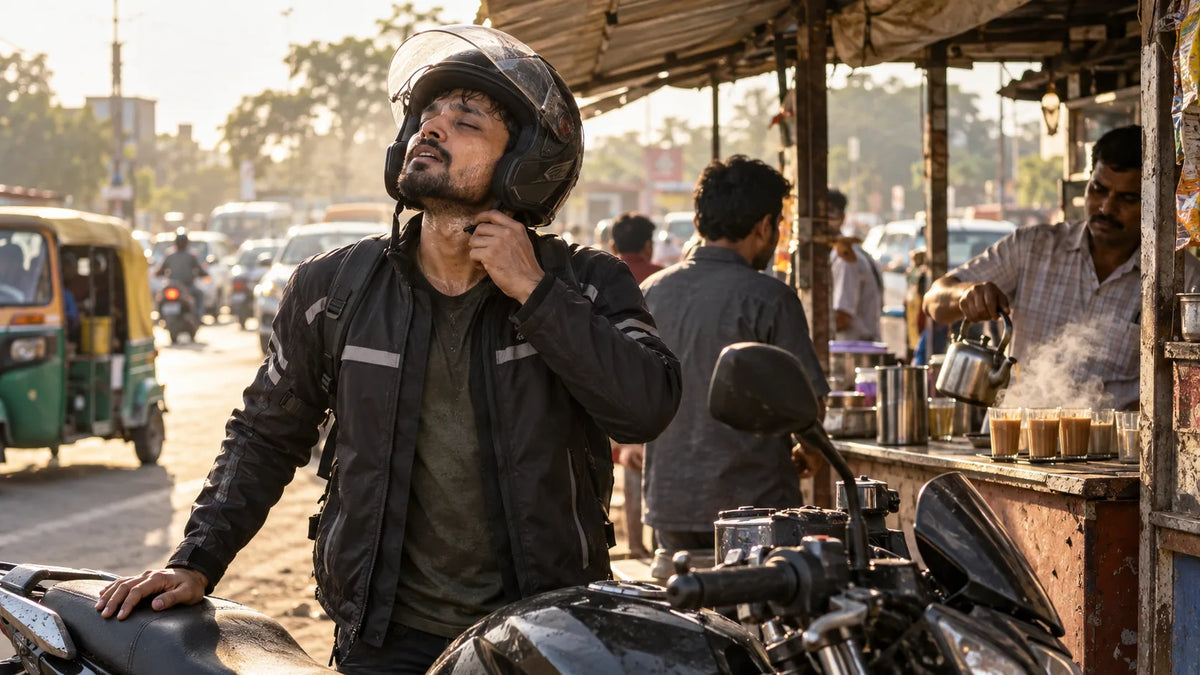
You're stopped at a Bhubaneswar junction, visor down, engine idling in a wall of two-wheelers. Ten years ago this commute took fifteen minutes. Now it's closer to fifty, and Bhubaneswar's humidity barely lets your helmet dry between rides.
That combination is why riders across the city keep noticing their helmet smelling worse than before. It isn't really about the sweat, though. It's about what grows in it. Here's what's happening inside your helmet on a Bhubaneswar commute, and what stops it.
Rider Takeaways
- Bhubaneswar's commute has stretched from around 15 to nearly 50 minutes, per Down To Earth (2025). That's more helmet time per ride.
- Humidity swings 60% to 85% year-round, so sweat rarely fully evaporates from your liner.
- The real cause of smell is Staphylococcus hominis bacteria feeding on sweat, not sweat itself.
- Festival crowds like Rath Yatra add stop-and-go stretches that make it worse.
Why Did Bhubaneswar's Commute Get So Much Sweatier?
Riders here aren't imagining it. Bhubaneswar's roads carry far more traffic than they were built for, trapping more heat and sweat under every helmet.
Quick Fact:
Annual vehicle registrations in Bhubaneswar rose from 25,543 in 2000-01 to 110,370 in 2019-20, and the city added over 2 million registered vehicles in the last decade alone, an 85% jump. Around 80% of those vehicles are two-wheelers. Source: Down To Earth, 2025
Annual vehicle registrations in Bhubaneswar rose from 25,543 in 2000-01 to 110,370 in 2019-20, and the city added over 2 million registered vehicles in the last decade alone, an 85% jump. Around 80% of those vehicles are two-wheelers. Source: Down To Earth, 2025
Road capacity hasn't kept pace. One commuter told Down To Earth their ride went from 15 minutes to about 50. That means more sweat soaked into the same foam pad, ride after ride.
Why Doesn't Your Helmet Ever Fully Dry Here?
Traffic is only half the problem. Bhubaneswar's air stays thick with moisture most of the year, so sweat rarely gets the chance to fully dry out.
Quick Fact:
Bhubaneswar's average relative humidity ranges from 60% in January, its driest month, to 85% in August, its most humid. The city also gets 1,628mm of rain a year, with July alone bringing 401mm. Source: Weather and Climate, historical averages
Bhubaneswar's average relative humidity ranges from 60% in January, its driest month, to 85% in August, its most humid. The city also gets 1,628mm of rain a year, with July alone bringing 401mm. Source: Weather and Climate, historical averages
Even January, the driest month, holds 60% humidity, enough to slow evaporation. During monsoon, this morning's liner is often still damp by evening.
Is It Really the Sweat, or the Bacteria in It?
Sweat itself doesn't smell. Bacteria feeding on it does, and damp foam padding is exactly where they thrive.
Quick Fact:
A 2025 study in the Indian Journal of Microbiology found Staphylococcus hominis abundance correlated strongly with odor intensity on sweat-soaked polyester fabric (r = 0.706), confirmed through qPCR testing. Source: Indian Journal of Microbiology, 2025
A 2025 study in the Indian Journal of Microbiology found Staphylococcus hominis abundance correlated strongly with odor intensity on sweat-soaked polyester fabric (r = 0.706), confirmed through qPCR testing. Source: Indian Journal of Microbiology, 2025
Unique Insight
Our finding: Bhubaneswar stacks both risk factors most cities get only one at a time — longer commutes add sweat, near-constant humidity keeps it there.
Researchers found this link held for single wear and for eight weeks of repeat wear alike. Your helmet needs no more than warmth and moisture to build the same bacteria.

How Do Bhubaneswar Riders Handle It Today?
Most riders here fall back on habits that don't solve the bacteria problem. They air the helmet out, spray perfume inside, or just accept the smell as part of city riding.
Quick Fact:
Bhubaneswar shuts down major stretches near CRP Square and the ISKCON Temple for the Rath Yatra, Bahuda Yatra, and Sunabesha processions each July, pushing thousands of two-wheelers onto slower detour routes for hours. Source: OdishaBytes, 2026
Bhubaneswar shuts down major stretches near CRP Square and the ISKCON Temple for the Rath Yatra, Bahuda Yatra, and Sunabesha processions each July, pushing thousands of two-wheelers onto slower detour routes for hours. Source: OdishaBytes, 2026
Festival season compounds it. Riders rerouted around Rath Yatra crowds spend even longer stuck in heat and humidity. The city's riding clubs, like Free Soul Riding Club and Bhubaneswar Biker's Club, still ride together. They cover the same traffic every year.
Unique Insight
Our finding: Bhubaneswar's traffic problem spikes hard around predictable festival dates, not just daily gridlock. Hygiene routines need to flex around those spikes too.
The Fix: Kill the Bacteria, Not Just the Smell
Airing out a helmet doesn't remove bacteria already in the foam. In Bhubaneswar's humidity, it barely dries the foam either.
Hygena's helmet deodorant spray is bacteriostatic. It stops odor-causing bacteria from multiplying instead of masking the smell on top. A few sprays after a sweaty commute or a Rath Yatra detour still work in Bhubaneswar's humid air. The formula targets bacteria directly, not evaporation.
A simple routine keeps it under control, even in this climate:
- Spray Hygena inside the shell after every sweaty ride, focusing on the foam liner.
- Let the helmet sit open for a few minutes before storing it, even if it stays humid outside.
- Add one extra spray after monsoon rides or a Rath Yatra detour, when the liner stays damp longer.

Frequently Asked Questions
Does Bhubaneswar's humidity make helmet smell worse than in drier cities?
Yes. At 60-85% relative humidity year-round, sweat evaporates far more slowly here than in drier cities. That gives odor-causing bacteria more time to multiply. Source: Weather and Climate, historical averages.
Why does my Bhubaneswar commute feel sweatier than it used to?
Commute times in the city have stretched from roughly 15 to 50 minutes as vehicles grew 85% in a decade. That means more time sweating under your helmet each ride. Source: Down To Earth, 2025.
Does riding through Rath Yatra traffic make helmet hygiene worse?
Yes. Detour routes around the CRP Square and ISKCON Temple closures add hours of slow, hot riding. That means more sweat and bacterial growth than a normal day. Source: OdishaBytes, 2026.
Where can I buy helmet deodorant spray in Bhubaneswar?
Hygena ships pan-India from hygena.in and is also on Amazon and Flipkart. Bhubaneswar riders can order online without a local store visit.
Conclusion
Bhubaneswar riders deal with two problems most cities don't face together. Commutes keep getting longer, and humidity never lets a helmet dry.
That dampness feeds bacteria, and bacteria is what actually causes the smell, not sweat itself. Spraying Hygena's bacteriostatic helmet deodorant after rides stops that growth at the source. Explore Hygena's full range at hygena.in and read more in our journal.
Sources
1. "How India moves: Planned Bhubaneswar is growing in an unplanned fashion," Down To Earth, 2025. Retrieved 2026-09-10.
2. "Bhubaneswar Humidity by Month," Weather and Climate. Retrieved 2026-09-10.
3. "Bhubaneswar Climate," Climate-Data.org. Retrieved 2026-09-10.
4. "Association of Staphylococcus hominis and Odor Production on Sweaty Polyester Sportswear," Indian Journal of Microbiology, 2025. Retrieved 2026-09-10.
5. "Traffic Restrictions In Bhubaneswar For ISKCON's Rath Yatra, Bahuda Yatra & Sunabesha," OdishaBytes, 2026. Retrieved 2026-09-10.
Share:
Helmet Padding Cleaning Guide: Step-by-Step
Helmet Cleaner Jabalpur: Dry Heat to Monsoon Humidity