
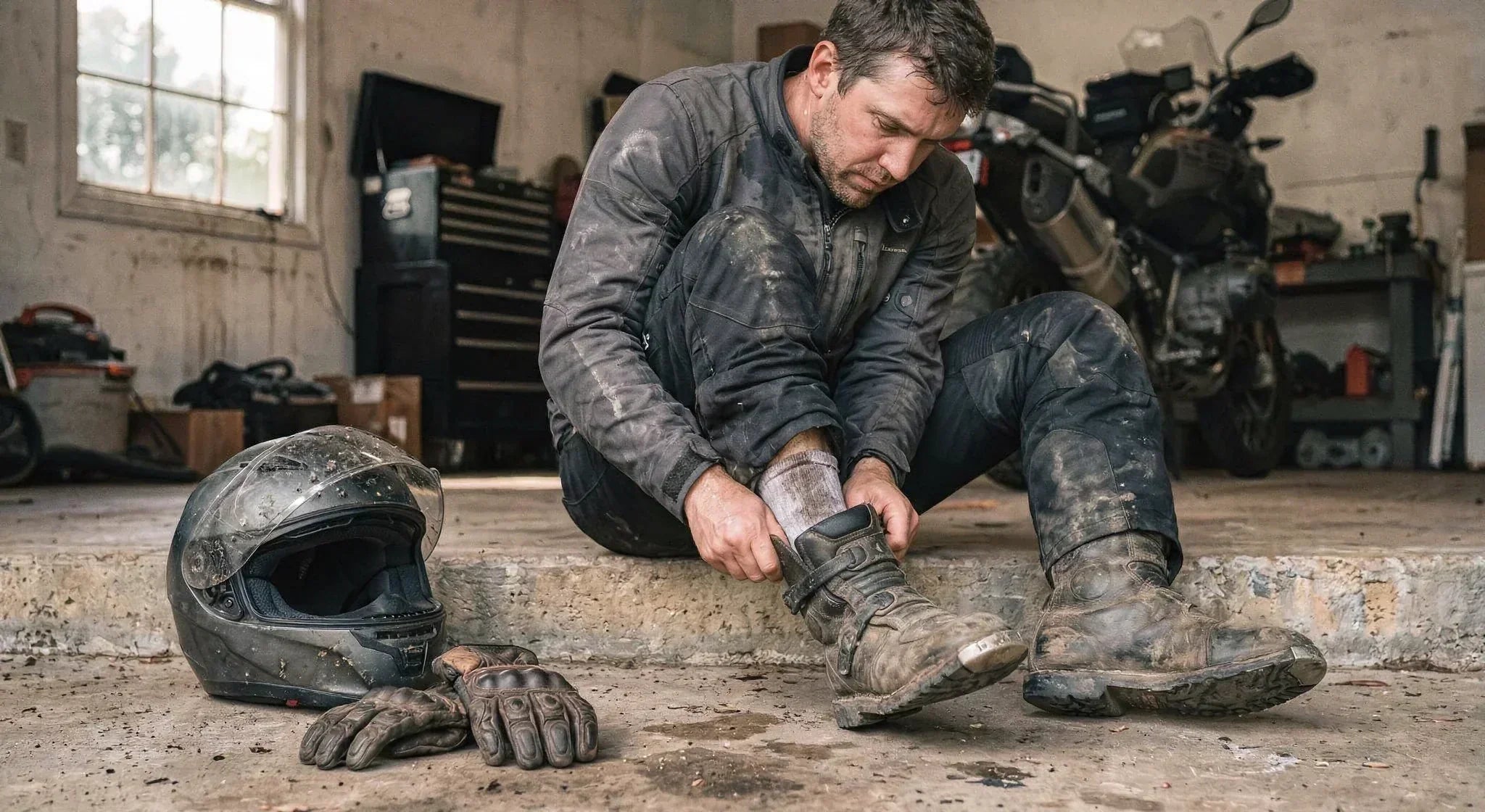
Pull off your boots after a long ride, and the whole room knows.
That sour, locked-in stink isn't just sweat. It's bacteria that have fed inside your boots all day, ride after ride. Most riders reach for perfume, talcum, or just leave the boots by the door. Nothing sticks. The smell always comes back stronger.
This guide covers what really causes the smell, how motorcycle boot odor removal actually works, and how to stop it returning. The fix takes minutes, not a weekend.
Rider Takeaways
- Each foot has over 250,000 sweat glands and feet can host up to 10 million microbes per cm² (The Conversation, 2025), and boots trap both.
- Odor is a bacteria problem, not a sweat problem. Masking sprays don't touch the cause.
- Dry your boots fully and kill the bacteria. That combination removes the smell and keeps it gone.
Why Do Your Motorcycle Boots Smell So Bad?
Your feet are sweat factories. The Cleveland Clinic reports each foot carries over 250,000 sweat glands, pumping out close to half a pint of sweat a day. Seal that inside a riding boot for hours, and you've built the perfect home for odor.
Here's the part most riders miss. Sweat itself is nearly odorless. The smell starts when bacteria living on your skin start eating it. Warm, dark, damp boots let those bacteria multiply fast.
And there are a lot of them. Writing in 2025, researchers at The Conversation noted feet can host up to 1,000 microbial species and 10 million cells per square centimetre. Your boots carry that whole crowd home with you.

Quick Fact:
The average human foot has more than 250,000 sweat glands and can produce roughly half a pint of sweat per day. Inside a closed riding boot, that moisture has nowhere to escape, creating the warm, damp conditions bacteria need to multiply and produce odor. Source: Cleveland Clinic.
The average human foot has more than 250,000 sweat glands and can produce roughly half a pint of sweat per day. Inside a closed riding boot, that moisture has nowhere to escape, creating the warm, damp conditions bacteria need to multiply and produce odor. Source: Cleveland Clinic.
Sweat Isn't the Real Problem. Bacteria Is.
In a 2006 study indexed on PubMed, scientists traced foot odor directly to microbial metabolism, not sweat. Two bacteria do most of the damage. Get rid of them, and the smell goes with them.
The first is Brevibacterium. It feeds on dead skin and turns the amino acid methionine into methanethiol, a sulfur compound with a cheesy, sharp reek. The second is Staphylococcus epidermidis, which breaks down leucine in sweat into isovaleric acid, the source of that classic sour-sock stench.
A 2015 paper in FEMS Microbiology Ecology confirmed the worst-smelling compounds cluster on the sole of the foot. That's exactly where your boot footbed sits all day. No airflow, plenty of fuel.
Unique Insight
Our finding: Riders treat boot smell like helmet smell: spray something nice on top and hope. But perfume sits over the bacteria, not on them. The colony keeps eating, keeps producing acid, and the cover-up fades within an hour. You're not removing odor, you're delaying it.
How to Remove Motorcycle Boot Odor Fast
The fix works in two moves: dry the boots completely, then kill the bacteria. A 2019 study in PMC found footwear with high internal humidity carries a much higher risk of foot problems. Moisture is the enabler, so it goes first.
Start same-day. Pull out the insoles and let them air separately. Stuff each boot loosely with newspaper or a dry cloth to pull moisture from the lining overnight. Don't park wet boots in a closed cupboard, that's where it festers.
Once dry, attack the bacteria. Wipe the interior with a cloth dampened in a diluted antibacterial solution, then let it dry again. For a faster reset, an antibacterial spray on the lining and footbed cuts the colony without soaking the boot.
Baking soda overnight helps absorb leftover moisture and mild odor. Tip it out before your next ride. It's a decent stopgap, but on its own it only manages the smell, it doesn't end it.
How Do You Stop Boot Odor From Coming Back?
Removing the smell once is easy. Keeping it gone is the real win. The aim is simple: never let bacteria build a colony again. That means controlling moisture daily and treating the boot, not just your feet.
Rotate your boots if you can. Riding the same pair every day never gives the lining time to dry. Swap insoles for moisture-wicking ones, and wear clean, breathable socks. Wash your feet before long rides, not just after.
The piece riders skip is the bacteriostatic step. A spray that inhibits bacterial growth keeps the colony from rebuilding between rides. That's the difference between a cover-up and a fix, and it's the exact idea Hygena was built on.
We made our bacteriostatic spray for helmet liners on one principle: kill the bacteria, don't mask the smell. The same logic works on any sweaty rider gear that traps heat and moisture. Treat the cause, and the stink has nothing to come back from.
Quick Fact:
Masking sprays add fragrance over odor-causing bacteria but leave the colony alive, so the smell returns within hours. A bacteriostatic formula inhibits bacterial growth at the source, which is why prevention outlasts perfume. Source: Foot odor due to microbial metabolism, PubMed (2006).
Masking sprays add fragrance over odor-causing bacteria but leave the colony alive, so the smell returns within hours. A bacteriostatic formula inhibits bacterial growth at the source, which is why prevention outlasts perfume. Source: Foot odor due to microbial metabolism, PubMed (2006).

Can Smelly Motorcycle Boots Actually Harm Your Feet?
Yes, and the smell is the early warning. The same warm, damp boot that grows odor bacteria also breeds fungus. The Mayo Clinic notes athlete's foot thrives in enclosed footwear that traps moisture, and an estimated 70% of people deal with it at some point.
For Indian riders, the risk runs higher. Garmi aur humidity dono milke fungus ke liye perfect setup banate hain. Researchers in the Indian Journal of Dermatology, Venereology and Leprology describe an epidemic-like rise in fungal skin infections across the country, linked to heat, sweat and closed footwear.
So that lingering boot smell isn't only embarrassing. It's a sign the conditions for itching, peeling and infection are already there. Fixing the odor and the moisture protects your feet, not just your nose.
Frequently Asked Questions
How do I get the smell out of motorcycle boots fast?
Dry them fully first, then kill the bacteria. Remove insoles, stuff with newspaper overnight, then wipe or spray the lining with an antibacterial solution. A 2006 PubMed study confirms bacteria, not sweat, cause the smell, so drying alone isn't enough.
Why do my boots smell even after I clean them?
Because cleaning removes dirt, not the bacteria deep in the lining. A 2015 FEMS Microbiology Ecology study found odor microbes concentrate on the footbed. If you don't treat that layer and dry it fully, the colony rebuilds within days.
Does spraying perfume or deodorant work on boots?
Only for an hour or two. Fragrance masks odor but leaves the bacteria alive to keep producing acid compounds. As 2006 PubMed research shows, the smell is microbial, so a bacteriostatic spray that inhibits growth lasts far longer than perfume.
Can stinky boots cause foot infections?
They share the same cause. The Mayo Clinic notes athlete's foot thrives in warm, damp, enclosed footwear, and an estimated 70% of people get it eventually. Persistent boot odor signals the exact moisture conditions fungus needs to grow.
Conclusion
Smelly motorcycle boots aren't a sweat problem, they're a bacteria problem hiding in a damp footbed.
The fix is the same one Hygena built for helmets: dry the gear, then stop the bacteria from coming back. Skip the perfume, treat the cause, and your boots stay fresh ride after ride. Your feet, and everyone near your door, will thank you.
Sources
1. "7 Reasons Why Your Feet Smell Bad," Cleveland Clinic, 2023. Retrieved 2026-06-14.
2. "The dirty truth about what's in your socks," The Conversation, 2025. Retrieved 2026-06-14.
3. "Foot odor due to microbial metabolism and its control," PubMed, 2006. Retrieved 2026-06-14.
4. "Spatial variations in the microbial community structure of the human foot," FEMS Microbiology Ecology, 2015. Retrieved 2026-06-14.
5. "Internal environment of footwear is a risk factor for tinea pedis," PMC, 2019. Retrieved 2026-06-14.
6. "Athlete's foot — Symptoms and causes," Mayo Clinic, 2024. Retrieved 2026-06-14.
7. "The unprecedented epidemic-like scenario of dermatophytosis in India," Indian Journal of Dermatology, Venereology and Leprology. Retrieved 2026-06-14.
Share:
Helmet Acne on a Long Bike Trip? How to Stop It
Motorcycle Packing List for Long-Distance Touring