
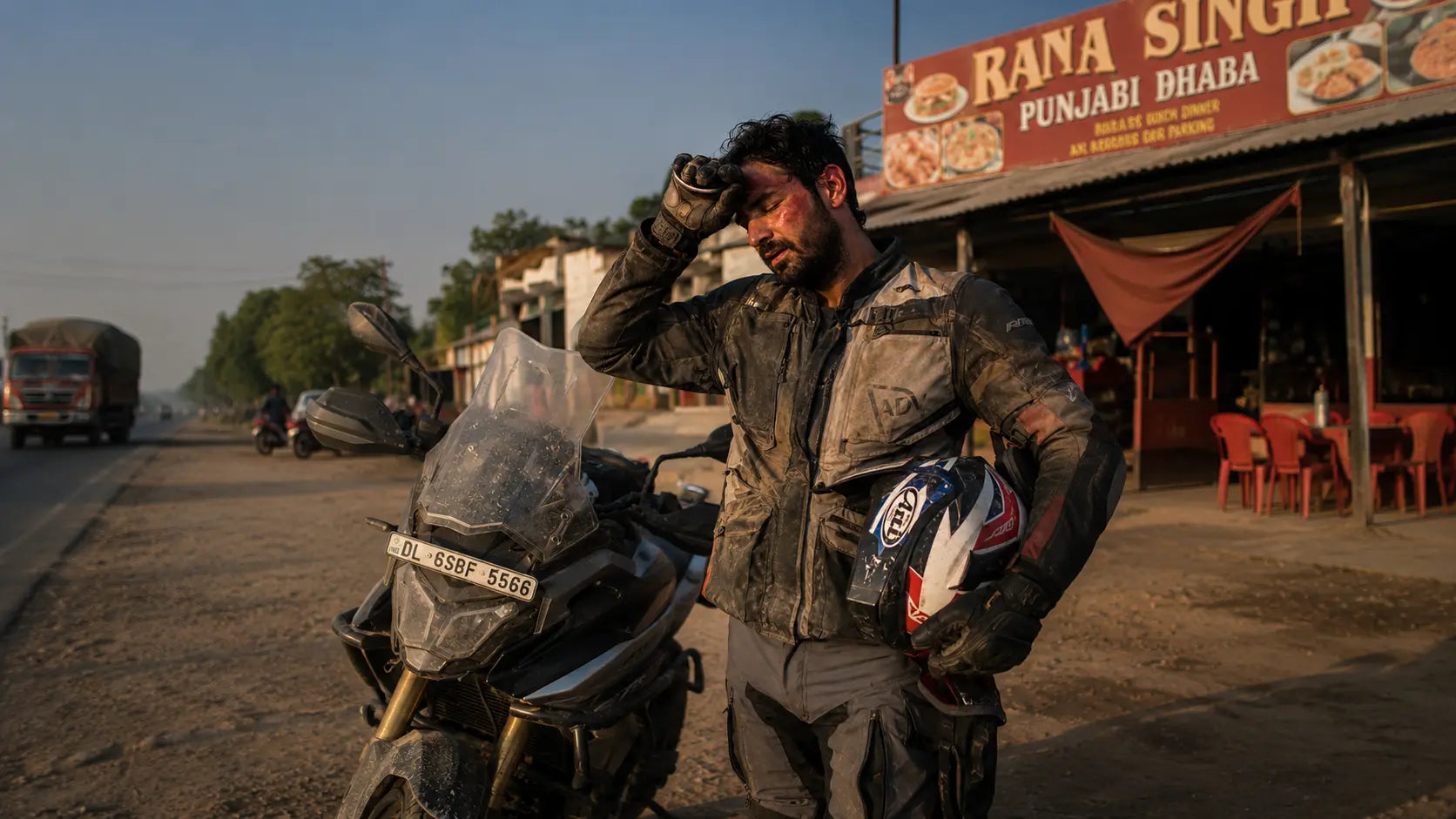
Day three of your Leh run, and your forehead is a minefield. Red bumps along the hairline. A sore patch where the strap sits. You didn't change your face wash, so what gives?
That's helmet acne, and a long bike trip is the perfect storm for it. Heat, sweat, friction, and a liner full of bacteria all press into the same skin for hours. The good news? You can calm it down without ending your ride.
Here's what's actually happening on your skin, and the road-tested playbook to clear it.

Rider Takeaways
- Helmet acne is acne mechanica, caused by pressure, friction, heat, and trapped sweat. Not poor face washing.
- A 2020 study found Staphylococcus aureus was the most common bacteria on motorcycle helmets, so your liner feeds the problem.
- On the road, the fix is simple: cleanse at stops, don't pick, use a thin barrier, and keep your helmet interior bacteria-free.
What Causes Helmet Acne on a Long Bike Trip?
Helmet acne is a type of breakout dermatologists call acne mechanica. It comes from physical stress on the skin: pressure, friction, heat, and occlusion. Not your usual acne triggers.
On a long ride, all four hit at once. Your helmet padding presses on your forehead. Sweat has nowhere to evaporate. The liner rubs with every bump. Pores clog, then inflame.
It's the same condition that gives footballers "chin strap acne." For us, it lands on the forehead, temples, and jawline, wherever the helmet touches.
Quick Fact:
Acne mechanica is a papulopustular eruption caused by pressure, occlusion, friction, and heat acting on the skin, alone or together. Unlike regular acne, it clears once the mechanical trigger is removed, which is why riders often break out only on tour. Source: Dermatology Times.
Acne mechanica is a papulopustular eruption caused by pressure, occlusion, friction, and heat acting on the skin, alone or together. Unlike regular acne, it clears once the mechanical trigger is removed, which is why riders often break out only on tour. Source: Dermatology Times.
India makes it worse. Summer riding means 35–40°C heat and humidity that can sit at 70–90%. Sweat just won't dry inside a closed helmet. Your skin stays wet, warm, and rubbed raw for hours.
Why Does It Get Worse the Longer You Ride?
Because the trigger never lets up. On a weekend ride, your skin recovers overnight. On a multi-day tour, it doesn't get the chance.
Then there's your liner. In 2020, a study of 130 motorcycle helmets recovered 392 bacterial isolates, with Staphylococcus aureus the most common at 22.7%. Sapkota et al., International Journal of Microbiology. That bacteria sits millimetres from your pores.
Each day you ride, sweat feeds that colony. The liner gets damper, the bacteria multiply, and your skin meets a dirtier surface every morning. Day one feels fine. Day four feels like sandpaper.
Unique Insight
Our finding: Most riders treat tour breakouts as a face-wash problem and pack more cleanser. But the dirtiest surface on the trip isn't your skin. It's the liner you put back on every morning. Clean skin against a dirty helmet still breaks out.
How Do You Treat Helmet Acne Mid-Trip?
You don't need a dermatologist at the next petrol pump. You need three habits at every long stop: cleanse, calm, and protect. They take five minutes.
First, cleanse. Wipe the sweat off with a gentle, fragrance-free face wash or a few non-comedogenic wipes. Sweat left on the skin keeps feeding bacteria.
Second, calm the active spots. A thin dab of benzoyl peroxide kills acne bacteria and clears clogged pores. Dermatologists recommend it as a first-line treatment for acne mechanica.
Third, protect the skin from the strap. A light, oil-free moisturiser reduces friction. And please, don't pick. Squeezing a bump under a helmet invites infection and scarring.

Quick Fact:
Benzoyl peroxide is a topical that kills acne-causing bacteria, unclogs pores, and reduces inflammation. For sports- and helmet-related acne mechanica, dermatologists pair it with washing the skin soon after the gear comes off. Source: U.S. Dermatology Partners.
Benzoyl peroxide is a topical that kills acne-causing bacteria, unclogs pores, and reduces inflammation. For sports- and helmet-related acne mechanica, dermatologists pair it with washing the skin soon after the gear comes off. Source: U.S. Dermatology Partners.
What Should You Pack to Stop Breakouts on Tour?
Prevention beats treatment, and it fits in a tank bag. The goal is to break the friction-sweat-bacteria loop before it starts.
A cotton skull cap or moisture-wicking balaclava is the single best move. It puts a clean, washable layer between your skin and the liner. Dermatologists suggest the same trick for athletes: a cotton barrier under the gear.
Pack non-comedogenic wipes, a travel face wash, spot treatment, and an oil-free sunscreen. Skip heavy, pore-clogging creams. They trap more under a closed helmet.
But here's the part most riders miss. You can do everything right on your face and still break out, because the helmet itself keeps reloading bacteria onto clean skin.
That's where Hygena fits. A few sprays inside the liner inhibits the bacteria that build up between washes, so the surface against your forehead stays cleaner tomorrow. It's the prevention step you can't do with a face wash — and it takes five seconds at a chai stop.

How Often Should You Clean Your Helmet on a Multi-Day Ride?
You can't deep-wash a liner on the road. But you can keep the bacteria down daily, and that's what matters for your skin.
Each night, pull the helmet's padding out if it's removable and let it air dry. In Indian humidity, that's the difference between a damp liner and a dry one by morning.
Treat the interior between stops, not just at the end of the trip. A bacteriostatic spray keeps the colony from doubling overnight. Think of it like brushing your teeth — small, daily, non-negotiable.
Frequently Asked Questions
Is helmet acne the same as normal acne?
No. Helmet acne is acne mechanica, driven by pressure, friction, heat, and trapped sweat rather than hormones or diet. It usually clears once the mechanical trigger is removed, which is why many riders only break out on long tours. Source: Dermatology Times, 2014.
Can a dirty helmet cause forehead acne?
Yes. A 2020 study of 130 helmets found 392 bacterial isolates, led by Staphylococcus aureus at 22.7%. That bacteria transfers to sweaty, friction-stressed skin, clogging and inflaming pores along the hairline and temples. Source: Sapkota et al., 2020.
Should I pop helmet acne on a trip?
Never. Squeezing a bump that sits under a tight helmet pushes bacteria deeper and risks infection and scarring. Spot-treat with benzoyl peroxide, keep your hands off, and let it settle while you protect the area from friction. Source: U.S. Dermatology Partners.
Does India's heat make helmet acne worse?
It does. Summer riding brings 35–40°C heat and humidity near 70–90%, so sweat can't evaporate inside a closed helmet. Skin stays wet and warm for hours, which speeds up both bacterial growth and acne mechanica. Source: rider hygiene field reports, 2026.
Conclusion
Helmet acne on a long bike trip isn't bad luck or bad skin. It's friction and bacteria meeting sweat, hour after hour, on the same patch of forehead.
Treat your skin at every stop, pack a cotton barrier, and keep the inside of your helmet clean. That last step is the one most riders skip. A few sprays of Hygena keeps the liner bacteria-free for tomorrow's ride, so your skin meets a fresh surface, not a fed colony. Ride longer, break out less.
Sources
1. "Acne mechanica caused by skin on skin friction," Dermatology Times, 2014. Retrieved 2026-06-16.
2. "Microbial Diversity and Antibiotic Susceptibility Pattern of Bacteria Associated with Motorcycle Helmets," Sapkota et al., International Journal of Microbiology, 2020. Retrieved 2026-06-16.
3. "Acne from Sports Helmets: Skincare Tips for Athletes," U.S. Dermatology Partners, 2023. Retrieved 2026-06-16.
4. "Head sweat rate prediction for thermal comfort assessment of bicycle helmets," NCBI/PMC, 2015. Retrieved 2026-06-16.
Share:
Helmet Cleaner Prayagraj: Why Spray Alone Won't Cut It
Smelly Motorcycle Boots? Here's How to Fix It Fast