
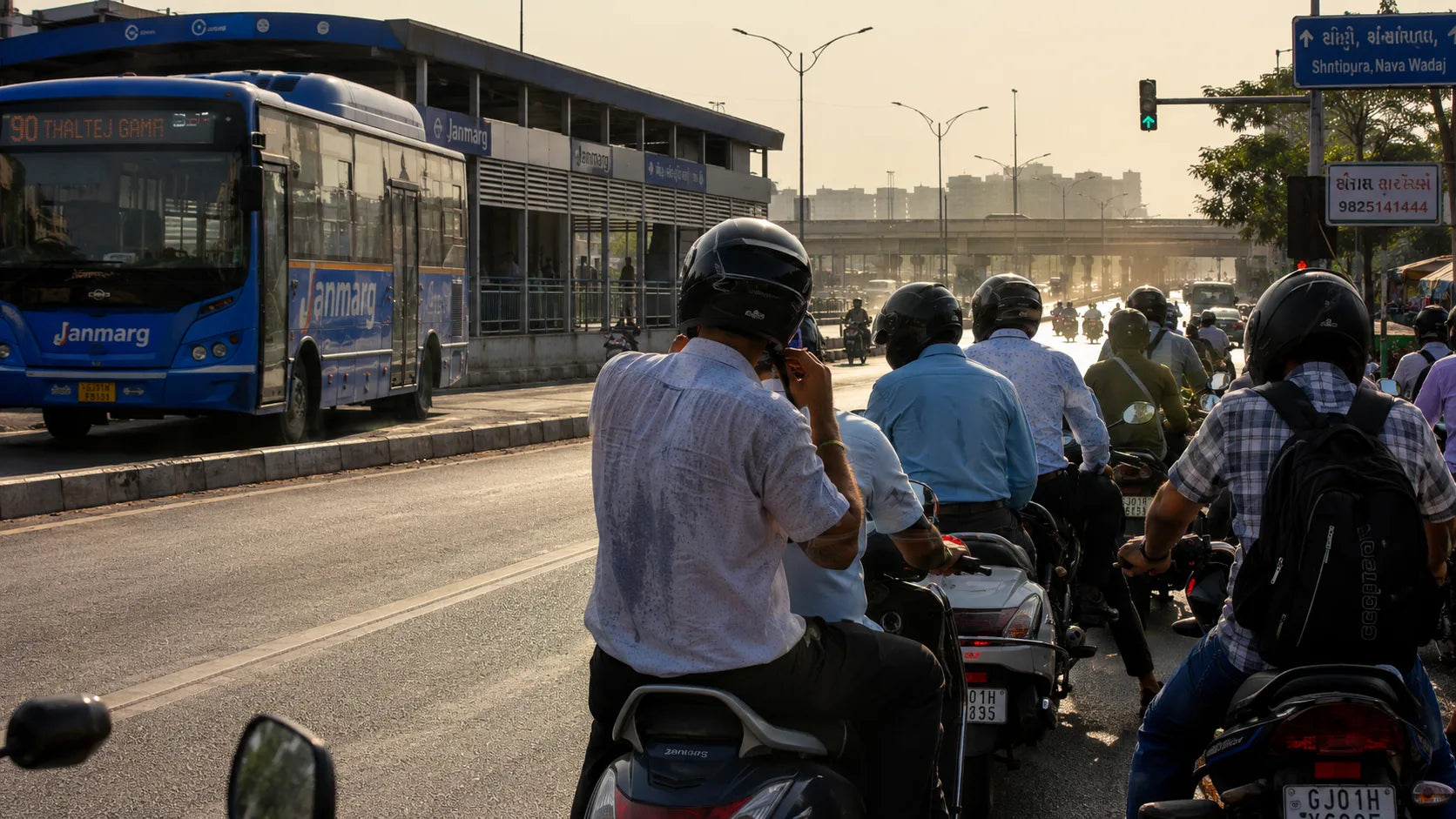
You're stuck at the Iskcon signal, engine idling, helmet sealed shut for 35 minutes while the sun bakes the asphalt. By the time you park at Prahlad Nagar, your helmet already smells like it hasn't seen daylight in a week.
That's not bad luck. Ahmedabad riders spend more time trapped inside their helmets than almost any other Indian city, and the heat makes it worse. This article breaks down why, using the city's own traffic and climate data, and what actually stops the smell.
Rider Takeaways
- Ahmedabad riders lost 106 hours to traffic in 2025, with evening commutes crawling at 17.3 km/h (TomTom Traffic Index 2025).
- Two-wheelers make up 75% of Ahmedabad's 3.9 million registered vehicles, nearly one for every two residents (CEPT University / Down To Earth, 2025).
- Humidity swings from 37% to 81% across the year, and a 2025 study links Staphylococcus hominis directly to sweat odor intensity (Indian Journal of Microbiology, 2025).
- Bacteriostatic sprays prevent bacterial growth between rides, a different mechanism from simply masking smell after it's already there.
Why Ahmedabad's Traffic Turns Every Commute Into a Helmet Sauna
Ahmedabad riders lost 106 hours to congestion in 2025, over four full days sealed inside a helmet just idling in traffic. Evening rush hour averages 17.3 km/h, meaning a 10 km ride takes nearly 35 minutes at a crawl (TomTom Traffic Index, 2025).
Quick Fact:
Ahmedabad's average congestion level hit 49% across 2025, with evening peaks touching 77%. On the worst day of the year, June 25, congestion crossed 67% citywide. Source: TomTom Traffic Index 2025
Ahmedabad's average congestion level hit 49% across 2025, with evening peaks touching 77%. On the worst day of the year, June 25, congestion crossed 67% citywide. Source: TomTom Traffic Index 2025
Idling in stop-start traffic means no airflow through the vents, no breeze to dry sweat, just body heat trapped against the padding. Every extra minute at a red light is a minute bacteria have to multiply undisturbed.
This isn't a one-off bad commute either. Two-wheelers make up 75% of Ahmedabad's 3.9 million registered vehicles, up from 2.38 million in 2009-10, a 65% jump in little over a decade (CEPT University study, via Down To Earth, 2025). More riders, more congestion, longer helmet-on time for everyone.
Why does everyone ride instead of taking the bus? A CEPT University study found 67% of Ahmedabad's public transport users have to switch modes mid-journey because of poor last-mile connectivity, even with the Janmarg BRTS corridor running since 2009. Two-wheelers fill that gap.
Does Ahmedabad's Heat and Humidity Really Make Helmet Smell Worse?
Yes. Ahmedabad's relative humidity swings from a dry 37% in March to a sticky 81% in August, while summer highs regularly touch 42°C in May (Weather and Climate, 1991-2020 data). That combination, sweat plus trapped humidity, is exactly what bacteria need to thrive.
Quick Fact:
Ahmedabad's humidity climbs 44 points between its driest and wettest months, and summer daytime highs average 41°C from March through June. Source: Weather and Climate, 1991-2020
Ahmedabad's humidity climbs 44 points between its driest and wettest months, and summer daytime highs average 41°C from March through June. Source: Weather and Climate, 1991-2020
A dry March morning ride and a monsoon-soaked August evening create very different conditions inside a helmet, but both end the same way. Sweat has nowhere to evaporate, and it soaks straight into the foam padding.
What's Actually Growing Inside Your Helmet
A 2025 study in the Indian Journal of Microbiology sequenced bacteria on sweat-soaked polyester fabric and found something specific: Staphylococcus hominis abundance correlated directly with how strong the odor smelled, confirmed through genetic testing (r = 0.706).
Unique Insight
Our finding: helmet padding behaves like the polyester fabric in that 2025 study, not like skin. It holds onto sweat and the bacteria feeding on it long after your ride ends, which is why a helmet can smell worse the next morning than it did when you took it off.
Airing out a wet helmet slows evaporation, but it doesn't kill the bacteria already colonizing the foam. That's the gap Hygena's bacteriostatic formula is built to close: it stops the bacteria from multiplying in the first place, rather than masking the smell they've already produced.
Tea tree extract and other natural antimicrobials in the formula work on contact. A few sprays after a ride, and the bacterial colony that would otherwise build up overnight simply doesn't get the chance.
How Ahmedabad Riders Handle Uttarayan Season Right Now
Every January, Ahmedabad's skies fill with kites for Uttarayan, and riders on two-wheelers face a real hazard: glass-coated manja strings cutting across roads at neck height. In 2025, four people died across Gujarat from kite-string injuries, including a child riding pillion on a motorcycle in Panchmahal.
Quick Fact:
GVK EMRI's 108 ambulance service logged 3,707 emergency calls across Gujarat by 6 PM on Uttarayan 2025, up from 3,362 the previous year, many linked to kite-string injuries and rooftop falls. Source: The Live Ahmedabad, 2025
GVK EMRI's 108 ambulance service logged 3,707 emergency calls across Gujarat by 6 PM on Uttarayan 2025, up from 3,362 the previous year, many linked to kite-string injuries and rooftop falls. Source: The Live Ahmedabad, 2025
To stay safe, riders wrap buffs and neck guards around their throats every January, layering fabric over the exact area a helmet already seals against the neck. That extra layer traps even more sweat right where bacteria already thrive.
Unique Insight
Our finding: Uttarayan season stacks two heat-and-sweat problems on top of each other: the buff under the chin strap and the padding above it. Riders who spray both, not just the helmet interior, cut down on the double odor buildup this season creates.

The Fix That Actually Survives an Ahmedabad Commute
Between four-day-a-year traffic delays and an 81% August humidity peak, an Ahmedabad rider's helmet needs more than the occasional wipe-down. Hygena's bacteriostatic spray is built to work between rides, not just after the smell has already set in.
Spray the interior padding and any buff or neck guard after a ride, let it sit for a minute, and the antimicrobial action gets to work before you're back in traffic tomorrow. It's dermatologically tested and trusted by over 10,000 riders across India, with a 4.8-star rating.
This isn't about masking the smell of a 35-minute crawl through Iskcon signal. It's about stopping the bacteria that cause it, so the next ride doesn't start with regret the second you put the helmet on.

Frequently Asked Questions
Does Ahmedabad's summer heat make helmet smell worse than other cities?
Yes. Ahmedabad's summer highs average 41°C from March to June, and that heat speeds up sweat production and bacterial growth inside a sealed helmet (Weather and Climate, 1991-2020). Riders in cooler cities have more breathing room between rides.
Where can I buy helmet deodorant spray in Ahmedabad?
Hygena's helmet deodorant spray ships across Ahmedabad through hygena.in, with delivery typically reaching riders within a few days regardless of neighborhood.
How often should Ahmedabad commuters clean their helmet given the traffic?
If you're spending an hour or more daily in traffic like most Ahmedabad riders, spray the interior after every 2-3 rides, and always after a heavy sweat day or monsoon soak.
Should I spray my neck buff during Uttarayan season too?
Yes. A buff worn under a helmet traps sweat the same way padding does. Spraying both during kite season keeps the added layer from becoming a second odor source.
Is helmet deodorant spray safe for daily use?
Hygena's formula is dermatologically tested for daily use and designed specifically for skin contact through helmet padding, unlike general fabric fresheners.
Conclusion
Ahmedabad's mix of brutal traffic, swinging humidity, and months of near-40°C heat means helmets here work harder than in most Indian cities. That's not a reason to give up on hygiene. It's the reason it matters more.
A bacteriostatic spray tackles the actual cause, not just the symptom, whether you're stuck at Iskcon signal or wrapping a buff for Uttarayan season. Grab Hygena's helmet deodorant spray at hygena.in and give your commute one less thing to dread.
Sources
1. "Ahmedabad traffic report," TomTom Traffic Index, 2025. Retrieved 2026-08-06.
2. "How India moves: In Ahmedabad, every second person owns a vehicle," Down To Earth, 2025. Retrieved 2026-08-06.
3. "Ahmedabad Weather by Month," Weather and Climate, 1991-2020 averages. Retrieved 2026-08-06.
4. "Association of Staphylococcus_hominis and Odor Production on Sweaty Polyester Sportswear," Indian Journal of Microbiology, 2025.
5. "6 persons died across Gujarat on Uttarayan; 4 due to kite string injuries," The Live Ahmedabad, 2025. Retrieved 2026-08-06.
Share:
Helmet Cleaner Warangal: What 5 Lakh Vehicles Miss
Helmet Cleaning Spray Delhi: What Actually Works