
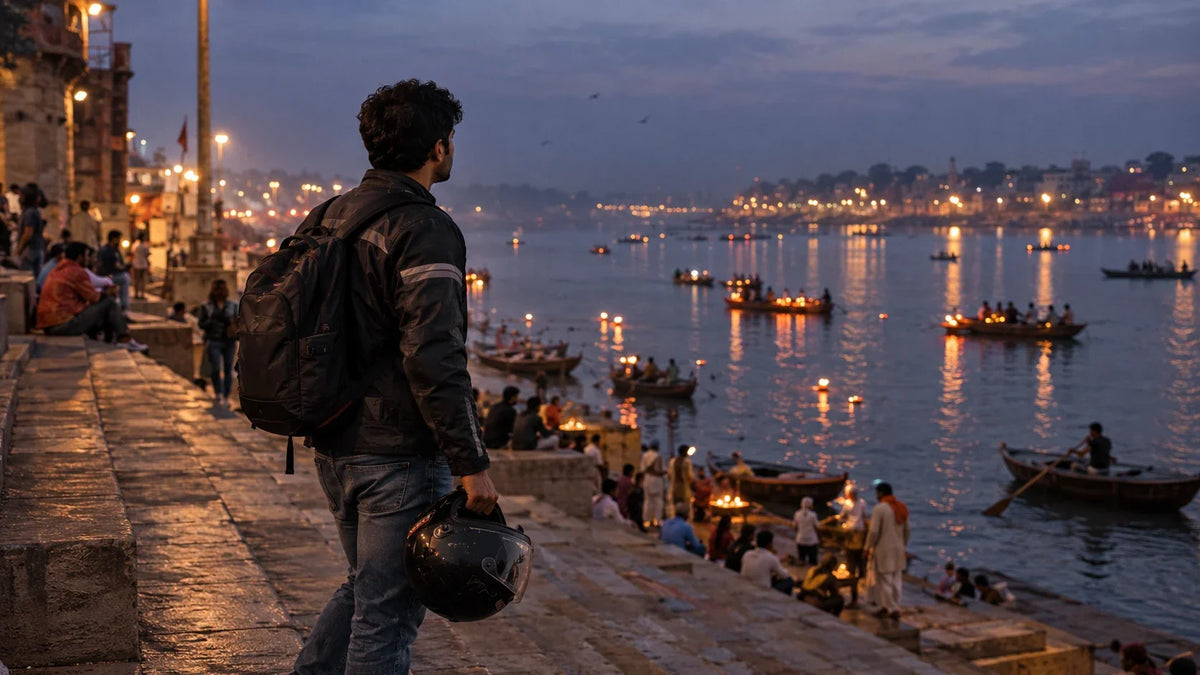
You've parked near Godowlia, threaded through a wall of pilgrims, and pulled your helmet off to wipe your face. It smells like a wet gali floor. Every rider in Varanasi knows this exact moment.
Search "helmet cleaner Varanasi" and you'll find spray bottles that promise a quick fix. Most of them just mask the smell for an hour. The real problem lives inside the padding. This city's crowds, dust, and humidity make it worse than almost anywhere else.
Rider Takeaways
- Varanasi's PM2.5 sat at 17.4 µg/m³ in late August 2026, 3.5x the WHO's annual guideline, according to IQAir.
- A 5 km ride near the ghats can take 40-45 minutes during evening aarti hours, per Down To Earth's 2025 mobility report.
- A 2020 study found 33.7% of Staphylococcus aureus isolated from motorcycle helmets was methicillin-resistant (MRSA).
- Cleaning removes dust. Only a bacteriostatic hygiene spray stops what's actually causing the smell.
Why Does Riding Through Varanasi's Ghats Wreck a Helmet So Fast?
Varanasi isn't a city you ride through so much as a city you ride around. Its ghats and galis pull in a floating population of 5-6 lakh people every single day. That's according to a 2025 tourism-department analysis reported by Down To Earth.
That includes 1-1.5 lakh tourists on any given day. Add pilgrims, cows, e-rickshaws, and hand-carts sharing the same 6-foot-wide lanes. A rider's helmet stays clamped on far longer than a straight commute would need. You're not just riding here. You're navigating.
The Kashi Vishwanath corridor alone has drawn 25.28 crore devotees since it opened in December 2021, generating an estimated ₹1.25 lakh crore for Uttar Pradesh's economy, per government data reported in October 2025. Every one of those visits adds foot traffic a two-wheeler has to inch through.
Quick Fact:
Varanasi's daily floating population runs 5-6 lakh people, with 1-1.5 lakh of them tourists on any given day. Congestion regularly builds at Godowlia, Maidagin, Beniyabagh, and Chowka Ghat. Source: Down To Earth, 2025
Varanasi's daily floating population runs 5-6 lakh people, with 1-1.5 lakh of them tourists on any given day. Congestion regularly builds at Godowlia, Maidagin, Beniyabagh, and Chowka Ghat. Source: Down To Earth, 2025
How Long Does a Varanasi Rider Actually Wear a Helmet?
Longer than the map suggests. During evening aarti hours, a 5 km ride near the ghats can take 40-45 minutes. That's per a 2025 Down To Earth report, and it's helmet-on time most cities never see.
Two-wheelers are also multiplying fast. Varanasi logged 48,690 new vehicle registrations between January and June 2025. Of those, 35,226 were motorcycles and scooters, per the same report. More riders, same narrow galis.
Every extra minute with a helmet on is a minute of trapped sweat feeding whatever's already living in the padding.
Unique Insight
Our finding: almost 3 in 4 new vehicles hitting Varanasi's roads are two-wheelers headed straight into lanes barely wide enough for a hand-cart. That combination of narrow galis and rising motorcycle counts means more riders logging longer helmet-on time than the city's infrastructure was ever built for.
What's Actually Living Inside a Varanasi Rider's Helmet?
Not just sweat. A 2020 study in the International Journal of Microbiology tested 130 motorcycle helmets. Researchers recovered 392 bacterial isolates across seven genera, led by Staphylococcus aureus (22.7%), S. epidermidis (19.6%), and E. coli (13.8%).
Here's the part that should worry you: of the S. aureus isolates recovered, 33.7% were methicillin-resistant, meaning standard antibiotics wouldn't touch them. That's the strain doctors call MRSA.
None of this needs a lab to explain. A helmet is warm, dark, and damp for hours at a stretch, exactly the conditions bacteria multiply in. Riding through Godowlia's crowds for 40 minutes straight only extends that window.
Quick Fact:
Of 130 motorcycle helmets tested, researchers recovered 392 bacterial isolates across 7 genera. 33.7% of the Staphylococcus aureus isolates were methicillin-resistant (MRSA). Source: Sapkota et al., International Journal of Microbiology, 2020
Of 130 motorcycle helmets tested, researchers recovered 392 bacterial isolates across 7 genera. 33.7% of the Staphylococcus aureus isolates were methicillin-resistant (MRSA). Source: Sapkota et al., International Journal of Microbiology, 2020

Does Varanasi's Air Make Helmet Smell Worse?
Yes, and it's measurable. Varanasi's PM2.5 reading sat at 17.4 µg/m³ in late August 2026, 3.5 times the WHO's annual guideline, according to IQAir. Winters have been far worse: readings hit 297 µg/m³ in early 2021, deep into hazardous territory.
Ozone, not particulate matter, was the dominant pollutant on the day IQAir last measured it, at 157 µg/m³. Every bit of that dust and haze settles into a helmet's foam and fabric on the ride home.
Humidity compounds it. Varanasi's relative humidity swings from 30% in April to 82% in August, per Climate-Data.org's historical averages. That's a wide, sticky window where sweat has nowhere to evaporate.
Quick Fact:
Varanasi's PM2.5 measured 17.4 µg/m³ as of late August 2026, 3.5x the WHO annual guideline, with 2021 readings peaking at 297 µg/m³. Source: IQAir, 2026
Varanasi's PM2.5 measured 17.4 µg/m³ as of late August 2026, 3.5x the WHO annual guideline, with 2021 readings peaking at 297 µg/m³. Source: IQAir, 2026
Unique Insight
Our finding: Varanasi riders get hit from two directions at once. Ozone-heavy air coats the outside of the helmet while August's 82% humidity keeps the inside from ever fully drying. Wiping the shell down does nothing for either problem.
Is a Helmet Cleaner Really What You're Looking For?
Probably not, and that's not a dodge. Hygena doesn't sell a cleaner. A cleaner removes dirt, dust, and grime you can see. A hygiene spray goes after the bacteria you can't see, the ones actually causing the smell.
Wipe down a helmet's shell with a cleaning spray and it'll look fresh. The padding underneath still holds whatever built up during a 40-minute crawl past Beniyabagh. That's why the smell comes right back within a day or two.
Hygena's spray is bacteriostatic. Tea tree extract and hydrogen peroxide stop odor-causing bacteria from multiplying at the source. They don't just mask what's already been produced. Cleaning and hygiene solve two different problems.
How Do You Actually Fix Helmet Smell in Varanasi's Conditions?
Start with the padding, not the shell. Remove it if your helmet allows, and let it air out somewhere the ghat dust can't settle back onto it.
Spray Hygena directly onto the liner and pads after a long ride. That matters most after a crawl through Godowlia or Chowka Ghat that ran 40-plus minutes. It's built to survive exactly that kind of heat-and-humidity combination without needing a full wash.
Riders wearing a helmet 4-5 hours a day should spray after every ride during Varanasi's peak humidity months. Delivery riders and long-tour visitors need it most. A dry, bacteria-free liner is what actually stops the smell from returning.

Frequently Asked Questions
Does Varanasi's humidity make helmet smell worse than other UP cities?
Yes. Humidity here swings from 30% in April to 82% in August, per Climate-Data.org. That keeps sweat trapped inside the padding for months, instead of drying between rides.
Where can I buy helmet hygiene spray in Varanasi?
Hygena ships across India, including Varanasi, through hygena.in. There's no need to hunt through Godowlia's markets for a local option.
Is a helmet cleaner spray the same as a helmet hygiene spray?
No. A cleaner lifts visible dirt off the shell. A hygiene spray like Hygena targets the bacteria in the padding, which is what actually causes the odor.
How often should I spray my helmet riding through Varanasi's pollution?
PM2.5 runs 3.5x the WHO guideline most of the year here. Spray after every ride longer than 20-30 minutes, and always after evening aarti-hour traffic.
Can a dirty helmet in Varanasi's crowded lanes cause scalp problems?
It can contribute. Helmets tested elsewhere carried MRSA-positive Staph aureus in over a third of samples, per a 2020 study. Long, sweaty rides through dense traffic only add to that risk.
Conclusion
Varanasi asks more of a helmet than most Indian cities. Between the ghat crowds, the aarti-hour crawls, and PM2.5 past WHO limits, this city wears a helmet down fast. A cleaner spray was never built for what's happening inside the padding.
Hygena's bacteriostatic spray goes after the bacteria itself, not just the smell it produces. Spray after your next ride through Godowlia and give your helmet what it actually needs. Check out hygena.in to see the full range.
Sources
1. "Varanasi Air Quality Index (AQI)," IQAir, 2026. Retrieved 2026-08-29.
2. "Varanasi's Mobility Crisis: From Pilgrimage Hub to Tourist Traffic Jam," Down To Earth, 2025. Retrieved 2026-08-29.
3. "Kashi Vishwanath Dham Corridor Boosts Uttar Pradesh Economy," News on Air, October 2025. Retrieved 2026-08-29.
4. "Microbial Diversity and Antibiotic Susceptibility Pattern of Bacteria Associated with Motorcycle Helmets," Sapkota et al., International Journal of Microbiology, 2020. Retrieved 2026-08-29.
5. "Varanasi Climate," Climate-Data.org, 1991-2020 averages. Retrieved 2026-08-29.
Share:
Why Helmet Hygiene Matters More Than Riders Think
Why Does My Motorcycle Jacket Smell Even After Washing?