
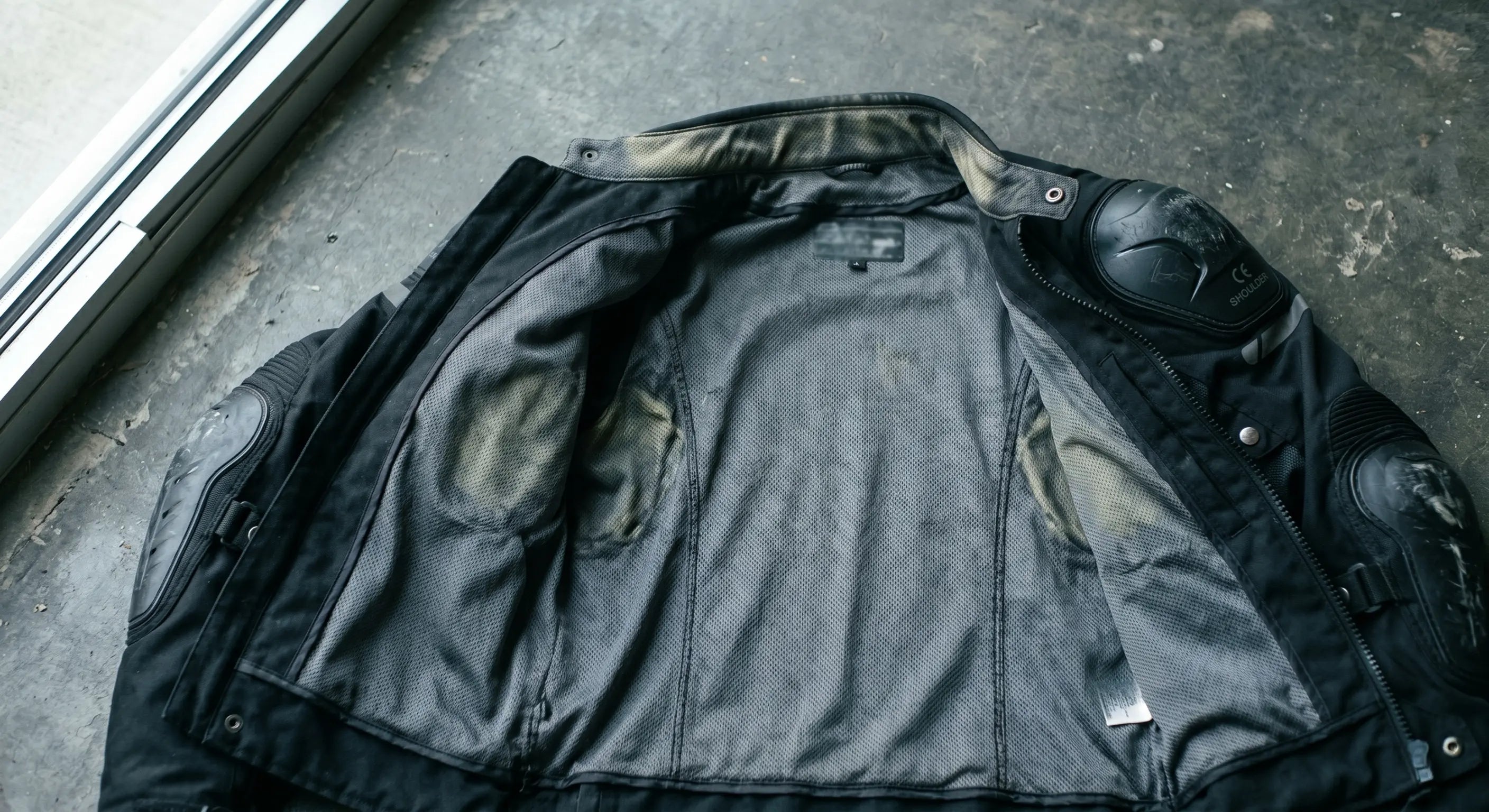
You washed it. You let it dry. You put it back on - and it still smells like last summer's commute. That's not a washing failure. That's biology.
Motorcycle jacket smell that survives a wash cycle is one of the most common frustrations riders deal with, and most of the fixes people try - more detergent, more soaking, hotter water - actually make the problem worse. The smell keeps coming back because the cause was never addressed.
This article explains what's actually happening inside your jacket, why standard washing misses it, and what fixes the problem for real.
Rider Takeaways
- Bacteria called Moraxella osloensis form biofilms inside textile linings that survive standard 30–40°C wash cycles - they're the source of the persistent "wet cloth" smell.
- The smell lives in the inner lining, not the outer shell. Most riders wash the wrong layer.
- Leather jackets trap odour differently - moisture absorbed into pores creates mold in seams and hidden padding that surface cleaning can't reach.
- Proper drying after every ride (not just after washing) is the single most effective habit change.
The Smell Lives in the Lining, Not the Shell
In 2021, researchers published findings in [PMC (Frontiers in Microbiology)] showing that polyester fibres - the most common material in motorcycle jacket inner linings - adhere more bacteria than natural fibres, because polyester is hydrophobic. Bacteria and sebum (the oily secretion from your skin) both bind preferentially to hydrophobic surfaces. Every time you ride, your jacket liner is collecting both.
Your outer shell - leather or textile - takes the road dirt, the rain, and the exhaust. But your inner lining takes the sweat. That distinction matters enormously when you're trying to fix the smell.
Most riders wash the outer jacket properly and rush the lining. Or they wash the jacket but store it before the lining is fully dry. The liner stays damp. In a warm wardrobe or a closed gear bag, that's enough for bacteria and mold to re-establish within 24 hours.
Quick Fact:
A 2021 study in Frontiers in Microbiology (PMC8515937) found that polyester fibres - the standard material in motorcycle jacket linings - adhere more bacteria than cotton or wool due to their hydrophobic surface chemistry. Bacteria and sebum both bind preferentially to hydrophobic fibres, making synthetic linings a high-risk zone for persistent odour accumulation. Source: [PMC8515937].
A 2021 study in Frontiers in Microbiology (PMC8515937) found that polyester fibres - the standard material in motorcycle jacket linings - adhere more bacteria than cotton or wool due to their hydrophobic surface chemistry. Bacteria and sebum both bind preferentially to hydrophobic fibres, making synthetic linings a high-risk zone for persistent odour accumulation. Source: [PMC8515937].
Why Bacteria Survive a Normal Wash
This is the part most riders don't know - and it explains everything.
In 2012, researchers identified Moraxella osloensis as the dominant bacteria responsible for persistent laundry smell, in a study published in Applied and Environmental Microbiology. The key finding: malodorous textiles had Moraxella osloensis counts 10 times higher than odour-free textiles. The bacteria produce 4-methyl-3-hexenoic acid - a volatile organic compound responsible for the sour, sweaty "wet cloth" smell that comes back every time the jacket gets warm or damp.
The reason it survives washing: biofilm.
Bacteria on textiles don't just sit on fibre surfaces - they form biofilms: protective layers of self-produced polymer that anchor them to the fabric and shield them from detergent and water. A 30-40°C domestic wash cycle, which is what most riders use to avoid damaging their gear, doesn't reach the temperature needed to break down established biofilms.
So you wash the jacket. Most bacteria die. The biofilm survivors stay. The jacket dries. You wear it the next day. Your body heat and fresh sweat reactivate the remaining colony. By evening, it smells again.
Quick Fact:
In 2012, researchers identified Moraxella osloensis as the dominant odour-causing bacterium in washed laundry, present in counts 10 times higher on malodorous textiles versus clean ones. These bacteria form biofilms that resist standard 30-40°C wash cycles and produce 4-methyl-3-hexenoic acid - the distinctive sour smell that returns when a jacket warms up or gets damp. Source: Applied and Environmental Microbiology, 2012.
In 2012, researchers identified Moraxella osloensis as the dominant odour-causing bacterium in washed laundry, present in counts 10 times higher on malodorous textiles versus clean ones. These bacteria form biofilms that resist standard 30-40°C wash cycles and produce 4-methyl-3-hexenoic acid - the distinctive sour smell that returns when a jacket warms up or gets damp. Source: Applied and Environmental Microbiology, 2012.

Leather Jackets Have a Different Problem
Leather does not have a biofilm problem. It has a porosity problem.
Leather is animal hide - naturally porous, designed to breathe. That's excellent for riding comfort. It also means that sweat, sebum, and odour compounds absorb into the leather grain itself, not just the surface. A standard surface wipe or light clean doesn't reach them.
The inner lining of a leather jacket is typically satin or polyester mesh - same bacteria problem as textile jackets. But leather also adds two failure modes:
Moisture trapped in seams: If a leather jacket gets wet (rain, heavy sweat) and isn't dried properly, moisture collects in the seams, the lining attachment points, and any padding layers. Mold takes hold there first - in places you can't see and can't reach with a cloth.
Conditioner trapping odour: Leather conditioners are oils or waxes that seal the leather surface. If you apply conditioner to a jacket that has absorbed sweat odour, you're sealing the smell in. Clean first, dry fully, then condition.
Unique Insight
Our finding: Most leather jacket odour guides start with "condition your jacket." The correct order is clean → dry fully → condition. Conditioning before cleaning is one of the most common reasons the smell keeps coming back in leather jackets specifically.
Quick Fact:
Leather's porous grain structure absorbs sweat compounds, sebum, and odour molecules at a depth that surface cleaning cannot reach. When moisture is trapped in seams or between the leather shell and inner lining - common after riding in rain without proper drying - mold colonises in hidden zones. Surface sprays and wipes address only the exterior layer.
Source: First MFG, leather care research; Decrum leather guide, retrieved 2026-06-12.
Leather's porous grain structure absorbs sweat compounds, sebum, and odour molecules at a depth that surface cleaning cannot reach. When moisture is trapped in seams or between the leather shell and inner lining - common after riding in rain without proper drying - mold colonises in hidden zones. Surface sprays and wipes address only the exterior layer.
Source: First MFG, leather care research; Decrum leather guide, retrieved 2026-06-12.
The Fix That Actually Works
The goal isn't to wash more often. It's to break the cycle at each stage.
After every ride - the free fix:
Hang the jacket inside-out in a ventilated spot. Not in the cupboard. Not in a gear bag. The lining needs airflow to dry out before bacteria establish themselves. This single habit change prevents most of the smell problem from ever developing.
For textile liners: White vinegar diluted 50:50 with water, applied with a cloth to the lining, then air-dried, is effective at disrupting bacterial biofilm. The acetic acid doesn't kill bacteria outright, but it breaks down the biofilm adhesion, making the bacteria easier to wash out. Use it on the lining before a regular wash, not as a substitute for one.
For leather: Clean the lining separately from the shell. Remove the lining if possible. Wipe down the leather interior with a damp cloth and very mild soap - nothing alkaline, which damages leather grain. Dry fully. Then, and only then, condition the exterior.
The temperature trap: Washing at temperatures above 60°C kills most bacteria but damages most motorcycle gear. Washing at 30-40°C is safe for gear but leaves biofilm intact. The answer is enzymatic detergents - they break down the organic matter (sweat proteins, sebum) that bacteria feed on, starving them at the root.
Our finding:
Riders who air their jacket inside-out after every ride report the smell problem effectively disappearing without any extra washing. The bacterial cycle only completes when moisture stays trapped. Remove the moisture; you remove the conditions for the smell.
Riders who air their jacket inside-out after every ride report the smell problem effectively disappearing without any extra washing. The bacterial cycle only completes when moisture stays trapped. Remove the moisture; you remove the conditions for the smell.

The Jacket Is a Warning. The Helmet Is Worse.
Here's something worth sitting with.
The bacteria building up in your jacket lining - the Moraxella osloensis, the biofilm, the sour-smelling acids - they're surviving wash cycles in fabric you clean at least occasionally.
Your helmet interior? Most riders never wash it at all. Same bacteria. Same warm, damp conditions. No washing, no airing, just daily sweat accumulating in foam padding that sits against your scalp every single ride.
A [2020 study found 392 bacteria in just 130 helmets]- including drug-resistant MRSA strains. Your jacket smells bad. Your helmet may be doing something worse, quietly.
The daily fix for your helmet is simpler than fixing your jacket. Hygena takes 5 seconds after each ride - a bacteriostatic spray applied to the interior that stops bacterial growth between washes. No soaking, no vinegar, no complicated process. Just bacteria-free padding for tomorrow's ride.
Frequently Asked Questions
Why does my motorcycle jacket smell worse when it's damp or hot?
Warmth and moisture reactivate Moraxella osloensis bacteria that survived your last wash. These bacteria produce 4-methyl-3-hexenoic acid - the sour "wet cloth" smell - as a metabolic byproduct. Dry conditions suppress them; warm damp conditions let them reproduce. The smell is a sign of active bacterial growth, not just trapped odour.
Is it safe to machine wash a motorcycle jacket?
Textile jackets can usually be machine washed at 30°C on a gentle cycle with the armour removed, then air-dried flat. Leather jackets should never be machine washed - water degrades the grain and adhesives in the stitching. Always check the care label. The bigger mistake is drying at high heat, which sets bacteria into fibres and can damage armour inserts.
What's the best way to remove odour from a leather motorcycle jacket?
Clean the lining separately with a damp cloth and mild soap. Wipe the leather interior with a leather-safe cleaner. Dry fully - at least 24 hours in ventilated air. Then condition the exterior. The sequence matters: conditioning before cleaning seals the smell in. Baking soda placed inside an open jacket overnight absorbs residual odour compounds through alkaline neutralisation.
How often should I wash my motorcycle jacket?
For daily commuters in Indian summer conditions: spot-treat the lining weekly, full wash monthly. But the more impactful habit is airing the jacket inside-out after every ride. Riders who do this consistently report the smell barely developing between monthly washes. Washing is repair; airing is maintenance.
Does fabric softener help with jacket smell?
No - and it can make things worse. Fabric softener coats textile fibres with a thin layer of chemicals that trap bacteria rather than washing them away. Use enzymatic detergents instead. They break down the sweat proteins and sebum that bacteria feed on, reducing their food source rather than just covering the smell.
Conclusion
The motorcycle jacket smell that comes back after washing isn't stubbornness. It's biology - bacteria that form biofilms in your liner, survive your wash cycle, and rebuild the colony on the next warm, sweaty ride.
Fix the root cause: air the jacket after every ride, treat the lining before washing, dry it completely before storing. For leather, clean before you condition. For textile, use cool water and enzymatic detergents.
And then look at your helmet - which never gets washed at all.
Sources
1. "The Bacterial Life Cycle in Textiles is Governed by Fiber Hydrophobicity," Frontiers in Microbiology, 2021. Retrieved 2026-06-12.
2. Moriyama University / Applied and Environmental Microbiology, 2012 - Moraxella osloensis and laundry malodour. Referenced via Nature Research Intelligence summary: retrieved 2026-06-12.
3. Sapkota et al., "Microbial Diversity and Antibiotic Susceptibility Pattern of Bacteria Associated with Motorcycle Helmets," International Journal of Microbiology, 2020. retrieved 2026-06-12.
4. First MFG, "How to Get Odor Out of a Leather Jacket or Vest." retrieved 2026-06-12.
5. Motorcyclist Online, "How To Deodorize Motorcycle Riding Gear." retrieved 2026-06-12.
Share:
Helmet Cleaner Varanasi: What Actually Works on the Ghats
The Motorcycle Rider's Skincare Routine - Before, During & After Rides