
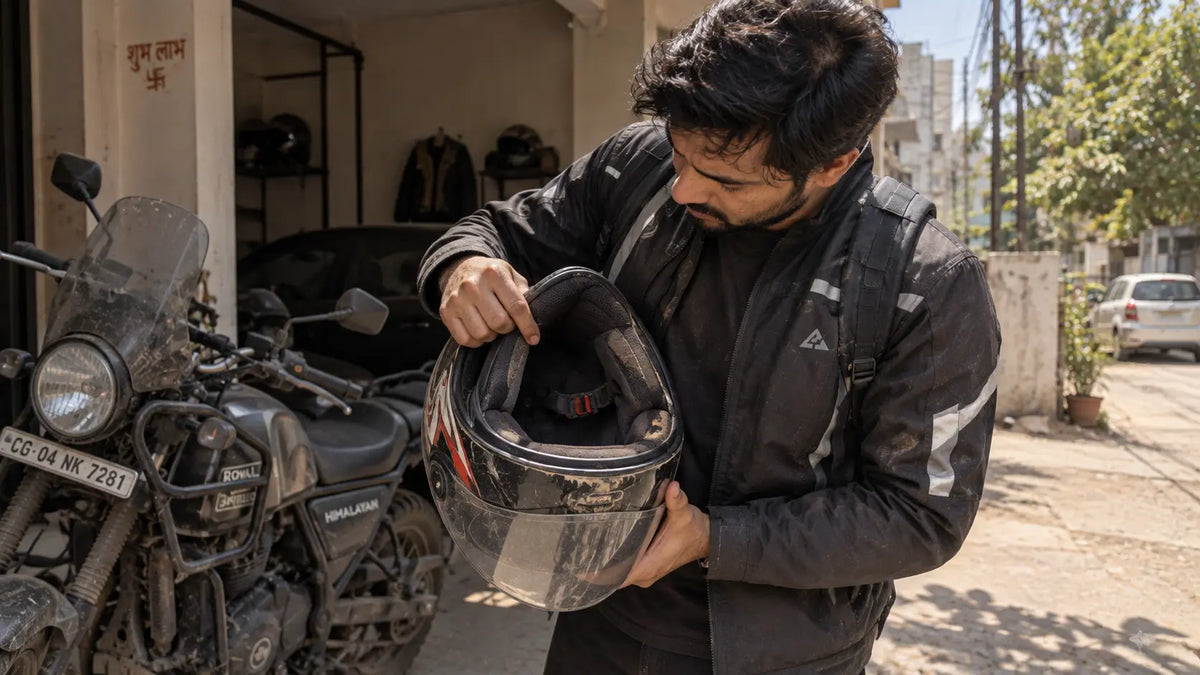
That helmet can smell fine at breakfast and rough by your evening ride.
If you ride through Raipur's summer heat, sweat gets trapped against the liner. Rainy months add another problem. Moisture can linger longer when your helmet isn't dried properly.
So when you search for helmet cleaner Raipur, you're usually trying to solve two different problems. You may need to remove visible dirt. You may also need to control the bacteria behind recurring helmet odor.
This guide separates those jobs. You'll see what Raipur's climate does to your helmet, why bacteria matter, and where a hygiene spray fits.
- IMD climate normals put Raipur's May mean maximum temperature at 39.4°C, making sweat buildup a serious helmet-care concern.
- A 2020 study of 130 motorcycle helmets recovered 392 bacterial and 346 fungal isolates.
- A cleaner removes dirt. A hygiene spray targets the microbial problem behind recurring odor.
- Raipur recorded 63,444 two-wheeler registrations from January through September 2026, showing a large and active two-wheeler market.
Why does Raipur's climate make helmet odor harder to ignore?
Raipur's hottest months create a simple helmet problem: more heat usually means more sweating during rides. IMD's 1991–2020 climate table gives Raipur a mean maximum temperature of 39.4°C in May. June remains hot, with a 38.9°C mean maximum. That heat matters because your liner sits against skin for the whole ride.
In the IMD's 1991–2020 climate normals, Raipur's mean maximum temperature reaches 39.4°C in May and 38.9°C in June. Those conditions can make sweat management a bigger part of daily helmet care. Source: India Meteorological Department.
Monsoon changes the equation again. IMD records about 181.6 mm of mean rainfall in July and 168.9 mm in August for Raipur. A wet ride can leave moisture around the liner, especially if you close the helmet and store it immediately.
That doesn't mean Raipur weather creates bacteria by itself. The practical issue is the repeated combination of sweat, moisture, skin contact, and limited drying between rides.
Our finding: Raipur's helmet routine needs two habits, not one. Dry the helmet after wet rides, then manage the bacteria that remain after repeated sweaty use.
Raipur's climate adds repeated heat and monsoon moisture to the helmet-care cycle. IMD's 1991–2020 normals show a 39.4°C mean maximum in May and 181.6 mm mean rainfall in July. Riders should therefore treat drying and interior hygiene as separate parts of helmet care.
Learn why helmet bacteria creates odor.

How much does daily riding add to the problem?
Raipur has a substantial two-wheeler base, even though a reliable public citywide congestion figure wasn't available in the sources reviewed. VAHAN-derived data show 63,444 two-wheeler registrations in Raipur from January through September 2026. That figure reflects new registrations, not the total number of riders or average commute time.
From January through September 2026, Raipur recorded 63,444 two-wheeler registrations in data derived from the VAHAN dashboard. This is a registration measure, not a congestion or commute-time measure. Source: VAHAN-derived Raipur two-wheeler data.
For a daily rider, the hygiene issue is simple. Every ride adds another period of skin contact, heat, sweat, and friction. If you ride twice a day, the liner gets two exposure cycles before it may fully dry.
Riders in Raipur also talk about weekend riding groups and local rides. Community discussions mention routes and riding groups around the city. That means a helmet can see both short city trips and longer weekend sessions.
Raipur rider discussions in 2026 included people looking for active weekend riding groups. A 2024 local discussion also mentioned Triploid MC and 36 IRC. These are community observations, not a formal count of Raipur's riding population. Source: r/Raipur community discussion, 2026.
After a longer ride, don't treat the helmet like a jacket you can hang anywhere. Open it fully, let air reach the liner, and avoid sealing it inside a bag while damp.
Raipur recorded 63,444 two-wheeler registrations from January through September 2026. That figure doesn't measure commute time, but it shows the scale of new two-wheeler activity. For individual riders, repeated helmet use makes drying, liner care, and bacterial control practical parts of a regular riding routine.
Explore Hygena's Rider Science articles.
What is actually growing inside a motorcycle helmet?
The smell isn't the sweat alone. Microbes can use sweat and skin residue as part of the environment inside a repeatedly worn helmet. A 2020 International Journal of Microbiology study examined 130 motorcycle helmets and recovered 392 bacterial isolates and 346 fungal isolates.
A 2020 study of 130 motorcycle helmets recovered 392 bacterial and 346 fungal isolates. Staphylococcus aureus accounted for 22.7% of bacterial isolates, while Staphylococcus epidermidis accounted for 19.6%. Source: Sapkota et al., International Journal of Microbiology, 2020.
That study doesn't prove every Raipur helmet has the same organisms. It shows why recurring helmet odor deserves more than fragrance.
It also explains why washing the removable padding isn't the whole routine. You can clean the fabric and still need a regular hygiene step between washes.
A 2020 microbiology study found substantial microbial contamination across 130 motorcycle helmets. Researchers recovered 392 bacterial and 346 fungal isolates. The study supports regular helmet hygiene, while its results should not be treated as a direct microbial survey of Raipur riders.
Is a helmet cleaner Raipur search really about cleaning?
Usually, it can be about both. Cleaning removes visible dirt, grime, and residue. Hygiene focuses on controlling microbes that contribute to recurring odor. Those jobs overlap, but they aren't identical.
| Need | What it does | Where it fits |
|---|---|---|
| Cleaning | Removes dirt and visible residue | Periodic liner care |
| Drying | Reduces lingering moisture | After sweaty or wet rides |
| Hygiene spray | Helps control odor-causing bacteria | Between deeper washes |
So a search for helmet cleaner Raipur shouldn't force you into one product category. If your helmet is dusty, clean it. If it keeps smelling after cleaning, address the hygiene problem too.
Hygena is designed for that second job. Its positioning is bacteriostatic helmet hygiene, so the aim is to control odor-causing bacteria rather than cover the smell with perfume.
Our finding: If the smell returns soon after washing, repeating the same wash isn't necessarily the answer. Your routine may be missing ongoing bacterial control between washes.
One practical routine: clean the liner according to the helmet maker's instructions, dry the interior completely, then use a helmet hygiene spray as directed between deeper washes.
How should Raipur riders handle helmet smell?
Start with the basics. After a sweaty ride, open the helmet and let the interior breathe. After rain, give the liner enough time to dry before storage. Don't lock a damp helmet inside a closed bag.
Then add a repeatable hygiene step. This matters because washing is occasional, while riding can happen every day. A routine between deeper washes helps keep the problem from building up again.
In a 2020 motorcycle-helmet microbiology study, researchers recovered fungi as well as bacteria from the tested helmets. The study recovered 346 fungal isolates across seven genera, reinforcing the value of regular helmet hygiene rather than relying on fragrance alone. Source: Sapkota et al., 2020.
For Raipur's hot season, make the routine part of your post-ride habit. For monsoon rides, add proper drying before storage. For weekend rides, reset the helmet after longer sessions.
That's the simple idea behind Hygena. You don't need to turn helmet care into a project. You need a small routine that matches how often you ride.
Where can you buy helmet cleaner in Raipur?
If you're searching for helmet cleaner Raipur because your helmet smells, check what the product is actually designed to do. A surface cleaner may remove dirt. A helmet hygiene spray should address the microbial side of recurring odor.
Hygena is available online through its official store. Use it as part of your helmet hygiene routine, while keeping regular liner cleaning and drying in place.
Hygena positions its flagship spray as a bacteriostatic helmet deodorant for controlling odor-causing bacteria. Its product page is the appropriate source for current product details, pricing, and usage instructions. Source: Hygena official product page.
Before your next ride, give your helmet the same attention you'd give your bike's visible parts. The difference is that helmet hygiene happens where you can't see it.

Frequently asked questions
Does Raipur heat make helmet smell worse?
Heat can increase sweating during a ride. IMD climate normals show a 39.4°C mean maximum temperature in Raipur during May. Sweat and skin residue can contribute to the environment where microbes persist. That makes drying and regular interior hygiene especially useful during hotter riding periods.
Is helmet cleaner enough for recurring odor?
Not always. Cleaning and hygiene solve different parts of the problem. A 2020 study recovered 392 bacterial isolates and 346 fungal isolates from 130 motorcycle helmets. If odor returns after cleaning, add a hygiene-focused step instead of relying on fragrance.
How often should I clean my Raipur helmet?
There isn't one universal schedule for every helmet. Follow the helmet maker's care instructions and increase attention after frequent sweaty rides. Raipur's hot May climate reaches a 39.4°C mean maximum in IMD normals, so daily riders may need more frequent drying and interior care.
Can I use Hygena after washing my liner?
Yes, when used according to the product instructions. Washing handles deeper cleaning, while Hygena is positioned for bacteriostatic odor control. Let the helmet interior dry properly after washing before storage, then use the spray as directed for ongoing hygiene.
Where can I buy helmet hygiene products in Raipur?
You can order Hygena through its official online store. Product availability, pricing, and current instructions should be checked on the official product page. The brand is designed specifically around helmet hygiene rather than general household surface cleaning.
Helmet cleaner Raipur: the practical answer
Your helmet doesn't need more perfume. It needs a routine that separates dirt, moisture, and bacteria control.
Raipur's heat can make sweat buildup a regular part of riding. Its monsoon season adds another drying challenge. Microbiology research also shows that motorcycle helmets can carry substantial bacterial and fungal contamination.
Clean the liner when needed. Dry the helmet after sweaty or wet rides. Then use a purpose-built hygiene spray to help control recurring odor between deeper washes.
If you're ready to make that routine easier, try Hygena Helmet Deodorant. For the science behind helmet odor, read The Bacteria Behind Helmet Odor.
Sources
- India Meteorological Department. Climatological Table for Raipur, 1991–2020 normals.
- Sapkota S, et al. "Microbial Diversity and Antibiotic Susceptibility Pattern of Bacteria Associated with Motorcycle Helmets." International Journal of Microbiology, 2020.
- VAHAN-derived Raipur two-wheeler registration data, January–September 2026.
- r/Raipur community discussions on local riding groups, 2024–2026.
Share:
Helmet cleaner Dhanbad: What Riders Should Know
Helmet Cleaner Bilaspur: Keep Your Helmet Fresh