
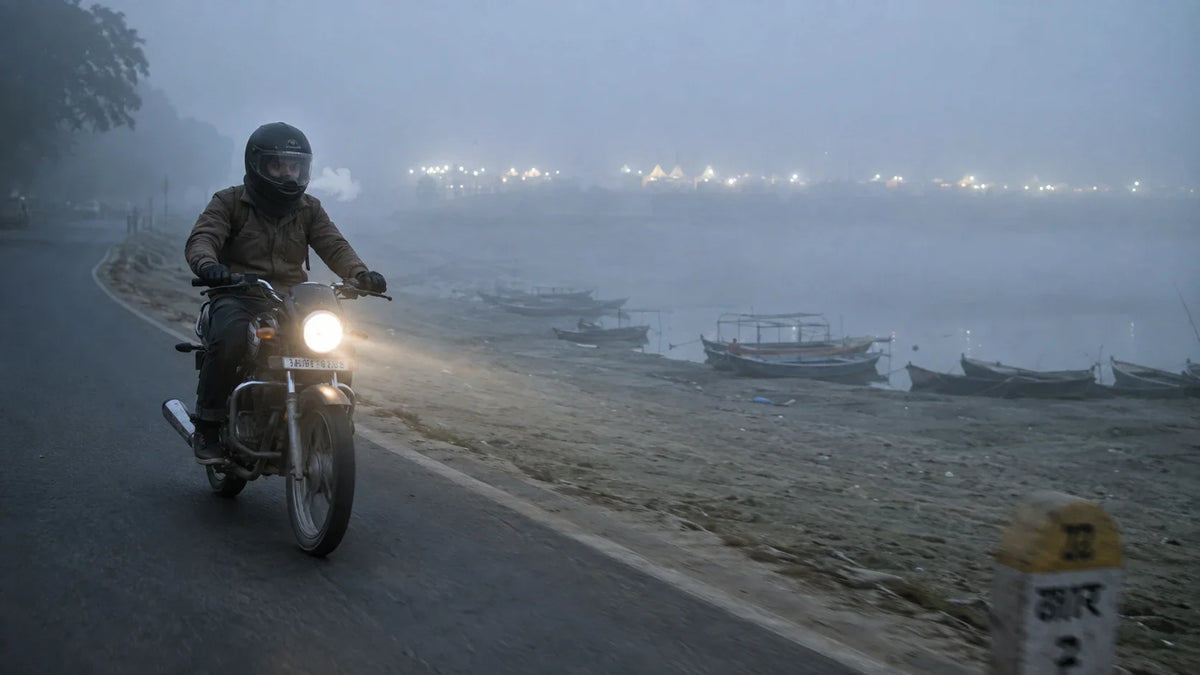
You're riding along the Sangam road before sunrise, fog so thick you can barely see the tail light ahead. By the time you pull your helmet off, the padding is damp, cold, and smells faintly sour, again.
Every rider searching for a helmet cleaner in Prayagraj is really chasing the same fix. It's a way to stop that smell from coming back. This guide breaks down why fog, heat swings, heavy traffic, and Kumbh-season crowds all work against your helmet. It also covers what actually solves it.
Rider Takeaways
- Prayagraj's winter fog and 80% August humidity keep helmet padding damp for hours after a ride, feeding bacteria growth.
- A UP-wide crash study ranks Prayagraj among the state's top 5 highest two-wheeler-crash districts. Summer months are the riskiest for commuters (Nature, 2025).
- A cleaner removes visible grime; it doesn't kill the bacteria actually causing the smell. That needs a hygiene product, not a cleaning spray.
Why Does Prayagraj's Fog and Heat Swing Wreck Your Helmet Faster?
From November to January, fog rolls in at night and lingers into the morning. January nights drop to around 5°C, with a record low of 1°C in 2013 (Climates to Travel, 1991-2020 data). Then summer flips the script completely.
May averages a scorching 34.2°C, with an all-time extreme of 48.4°C recorded in 1994. Humidity climbs from 71% in January to 80% in August. Your helmet goes from fog-damp to sweat-soaked within months, never getting a real chance to dry out.
Quick Fact:
Prayagraj's winter cold minimum of 9.6°C average in January and its summer average high of 42°C in May sit roughly 32 degrees apart. That constant swing keeps helmet foam either damp or sweaty almost year-round. Source: Climates to Travel
Prayagraj's winter cold minimum of 9.6°C average in January and its summer average high of 42°C in May sit roughly 32 degrees apart. That constant swing keeps helmet foam either damp or sweaty almost year-round. Source: Climates to Travel
Unique Insight
Our finding: Prayagraj's fog-to-heat cycle means helmet padding rarely gets a true dry window. Riders in drier North Indian cities get a few dry winter weeks. Prayagraj's fog keeps humidity elevated even when temperatures drop.
What Does Prayagraj's Kumbh-Season Crowd Do to Your Riding Routine?
Prayagraj hosted an estimated 400 million pilgrims across the six-week 2025 Maha Kumbh Mela. Roughly 100 million arrived on Mauni Amavasya alone (Wikipedia, 2025). That's not a once-a-decade footnote for local riders.
During the 2025 Mela, authorities banned most vehicles from the festival zone entirely (Wikipedia, 2025). Local traffic got pushed onto narrower side routes for days at a time. Diverted routes and dust-choked temporary roads become the daily commute for weeks.
Add a university town that's produced two Presidents and two Prime Ministers of India. You get a city where thousands ride to class, coaching centers, or work every single day (Wikipedia, University of Allahabad). Most of them wear the same helmet through every season the city throws at them.
Quick Fact:
Seven of India's 15 prime ministers since independence have ties to Prayagraj, and the city is nicknamed India's "Prime Minister Capital." That civic pride runs alongside a daily grind of long commutes on two wheels. Source: Wikipedia, Prayagraj
Seven of India's 15 prime ministers since independence have ties to Prayagraj, and the city is nicknamed India's "Prime Minister Capital." That civic pride runs alongside a daily grind of long commutes on two wheels. Source: Wikipedia, Prayagraj
Is the Smell Really Just Sweat, or Is It Bacteria?
A 2016 microbiology study swabbed 40 randomly sampled commercial motorcycle helmets. It cultured 83 separate bacterial isolates across nine species (American Journal of Microbiological Research, 2016). Staphylococcus aureus alone accounted for 31 of those isolates.
Firmicutes bacteria made up 74.7% of everything found, with the rest classed as Proteobacteria. Some isolates showed complete resistance to common antibiotics like amoxicillin. That's what's actually multiplying inside a warm, damp Prayagraj helmet, not just leftover sweat.
Quick Fact:
83 bacterial isolates across nine species were cultured from just 40 helmets in this study, and Staphylococcus aureus alone made up 31 of them. Source: American Journal of Microbiological Research, 2016
83 bacterial isolates across nine species were cultured from just 40 helmets in this study, and Staphylococcus aureus alone made up 31 of them. Source: American Journal of Microbiological Research, 2016
Unique Insight
Our finding: Many of Prayagraj's daily riders, students and commuters alike, wear one helmet for years without a break. That's the exact long-exposure pattern the Lagos helmet study's 74.7% Firmicutes finding warns about.
How Risky Is the Daily Commute Itself?
A 2025 weather-crash study analyzed 954,941 two-wheeler crashes across Uttar Pradesh from 2013 to 2018 (Nature Scientific Reports, 2025). Prayagraj ranked among the state's five highest-crash districts, alongside Lucknow, Firozabad, Gorakhpur, and Hardoi.
Men made up 73.45% of crash victims, and riders aged 25 to 35 were hit hardest at 29.67% of cases. Summer months saw the highest crash rates of the year. That's exactly when heat and sweat peak inside the helmet.
Think of a coaching student riding to class before dawn, or a delivery rider out past dusk. Their risk window stretches all day long. More time in the saddle means more time for a damp helmet to work against them.
Quick Fact:
Prayagraj sits among Uttar Pradesh's five worst districts for two-wheeler crashes out of roughly 954,941 statewide incidents studied over six years. Longer, more stressful rides mean more sweat and more time inside a bacteria-friendly helmet. Source: Nature Scientific Reports, 2025
Prayagraj sits among Uttar Pradesh's five worst districts for two-wheeler crashes out of roughly 954,941 statewide incidents studied over six years. Longer, more stressful rides mean more sweat and more time inside a bacteria-friendly helmet. Source: Nature Scientific Reports, 2025
Is a Helmet Cleaner in Prayagraj the Same Thing as a Hygiene Spray?
Not quite, and the difference matters. A cleaner is built to lift visible dirt and dust. That's exactly what you'd want after riding through Kumbh-season crowds or a foggy, muddy morning.
A hygiene spray does something different. It targets the bacteria feeding on sweat inside the padding, the actual source of the smell. Wiping away dust doesn't stop bacteria from multiplying overnight. You need both jobs done, not one standing in for the other.
Hygena isn't a cleaner. It's a bacteriostatic hygiene spray that stops odor-causing bacteria at the source, after you've already knocked the visible grime off.
| What You Need | Helmet Cleaner Spray | Hygena Hygiene Spray |
|---|---|---|
| Removes visible dust and grime | Yes | Not its job |
| Kills odor-causing bacteria | No | Yes, bacteriostatic action |
| Best used after a Kumbh-route or dusty ride | Yes, for wipe-downs | Yes, right after |
| Stops smell from coming back | No | Yes |
What Actually Fixes This for a Prayagraj Rider?
Start with the basics: wipe down dust after a Kumbh-route or unpaved-road ride. Then let the helmet air out somewhere it can actually dry, not a sealed bag. Fog and humidity mean that step alone won't finish the job.
That's where Hygena comes in. A few sprays inside the shell do the real work. After a foggy ride or a long coaching-center commute, they target the bacteria your helmet keeps feeding. So the smell doesn't just come back in a week.

Frequently Asked Questions
Does Prayagraj's fog actually make helmet smell worse?
Yes. Fog keeps ambient humidity high from November to January. Padding that got sweaty never fully dries before the next ride, so bacteria keep multiplying (Climates to Travel).
Where can I get a helmet hygiene spray in Prayagraj?
Hygena ships pan-India through hygena.in, so Prayagraj riders can order directly rather than hunting for a local stockist.
How often should I use a hygiene spray during Kumbh season?
After any ride through dust, crowds, or unpaved diversion routes, spray and let the helmet air-dry before your next ride. Dust plus sweat multiplies the bacteria load fast.
Can I just wash the padding instead?
Washing helps with visible grime but many liners can't handle frequent full washes without damage. A hygiene spray works between washes to keep bacteria down without wearing out the foam.
Is helmet smell worse for daily coaching-center or campus commuters?
Yes. Riders who wear the same helmet daily are common in Prayagraj's coaching and university crowd. That habit gives bacteria a longer, uninterrupted run at the padding.
Does summer heat in Prayagraj make things worse than winter fog?
Both are tough in different ways. May's 42°C average high means more sweat volume. Winter fog means slower drying, so the helmet rarely gets a clean break either season.
Conclusion
Prayagraj asks a lot of a helmet. Fog won't let it dry, summer heat soaks it, and Kumbh dust coats it for weeks. A cleaner handles the dust. It was never built to handle the bacteria.
That's the gap Hygena fills, a bacteriostatic spray made for riders dealing with exactly this kind of daily grind. Wipe off the dust, then spray to stop the smell at its source. Shop Hygena's helmet hygiene spray to get started.
Sources
1. "Allahabad Climate," Climates to Travel, 1991-2020 averages. Retrieved 2026-08-29.
2. "2025 Prayag Maha Kumbh Mela crowd crush," Wikipedia, 2025. Retrieved 2026-08-29.
3. "Prayagraj," Wikipedia. Retrieved 2026-08-29.
4. "University of Allahabad," Wikipedia. Retrieved 2026-08-29.
5. "Antibiotics Susceptibility Pattern and Plasmid Profile of Bacteria Isolated from Public Motorcycle Helmets," American Journal of Microbiological Research, 2016. Retrieved 2026-08-29.
6. "Weather-driven risk assessment model for two-wheeler road crashes in Uttar Pradesh, India," Scientific Reports, 2025. Retrieved 2026-08-29.
Share:
Helmet Cleaner Guntur: Is It Really What You Need?
Helmet Acne on a Long Bike Trip? How to Stop It