
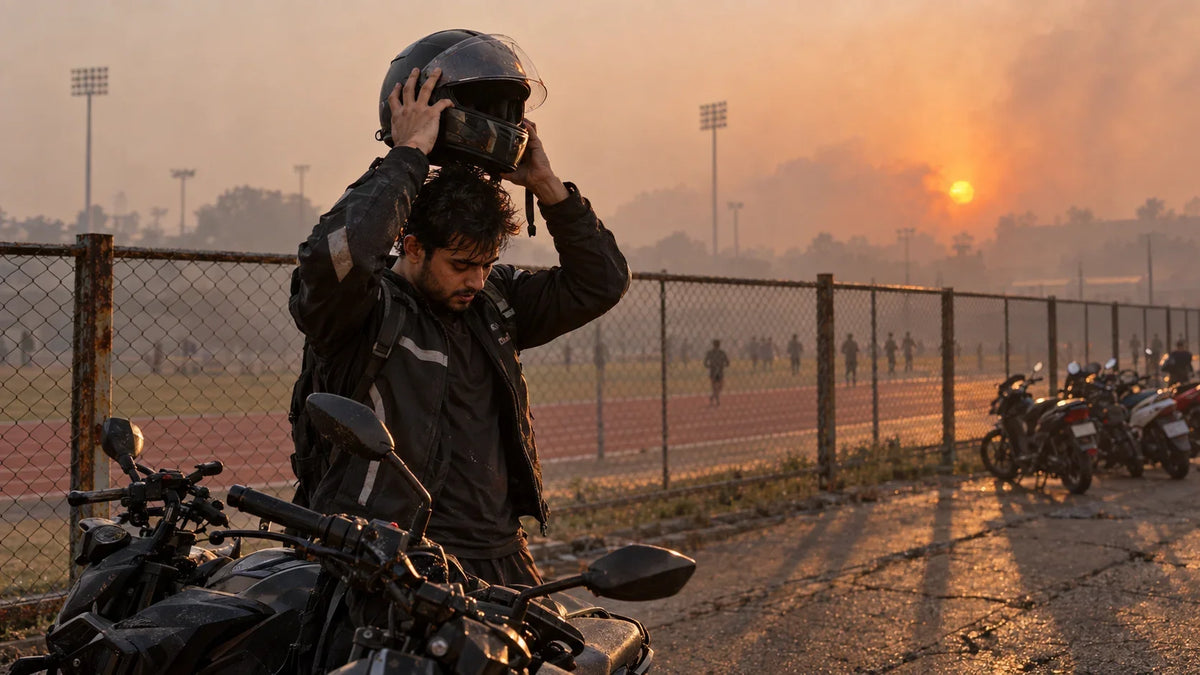
You're idling at the Sirhind Road flyover, haze sitting low over the traffic. Your helmet's already damp on the inside, and it's a normal Tuesday if you ride in Patiala.
Punjab has the second-highest two-wheeler ownership of any Indian state, so a lot of Patiala riders are living this daily. A quick search for "helmet cleaner Patiala" usually turns up wipes and sprays that handle the outside. Almost none of them touch what's actually growing inside the liner.
Here's what Patiala's climate and commute are doing to your helmet, and what closing that gap actually takes.
Rider Takeaways
- Patiala's humidity swings from 32% in May to 82% in August, a 50-point jump. That keeps helmet padding damp for hours (Climate-Data.org).
- Punjab has India's second-highest two-wheeler ownership at 75.6% of households, well above the 49.7% national average (NFHS-5, 2019-21).
- Patiala's PM2.5 jumps from a moderate 12-35 µg/m³ in spring-summer to an unhealthy 55-150 µg/m³ during October-November stubble season (IQAir).
- A cleaner wipes off dust. It does nothing to the bacteria already living in the foam. That distinction matters more here than in most cities.
Why Doesn't Patiala's Humidity Ever Give Your Helmet a Break?
Patiala's humidity runs from a dry 32% in May to a heavy 82% in August, a 50-point swing. That's per Climate-Data.org's 1991-2020 averages. May's own average high touches 39.1°C, so even the "dry" month is a sweat month.
That means your helmet padding rarely gets a real chance to dry out between rides. Sweat evaporates fastest in dry heat, but Patiala only offers a few weeks of that before humidity climbs back up. July and August alone bring 240mm and 228mm of rain.
Quick Fact:
Patiala's humidity swings 50 points across the year, from 32% in May to 82% in August, while the wettest month (July) brings 240mm of rain. Source: Climate-Data.org.
Patiala's humidity swings 50 points across the year, from 32% in May to 82% in August, while the wettest month (July) brings 240mm of rain. Source: Climate-Data.org.
Damp foam is exactly where odor-causing bacteria multiply fastest. Air-drying your helmet on the seat for ten minutes does very little here. The surrounding air is already holding onto that much moisture.
Punjab Rides More Than Almost Anywhere Else in India
75.6% of Punjab households own at least one two-wheeler. That's the second-highest rate in the country after Goa's 86.7%, and well above India's 49.7% national average (NFHS-5, 2019-21). More helmets stay in daily rotation here, and more of them get shared between family members.
Quick Fact:
75.6% of Punjab households own a two-wheeler, India's second-highest rate after Goa, versus a 49.7% national average. Source: NFHS-5, 2019-21.
75.6% of Punjab households own a two-wheeler, India's second-highest rate after Goa, versus a 49.7% national average. Source: NFHS-5, 2019-21.
That ownership shows up on the road fast. In December 2024, Patiala banned heavy vehicles from entering urban areas between 8am and 8pm. Officials said their growing movement was badly disrupting traffic and causing long jams (The Tribune, December 2024). Even with that fix, a two-wheeler still shares every narrow lane with trucks and tempos outside that window.
And when one flyover goes down for repair, the whole city feels it. In March 2026, PWD work on Flyover 22 combined with a parked truck. A normal 10-minute school run turned into a 30-minute crawl. Parents walked board-exam students the last stretch on foot (The Tribune, March 2026). That's extra helmet-on time you didn't plan for, sweat included.
Unique Insight
Our finding: Punjab's household two-wheeler ownership is 26 points above the national average, which means Patiala helmets get shared, borrowed, and re-worn between family members far more often than in a city where two-wheelers are a minority choice. Shared helmets mean shared bacteria, not just shared smell.
What's Actually Growing Inside Your Helmet?
A cleaner wipes visible grime off the shell. It was never built to reach what's happening inside the foam padding, and that's the part causing the smell.
A 2025 study in Ecotoxicology and Environmental Safety tested 78 skin microbiota samples during winter haze season. It found fine particulate exposure tied to sharply higher levels of Acinetobacter and Pseudomonas bacteria on skin. Some strains carried antibiotic-resistance genes, confirmed through in-vitro testing.
Patiala's own PM2.5 readings climb from a moderate 12.1-35.4 µg/m³ in spring-summer to an unhealthy 55.5-150.4 µg/m³ in October-November (IQAir). That's right when stubble-burning smoke settles over the region.
That same haze irritating your throat on the ride home also settles on your scalp. It gets sealed inside a warm, damp helmet for hours. Wiping the shell doesn't touch any of that.
Why Does Patiala's Sports Capital Ride So Early?
Patiala is home to the Netaji Subhas National Institute of Sports, a 268-acre campus the Government set up in 1961. It's now often called Asia's largest sports institute, and thousands of trainee athletes and coaches move through it every year.
A lot of that traffic arrives on two wheels before sunrise, for a track session or swim slot. It arrives again for the ride home after hours of physical training. That's two extra helmet-on sessions layered onto an already long, humid riding day. Each one adds its own round of sweat to padding that never quite dries.
Quick Fact:
NSNIS Patiala spans 268 acres and has trained coaches and athletes since 1961, making it one of the country's busiest sports training campuses. Source: NSNIS Patiala.
NSNIS Patiala spans 268 acres and has trained coaches and athletes since 1961, making it one of the country's busiest sports training campuses. Source: NSNIS Patiala.
Riders headed to Qila Mubarak's old-city lanes for work deal with a different problem. Tight, shaded streets trap heat and dust between the walls. Either way, Patiala doesn't give a helmet many easy chances to actually dry.

Is a Helmet Cleaner Patiala Search Really Enough?
Search "helmet cleaner Patiala" and most results are wipes, sprays, or polish made for the shell and visor. They're built to remove dirt you can see, not bacteria you can't.
Cleaning and hygiene solve different problems. A cleaner lifts grime, dust, and grease off a hard surface. Hygiene works on what's living in porous foam, and no amount of wiping the outside reaches that layer.
| What it does | A helmet cleaner/wipe | Hygena hygiene spray |
|---|---|---|
| Removes visible dust/grime | Yes | Not the focus |
| Reaches bacteria inside foam padding | No | Yes, bacteriostatic action |
| Masks or removes odor at the source | Masks it | Targets the bacteria causing it |
The Helmet Cleaner Patiala Riders Actually Need
Hygena's bacteriostatic helmet spray doesn't try to mask smell the way a fabric freshener does. It targets the bacteria feeding on sweat inside your padding. That's the mechanism a wipe or cleaner was never designed to reach.
For Patiala riders, that means it holds up through a humid August commute and a hazy NSNIS training run. It handles everything Sirhind Road traffic throws at your helmet-on time too. A few sprays after your ride, and the padding stays hygienic instead of just dry.

Frequently Asked Questions
Does Patiala's stubble-burning season make helmet smell worse?
Yes. PM2.5 in Patiala rises from a moderate 12-35 µg/m³ in spring-summer to 55-150 µg/m³ in October-November (IQAir). Haze exposure is also linked to more odor-causing bacteria on skin (Ecotoxicology and Environmental Safety, 2025).
Where can I buy helmet deodorant spray in Patiala?
Hygena ships pan-India, including Patiala, through hygena.in. There's no need for a local storefront visit.
Is a helmet cleaner enough for Patiala's humidity?
No. A cleaner removes surface dust but doesn't reach bacteria in damp foam padding. Patiala's humidity hits 82% in August (Climate-Data.org), giving bacteria plenty of time to multiply.
How often should I use a hygiene spray on my helmet?
After every ride during humid or hazy months, and at least twice a week otherwise. Riders training at NSNIS or riding Sirhind Road daily should treat this as a post-ride habit, not a once-in-a-while fix.
Can I use Hygena on a shared or borrowed helmet?
Yes, and Punjab's 75.6% two-wheeler ownership rate (NFHS-5) means helmets get shared often. A quick spray between users targets the bacteria left behind, not just the smell.
Conclusion
Patiala asks a lot of a helmet. Humidity that swings 50 points, stubble-season haze, and one of India's highest two-wheeler ownership rates all add up. Your helmet's padding rarely gets to fully dry out.
A cleaner was never built for that job. Hygena's bacteriostatic spray was, working on the bacteria inside the foam rather than the dust on the shell. Spray it after your ride, whether that's a training run to NSNIS or a crawl through Sirhind Road traffic. Your helmet stays genuinely fresh, not just wiped down.
Sources
1. "Patiala Climate," Climate-Data.org, 1991-2020 averages. Retrieved 2026-09-08.
2. "Cars, Two Wheelers, Cycles Per Household Across Indian States," Rushlane, citing NFHS-5 (2019-21). Retrieved 2026-09-08.
3. "Ban on Entry of Heavy Vehicles in Urban Areas from 8am to 8pm," The Tribune, December 2024. Retrieved 2026-09-08.
4. "Late for Board Exam, Students Panic as PWD Work Triggers Traffic Chaos in Patiala," The Tribune, March 2026. Retrieved 2026-09-08.
5. "Patiala Air Quality Index (AQI)," IQAir, historical monthly data. Retrieved 2026-09-08.
6. Ecotoxicology and Environmental Safety, Vol. 294, April 2025, winter haze/PM skin microbiota study. Verified via DOAJ open-access record. Retrieved 2026-09-08.
7. "About NSNIS Patiala," Netaji Subhas National Institute of Sports. Retrieved 2026-09-08.
Share:
Why Kochi's Humidity Turns Your Helmet Into a Bacteria Trap
Helmet Padding Cleaning Guide: Step-by-Step