
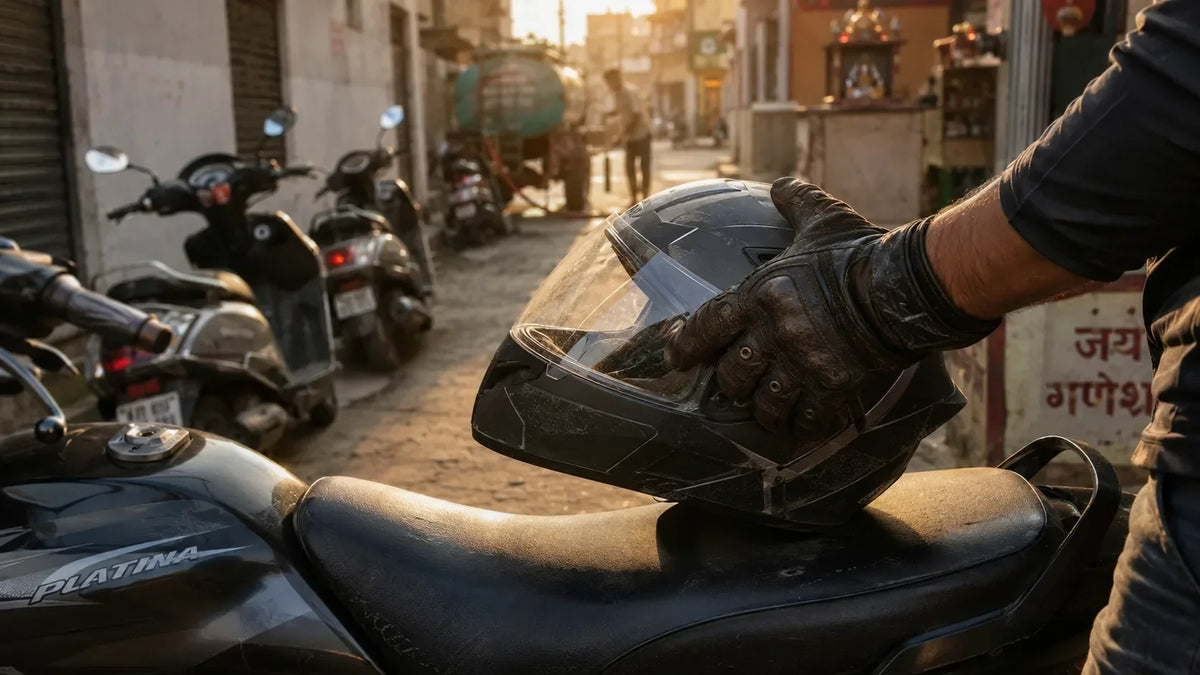
You're still idling at Cotton Market Square when your visor starts fogging up from your own sweat.
Type "helmet cleaner Nagpur" into Google and you'll get a wall of sprays promising a fresh helmet by evening. Most of them just wipe off dust. None of them touch the bacteria multiplying inside your liner while you sit in that queue.
Nagpur ki garmi mein, dust and sweat build up fast, and this city's traffic isn't getting any shorter. This piece breaks down what Nagpur's slowing roads, its heat, and its two-wheeler-heavy streets actually do to a helmet, and why cleaning one isn't the same as making it hygienic.
Rider Takeaways
- At Cotton Market Square, a five-minute crossing can now take a half-hour at peak times, per 2025 reporting on Nagpur's traffic. Source: TheNewsDirt, August 2025.
- RTI data shows 7,69,164 two-wheelers were registered in Nagpur City between 2022 and 2024, versus 1,73,524 cars. Source: Nagpur Today, 2025.
- Nagpur hit 44.7°C on April 19, 2025, the hottest reading anywhere in India that day, with humidity swinging from 24% to 80% across the year.
- A cleaner wipes off dust. Only a bacteriostatic spray like Hygena stops the odor-causing bacteria underneath.
How Much Sealed Helmet Time Is Nagpur Traffic Adding?
More than it used to. At Cotton Market Square, a junction that once took five minutes to clear can now stretch into a half-hour crawl at peak hours. Blame the 40-plus infrastructure projects running across the city at once. Source: TheNewsDirt, citing Times of India reporting, August 2025.
The Nagpur Municipal Corporation's ₹197 crore Intelligent Traffic Management System is meant to fix this. Simulations predict it could cut travel times on major corridors by 28% to 48% once it's fully running. Until then, every extra minute at a junction is an extra minute of sweat building up inside a sealed helmet.
Quick Fact:
Cotton Market Square, once a five-minute crossing, can now take up to half an hour at peak hours, driven by 40-plus simultaneous infrastructure projects across Nagpur. Source: TheNewsDirt, "Nagpur Must Act Now," August 2025
Cotton Market Square, once a five-minute crossing, can now take up to half an hour at peak hours, driven by 40-plus simultaneous infrastructure projects across Nagpur. Source: TheNewsDirt, "Nagpur Must Act Now," August 2025
Most Nagpur riders cope with the wait the same way riders everywhere do: crack the visor at the lights, hope the breeze does something. None of that reaches the bacteria already sitting in the foam.
Why Are There More Two-Wheelers Than Ever on Nagpur's Roads?
RTI data obtained by activist Abhay Kolarkar in 2025 shows Nagpur City registered 7,69,164 two-wheelers between January 2022 and December 2024. Four-wheelers, by comparison, totalled just 1,73,524. Source: Nagpur Today, RTI data, September 2025. That's nearly 4.5 two-wheelers for every car on the road.
Year by year, the count barely slows down: 2,95,999 two-wheelers in 2022, 2,61,186 in 2023, and 2,12,059 more through just the first eleven months of 2024. Affordability and easy commuting through congested lanes keep bikes and scooters the default choice for most Nagpurians.
Quick Fact:
Between January 2022 and December 2024, Nagpur City's RTO registered 7,69,164 two-wheelers against 1,73,524 four-wheelers, RTI data shows. Source: Nagpur Today, "Two-wheelers still rule Nagpur roads," September 2025
Between January 2022 and December 2024, Nagpur City's RTO registered 7,69,164 two-wheelers against 1,73,524 four-wheelers, RTI data shows. Source: Nagpur Today, "Two-wheelers still rule Nagpur roads," September 2025
That's a lot of helmets doing the same commute you are, every single day, through the same heat. Nagpur riders often joke that the city's two-wheeler culture runs on affordability and stubbornness in equal parts. Clubs like DON, a KTM-centric riding fraternity known for off-roading trips out of the city, have grown alongside this boom, but the daily commuter helmet gets far less attention than the weekend touring one.
Unique Insight
Our finding: Nagpur riders think about their helmet's shell scratches and visor scuffs long before they think about what's growing inside the liner. The RTI numbers show how many helmets are on the road; almost none of that conversation is about hygiene.
What's Actually Growing Inside That Helmet?
In 2020, researchers examined 130 motorcycle helmets and isolated 392 bacteria and 346 fungi across seven genera. Staphylococcus aureus made up 22.7% of the bacteria found, and a portion of it was drug-resistant. Source: Sapkota et al., International Journal of Microbiology, 2020.
That's the science a "helmet cleaner" search usually skips. Wiping the shell or spraying perfume onto the padding does nothing to that bacterial load. It just masks the smell it's producing, for a few hours, until the sweat comes back.

Does Nagpur's Heat Really Make Helmet Bacteria Worse?
Yes, and 2025 gave Nagpur a data point to prove it. On April 19, 2025, the city recorded 44.7°C, the highest temperature anywhere in India that day. That was 4.1°C above the normal seasonal average, per the India Meteorological Department. Source: Pune Pulse, citing IMD, April 2025.
Nagpur's humidity doesn't stay low for long either. It bottoms out at 24% in April, the driest month, then climbs to 80% by August as the monsoon sets in. Source: Weather and Climate, Nagpur. Heat speeds up sweating. Humidity slows down evaporation. A helmet liner caught between the two rarely gets a chance to fully dry.
Quick Fact:
Nagpur's relative humidity ranges from 24% in April to 80% in August, with the city also recording India's hottest temperature of the day, 44.7°C, on April 19, 2025. Sources: Weather and Climate, Nagpur, humidity averages; Pune Pulse, citing IMD, April 2025
Nagpur's relative humidity ranges from 24% in April to 80% in August, with the city also recording India's hottest temperature of the day, 44.7°C, on April 19, 2025. Sources: Weather and Climate, Nagpur, humidity averages; Pune Pulse, citing IMD, April 2025
May is worse still. Average daytime highs in Nagpur touch 44°C, among the sharpest in Maharashtra. Under a closed-face helmet, that heat has nowhere to escape. Sweat production goes up, and so does the warm, damp environment that bacteria need to multiply.
Then the monsoon flips the problem. Rain from June through October pushes humidity back up, so a liner that dried out fine in April suddenly can't dry at all. Most riders respond by airing the helmet out on the balcony overnight and hoping for the best, a habit that does nothing for the bacteria already living in the foam.
Unique Insight
Our finding: A city getting slower on the road, not faster, is usually read as bad news for commuters. For helmet hygiene, it's a bigger problem than most Nagpur riders realize, longer helmet-on time in 44°C heat compounds every ride.
Is a Helmet Cleaner the Same as a Helmet Hygiene Spray?
No, and this is where most searches for "helmet cleaner Nagpur" go wrong. A cleaner is built to lift dirt, dust, and grime off a surface. A hygiene product like Hygena is built to stop odor-causing bacteria from multiplying in the first place.
Both jobs matter on Nagpur's dusty summer roads. But they're not interchangeable. Wiping down a visor with a cleaning spray does nothing about the Staph aureus and other bacteria living in the padding, the ones actually responsible for that smell you can't wash out.
| Job | Helmet Cleaner | Helmet Hygiene Spray (Hygena) |
|---|---|---|
| Removes visible dust and grime | Yes | No, not its job |
| Stops odor-causing bacteria multiplying | No | Yes, bacteriostatic formula |
| Used between washes | Occasionally | Every ride |
Hygena is a bacteriostatic spray, not a cleaner. It's formulated with tea tree extract and other natural antimicrobials that stop bacterial growth at the source. It survives a 44°C afternoon commute and takes seconds to apply after a ride. In a city adding two-wheelers faster than it's adding roads, that's the fix that actually holds up.

The fix is simpler than searching for another spray at the local store. Spray it on after every ride, dry season or wet, and you're covering the one job a cleaner never could.
Frequently Asked Questions
Does a helmet cleaner spray actually kill the bacteria causing helmet smell in Nagpur?
Most helmet cleaner sprays are built to lift dirt and grime, not kill bacteria. A 2020 study found Staph aureus in 22.7% of 392 bacteria isolated from motorcycle helmets. Source: Sapkota et al., International Journal of Microbiology, 2020. A bacteriostatic hygiene spray targets that bacteria directly.
Why does my helmet smell worse in Nagpur's summer than in other cities?
Nagpur recorded 44.7°C on April 19, 2025, India's hottest reading that day. Source: Pune Pulse, citing IMD. That heat pushes sweat production up inside a closed-face helmet, feeding the bacteria that cause odor faster than in cooler cities.
How often should Nagpur riders clean or sanitize their helmet interior?
Wash the removable padding every two to three weeks, more often during peak summer heat. Spray a bacteriostatic hygiene product like Hygena after every ride, since bacteria start multiplying within hours of a sweaty commute.
Where can I buy a helmet hygiene spray in Nagpur?
Hygena ships across Nagpur and the wider Vidarbha region through hygena.in, with cash-on-delivery available. It's built for riders dealing with exactly the heat and dust Nagpur sees from March through June.
Can I just use a helmet cleaner instead of washing the padding?
No. A cleaner handles surface dirt on the shell and visor. The padding needs a separate wash cycle plus a bacteriostatic spray between washes, since that's where sweat, heat, and bacteria actually collect.
Conclusion
Nagpur's helmets deal with a specific combination: roads that are getting slower to cross, 7,69,164 two-wheelers sharing them, and summer heat that hit 44.7°C in 2025. A cleaner spray addresses none of that.
Hygena does. It's not a cleaner, it's a hygiene habit, a few seconds after every ride that stops bacteria before it starts smelling. Try it and see what a genuinely fresh helmet feels like after a Nagpur summer.
Sources
1. "Two-wheelers still rule Nagpur roads, reveals RTI data," Nagpur Today, September 1, 2025. Retrieved 2026-07-30.
2. "India's Hottest City in Maharashtra: Temperature Soars to 44.7°C," Pune Pulse, citing IMD, April 20, 2025. Retrieved 2026-07-30.
3. "Nagpur Humidity by Month," Weather and Climate, climate averages 1991-2020. Retrieved 2026-07-30.
4. "Nagpur Must Act Now to Avoid Becoming India's Next Traffic Nightmare," TheNewsDirt, August 15, 2025. Retrieved 2026-07-30.
5. Sapkota, A. et al., "Microbial Diversity and Antibiotic Susceptibility Pattern of Bacteria Associated with Motorcycle Helmets," International Journal of Microbiology, 2020. Retrieved 2026-07-30.
Share:
7 Signs Your Motorcycle Helmet Needs Immediate Cleaning
Helmet Cleaner Nashik: Dust, Heat, and the Truth