
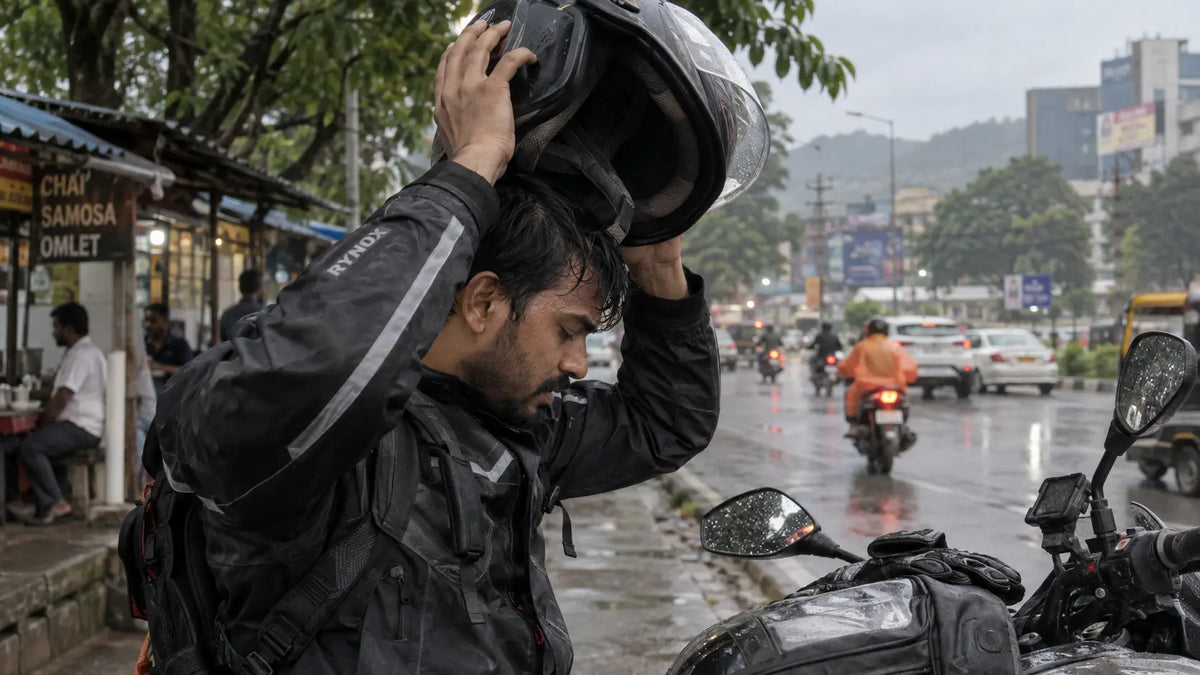
Guwahati rides can turn a clean helmet sweaty faster than you expect.
You leave home fresh, sit through traffic, and reach work with a damp liner. Then the helmet stays closed until the next ride. In Guwahati, that cycle matters because the city gets heavy rainfall and long warm seasons. Your liner can hold sweat and moisture after a normal commute.
That's why a helmet cleaner Guwahati search needs one important distinction. Cleaning removes dirt and buildup. Helmet hygiene focuses on controlling the bacteria linked with unwanted odour. You need both habits, but they solve different problems.
- Guwahati averages 1,695.3 mm of annual rainfall. IMD records 90 rainy days in its 1991–2020 table.
- A 2020 study recovered 392 bacteria and 346 fungi from 130 motorcycle helmets.
- Traffic can keep Guwahati riders helmet-on for much longer than the distance suggests.
- Clean the liner regularly, let it dry fully, and add a hygiene routine between deeper washes.
Why Guwahati's climate makes helmet hygiene harder
Guwahati's climate gives riders plenty of heat and moisture to manage inside a helmet. The India Meteorological Department's 1991–2020 table reports 1,695.3 mm of annual rainfall and 90 rainy days. June averages 314.0 mm of rain across 14.6 rainy days.
IMD's 1991–2020 Guwahati table reports 1,695.3 mm of mean annual rainfall. It records 90 rainy days. June averages 314.0 mm of rainfall. Wet rides and slower drying can leave more moisture inside helmet liners. Source: India Meteorological Department, Guwahati climate data.
That moisture doesn't automatically mean your helmet becomes unsafe. It does make drying and hygiene more important. A damp liner can also feel uncomfortable against your scalp after repeated rides.
Think about a typical Guwahati routine. You ride to work, park the bike, and leave the helmet in a closed cupboard. Then you repeat the same routine in the evening. The liner gets little time to lose moisture.
Your helmet also collects skin oil, sweat, dust, and dead skin. Those residues become part of the environment where skin-associated microbes can live.
Our finding: In a wet city, drying time becomes part of helmet hygiene. Don't treat drying as an optional extra after a sweaty ride.
Internal link: how often to clean your motorcycle helmet.
What does Guwahati traffic do to your helmet liner?
Distance isn't the only thing that decides how long your helmet stays on. Guwahati traffic can stretch short trips into long rides. In May 2025, local reporting described four-to-five-kilometre two-wheeler trips taking up to 30 minutes during rush hour.
The Assam Tribune reported this in May 2025. Guwahati riders said four-to-five-kilometre trips could take up to 30 minutes during rush hour. The same report cited an average traffic speed of about 20 km/h. Source: The Assam Tribune, 2025.
That matters because your helmet doesn't know whether the bike is moving. Your scalp still sits inside the liner while you wait at signals and bottlenecks.
Local reporting in May 2025 also highlighted congestion around Hatigaon, Ganeshguri, GMCH, Chandmari, Silpukhuri, and Guwahati Club. These are exactly the kinds of stop-and-go stretches that keep riders sealed inside their gear.
Longer helmet-on time means more exposure to sweat and skin oils. It doesn't prove that every rider develops odour. It does explain why a regular hygiene routine makes sense.
Rain can make the problem more annoying. An April 2025 rain spell caused waterlogging and severe congestion across several Guwahati areas, including Beltola and Six Mile.
In April 2025, an hour-long rain spell caused widespread waterlogging and severe congestion across several Guwahati areas. Wet conditions can also make post-ride drying more important for riding gear. Source: Times of India, 2025.
Internal link: helmet interior hygiene guides.
What bacteria can live inside a motorcycle helmet?
A motorcycle helmet can carry a surprisingly broad mix of microorganisms. In 2020, researchers tested 130 motorcycle helmets in Nepal and recovered 392 bacterial isolates and 346 fungal isolates.
A 2020 International Journal of Microbiology study examined 130 motorcycle helmets. Researchers recovered 392 bacterial isolates and 346 fungal isolates. Staphylococcus aureus was the most common bacterial isolate at 22.7% of the bacterial isolates. Source: Sapkota et al., 2020.
The study found Staphylococcus aureus, Staphylococcus epidermidis, E. coli, Klebsiella, Pseudomonas, and other organisms. It also found several fungal genera.
That doesn't mean your helmet contains the same organisms. The study used helmets from a specific population in Nepal. Its value is showing that used motorcycle helmets can carry diverse microbial communities.
Another study of skin microbiota helps explain why sweat matters. Researchers found that many skin-associated bacteria grow well under sweat-rich conditions. Staphylococcus epidermidis showed a strong preference for sweat.
Odour develops when microorganisms metabolise substances available in sweat and skin residues. So perfume can change the smell without changing the underlying environment.
Internal link: what grows inside motorcycle helmets.

How do Guwahati riders handle helmet hygiene today?
Guwahati has an active riding culture, and local riders discuss group rides, weekend routes, and rider communities online. That culture creates plenty of riding time, especially beyond the city.
A 2026 Guwahati Reddit discussion asked about active local rider groups. Riders mentioned weekend solo rides and routes toward Chandrapur and Digaru. A 2024 discussion also referenced Bikers of Assam and local riding groups. Source: r/guwahati, 2026 and r/guwahati, 2024.
That local culture matters for helmet hygiene. A weekend ride can mean several hours in the same liner. Add rain, sweat, and a damp storage spot, and the next ride starts with yesterday's residue.
One common mistake is treating fragrance as the whole solution. A strong scent can make the helmet seem fresh for a while. It doesn't replace washing the liner or managing bacterial activity.
Another mistake is leaving a wet helmet closed. Let the liner dry in a clean, ventilated place before storing it. Follow the helmet maker's care instructions for removable pads.
Our finding: Guwahati's rider routine has two separate moisture problems. Rain affects the outside and storage conditions. Sweat affects the liner directly.
Internal link: rider hygiene guides.
Helmet cleaner Guwahati: cleaning vs hygiene
If you're searching for helmet cleaner Guwahati options, first decide what your helmet actually needs. Cleaning and hygiene overlap, but they aren't interchangeable.
A 2020 helmet study found bacterial growth in 86.8% of helmets that had never been washed or disinfected. The study also found lower microbial growth among helmets that were frequently washed or disinfected. Source: Sapkota et al., 2020.
| Need | What it does | When it matters |
|---|---|---|
| Cleaning | Removes dirt, sweat residue, oils, and buildup. | When the liner needs a deeper wash. |
| Drying | Reduces retained moisture after riding. | After sweaty or wet rides. |
| Hygiene | Helps control microbial activity between deeper cleans. | For regular riding routines. |
So a helmet cleaner isn't a magic replacement for washing. If your liner is visibly dirty, wash it according to the helmet manufacturer's instructions.
For the between-wash routine, Hygena is designed around bacteriostatic control. Its current product information says it helps control odour-causing bacterial activity and works in about 10 seconds.
Hygena also states that the formula is designed for common helmet liner materials when used as directed. Let the liner dry properly before wearing the helmet.
Internal link: see Hygena Helmet Deodorant.
How to keep your Guwahati helmet fresher between rides
The easiest routine is short. First, remove loose moisture and let the helmet breathe. Next, use your hygiene product as directed. Then store the helmet somewhere clean and ventilated.
Hygena's current product page recommends use before every ride. It describes a quick-dry formula that works within about 10 seconds. The page also says the product is designed for common helmet types and liner materials when used as directed. Source: Hygena product page, accessed September 2026.
- After a sweaty ride, open the helmet and let the liner breathe.
- If the liner is wet, give it time to dry before storage.
- Deep-clean removable padding according to the helmet manufacturer's instructions.
- Use a helmet hygiene spray between deeper washes when your routine needs extra odour control.
- Keep the helmet away from damp bags, wet rain gear, and dirty storage spaces.
This routine works especially well for daily Guwahati commuters. You don't need a complicated ritual. You need consistency.
For weekend riders, the same habit matters after longer trips. A helmet that feels fine after one ride can still accumulate residue over several weeks.
CTA: Make helmet hygiene part of your Guwahati ride routine with Hygena.

Frequently asked questions about helmet cleaner Guwahati
Does Guwahati humidity make helmet smell worse?
Moisture can contribute to a helmet environment where microbes thrive. IMD records 1,695.3 mm of annual rainfall for Guwahati. Keep the liner dry and maintain regular hygiene between deeper cleaning sessions.
How often should Guwahati riders wash helmet padding?
There isn't one schedule for every rider. Daily commuters may need more frequent washing than occasional riders. A 2020 study found lower microbial growth in helmets that were frequently washed or disinfected.
Can helmet cleaner replace washing the liner?
No. A spray can't remove every layer of dirt, oil, and residue. Wash removable padding according to the helmet maker's instructions. Use hygiene products as a between-clean routine, not as a substitute for deep cleaning.
Is helmet cleaner useful after a rainy Guwahati ride?
Dry the helmet first and avoid sealing moisture inside. Guwahati experienced severe waterlogging after intense rain in 2025. Once the liner is properly dry, a hygiene routine can help manage odour between deeper washes.
Where can I buy helmet hygiene spray in Guwahati?
You can order Hygena's Helmet Deodorant online from the official Hygena product page. The current listing shows the 100 ml bottle at ₹599. Follow the usage directions and let the liner dry properly.
Conclusion: a cleaner helmet needs a better routine
Guwahati combines rain, heat, sweat, and stop-and-go traffic. Your helmet sits through all of it with you. Your helmet sits through all of it with you.
The answer isn't to spray fragrance and forget the liner. Clean the padding when it needs a deeper wash. Dry the helmet after sweaty or wet rides. Then maintain hygiene between those washes.
That's where a product such as Hygena fits. Its bacteriostatic approach is designed to help control bacterial activity linked with odour. It gives your everyday routine a simple extra step.
Helmet hygiene doesn't need to become another chore. Spray, let it dry, and get back to riding.
Next, read how often you should clean your motorcycle helmet or explore Hygena's helmet hygiene science.
Sources
- India Meteorological Department. Guwahati climatological table, 1991–2020. Source. Retrieved September 17, 2026.
- Sapkota S, et al. "Microbial Diversity and Antibiotic Susceptibility Pattern of Bacteria Associated with Motorcycle Helmets." International Journal of Microbiology, 2020. Source. Retrieved September 17, 2026.
- Grice EA, Segre JA. "The skin microbiome." Nature Reviews Microbiology, 2011. Source. Retrieved September 17, 2026.
- Hodgson A, et al. "Sweat and Sebum Preferences of the Human Skin Microbiota." 2023. Source. Retrieved September 17, 2026.
- The Assam Tribune. "Trapped in traffic: How many hours are Guwahatians losing daily?" May 22, 2025. Source. Retrieved September 17, 2026.
- Times of India. "Hour-long rain leads to severe traffic congestion in city." April 23, 2025. Source. Retrieved September 17, 2026.
- Hygena. Helmet Deodorant 100 ml product page. Source. Retrieved September 17, 2026.
- Reddit r/guwahati. Local rider-community discussions, 2024 and 2026. 2026 discussion and 2024 discussion. Retrieved September 17, 2026.
Share:
Helmet Cleaner Shimla: Keep Your Helmet Fresh
Helmet Sanitizer Chandigarh: A Rider's Guide to Helmet Hygiene