
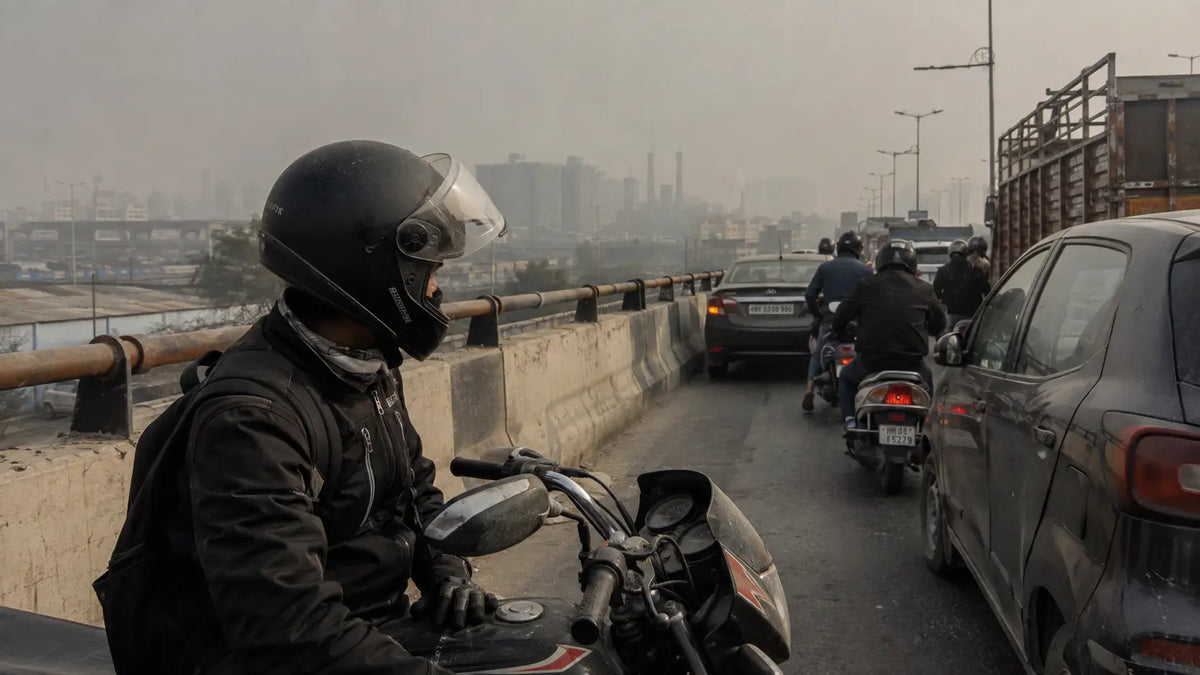
Stuck on the flyover near Badarpur border, you can taste the air before you smell your own helmet. Both problems are real, and only one of them gets solved by a wet wipe.
Search "helmet cleaner Faridabad" and you'll land on sprays built to lift road grime off a visor. None of them touch what's multiplying in the padding while you idle in NCR traffic, breathing some of the country's worst air.
Faridabad's helmet problem comes from two directions at once: an industrial city's smog and a commute that keeps getting longer. Here's what's actually happening inside your helmet, and why a cleaner only solves half of it.
Rider Takeaways
- Faridabad's November 2025 air quality averaged 372 AQI, "Hazardous" territory, against 83 AQI in July, the cleanest month that year. Source: aqi.in historical data.
- Commuters on the Gurugram-Faridabad stretch now lose up to 1.5 to 2 hours a day to snarl-ups that used to take 40 minutes. Source: The Tribune, July 2024.
- A 2020 study found Staphylococcus aureus in 22.7% of bacteria isolated from motorcycle helmets, a third of it drug-resistant.
- A helmet cleaner lifts dust off the shell. It does nothing about the bacteria feeding on sweat trapped in the foam.
Why Is Faridabad's Air Doing More Damage to a Helmet Than the Sweat Is?
Most Indian riding cities deal with heat and sweat. Faridabad deals with that plus some of the worst ambient air in the country, and both land on the same sealed piece of foam against your scalp.
Faridabad's annual AQI averaged 152 in 2025, already in "Poor" territory for a full year. But November 2025 alone spiked to 372, solidly "Hazardous," while July 2025 sat at a comparatively clean 83. That's more than a four-fold swing inside the same calendar year, per historical tracking from aqi.in.
Layer heat on top. May, Faridabad's hottest month, averages highs near 41°C, and humidity swings from a bone-dry 25% in April to 67% by August. Sweat production rises with the heat. Fine particulate matter rises with the smog season. Both end up trapped in the same padding.
Quick Fact:
Faridabad's air quality averaged 372 AQI ("Hazardous") in November 2025, its most polluted month that year, against 83 AQI ("Good") in July, its cleanest. Source: AQI.in, Faridabad historical air quality data
Faridabad's air quality averaged 372 AQI ("Hazardous") in November 2025, its most polluted month that year, against 83 AQI ("Good") in July, its cleanest. Source: AQI.in, Faridabad historical air quality data

Unique Insight
Our finding: most helmet-hygiene advice assumes sweat is the only input. Faridabad riders are dealing with fine particulate matter settling into the same padding, on top of heat that never really lets up between March and August.
How Much Extra Helmet-On Time Is Faridabad's NCR Commute Adding?
Faridabad sits inside the National Capital Region, which means most of its riders aren't doing a short local hop. They're commuting into Delhi, Noida, or Gurugram, and the roads connecting those cities have not kept pace.
On the Gurugram-Faridabad stretch, commuters who once budgeted 40 minutes for peak-hour traffic are now stuck for 1 to 1.5 hours most days. One daily commuter told The Tribune he spends an average of two hours a day in snarl-ups on this single route. Source: The Tribune, July 2024.
It's worse heading toward Noida and Ghaziabad. Around one lakh commuters make that trip daily, and because there's no direct road connecting the cities, a stretch that should take 10 minutes can stretch to 1.5 hours through Kalindi Kunj. Source: News24, citing Haryana Civil Aviation Minister Vipul Goel, March 2025.
Quick Fact:
Around one lakh commuters travel daily between Faridabad and Noida or Ghaziabad, and because no direct road connects the cities, a 10-minute stretch can take up to 1.5 hours via Kalindi Kunj. Source: News24, "FNG Expressway Gets Green Light," March 2025
Around one lakh commuters travel daily between Faridabad and Noida or Ghaziabad, and because no direct road connects the cities, a 10-minute stretch can take up to 1.5 hours via Kalindi Kunj. Source: News24, "FNG Expressway Gets Green Light," March 2025
Most riders crack the visor at a red light and call it ventilation. That does nothing for the bacteria already sitting in the liner from the previous day's ride, smog or no smog.
What's Actually Multiplying Inside a Sealed Helmet?
In 2020, researchers examined 130 motorcycle helmets and isolated 392 distinct bacteria. Staphylococcus aureus made up 22.7% of what they found, and roughly a third of those isolates came back drug-resistant. Source: Sapkota et al., International Journal of Microbiology, 2020.
None of that bacteria cares whether the air outside is smoggy or clear. It feeds on sweat and skin oil trapped in warm foam, and a Faridabad commute supplies plenty of both, especially once you factor in an hour or two stuck in traffic every day.
Wipe the dust and soot off a visor and the helmet looks fresh. The bacterial load underneath hasn't moved.
Quick Fact:
A 2020 study of 130 motorcycle helmets isolated 392 bacteria, led by Staphylococcus aureus at 22.7%, with about a third of those isolates confirmed drug-resistant. Source: Sapkota et al., International Journal of Microbiology, 2020
A 2020 study of 130 motorcycle helmets isolated 392 bacteria, led by Staphylococcus aureus at 22.7%, with about a third of those isolates confirmed drug-resistant. Source: Sapkota et al., International Journal of Microbiology, 2020
How Do Faridabad's Riders Actually Live With Their Helmets?
Faridabad isn't a leisure-riding city first. It's an industrial one. A 2023 survey put roughly 25,000 manufacturing units in the city, with 70 to 75% of them still operating out of non-regularised zones lacking basic road and water infrastructure. Source: The Tribune, December 2023.
That means a huge share of Faridabad's daily two-wheeler traffic is workers riding to and from factory clusters on roads that don't have proper drainage or dust control, not weekend tourers on a scenic route.
Weekend riding culture exists too, just a short ride away. Throttle Shrottle, a biker café on the Faridabad-Gurgaon road, draws around 200 riders on a typical Sunday morning. Source: LBB. But Monday through Saturday, it's the industrial commute that puts the most hours on a Faridabad helmet, not the weekend ride.
Unique Insight
Our finding: Faridabad's helmet hygiene conversation is skewed toward weekend riders and biker cafés, when the bigger daily bacterial load sits with workers commuting through dusty, non-regularised industrial lanes five or six days a week.
Is a Helmet Cleaner Enough for Faridabad's Smog and Sweat?
No. Type "helmet cleaner Faridabad" into Google and most results are built to lift dust, soot, and grime off the shell and visor. That's a real job, but it's a surface job.
A cleaner deals with what's sitting on top: dust, soot, road grime. It never touches what's underneath, the bacteria actually responsible for helmet smell, whether the liner looks smog-dusted or spotless. In a city where the air adds a second layer of grime on top of sweat, riders often assume one wipe-down covers both problems. It doesn't.
Hygena skips the cleaning step entirely. It's a bacteriostatic spray built to stop odor-causing bacteria from multiplying between washes, whatever the AQI reading says that day.
| Job | Helmet Cleaner | Helmet Hygiene Spray (Hygena) |
|---|---|---|
| Removes visible dust, soot, grime | Yes | No, not its job |
| Stops odor-causing bacteria multiplying | No | Yes, bacteriostatic formula |
| Used between washes | Occasionally | Every ride |
The Fix for Faridabad's Two-Front Problem
Washing the liner deals with the visible layer, dust, soot, sweat stains. It does not stop bacteria from rebuilding before your next Gurugram-Faridabad crawl or your next factory-gate commute.
Hygena is built to work in that gap: between wash days, not as a stand-in for them. A few sprays after a smoggy commute or a two-hour traffic snarl keep bacterial buildup down until the next wash day rolls around.
A routine that actually holds up against Faridabad's air and its traffic:
- Wash the removable padding every two to three weeks, more often through the worst smog months (October to January).
- Spray a bacteriostatic deodorant like Hygena after every ride, traffic-crawl commute included.

Frequently Asked Questions
Does Faridabad's pollution make helmet smell worse than in less polluted cities?
Indirectly, yes. Faridabad's AQI averaged 372 in November 2025, its worst month. Fine particulate matter settles into the same padding that traps sweat, adding grime on top of the bacteria that actually cause the smell.
Is a helmet cleaner enough for Faridabad's dust and smog?
No. A cleaner lifts visible dust and soot off the shell and liner surface. It doesn't touch the bacteria underneath, which is what causes the smell after a long NCR commute, clean air or not.
How much does Faridabad's traffic add to daily helmet-on time?
A lot. Gurugram-Faridabad commuters lose up to 1.5 to 2 hours a day to snarl-ups, and the Faridabad-Noida/Ghaziabad stretch can turn a 10-minute trip into 90 minutes. That's extra sealed hours most riders don't budget for.
Where can I buy a helmet hygiene spray in Faridabad?
Hygena ships to Faridabad and the wider NCR directly from hygena.in, with cash-on-delivery available. There's no dedicated helmet-hygiene counter in the city yet, so ordering online is currently the fastest route.
How often should Faridabad riders clean their helmet interior?
Wash the padding every two to three weeks, more often during the October-to-January smog season when both particulate matter and sealed commute hours are at their highest.
Conclusion
Faridabad's helmet problem runs on two fronts most riders never connect: air that hit 372 AQI in November 2025, and a commute that can turn a 10-minute stretch into 90 minutes. Both end up trapped in the same sealed padding.
Searching for a helmet cleaner Faridabad only solves the visible half of the problem, the dust and soot sitting on top. Pair a regular liner wash with a bacteriostatic spray like Hygena and you've covered the bacteria a cleaner was never designed to touch.
Sources
1. "Faridabad Air Quality Index," AQI.in, historical data 2020-2025. Retrieved 2026-07-30.
2. "3-km traffic jams a routine affair on Gurugram-Faridabad stretch," The Tribune, July 12, 2024. Retrieved 2026-07-30.
3. "FNG Expressway Gets Green Light," News24, March 22, 2025. Retrieved 2026-07-30.
4. Sapkota, A. et al., "Microbial Diversity and Antibiotic Susceptibility Pattern of Bacteria Associated with Motorcycle Helmets," International Journal of Microbiology, 2020. Retrieved 2026-07-30.
5. "70% of 25K Faridabad units being run from non-regularised zones," The Tribune, December 30, 2023. Retrieved 2026-07-30.
6. "Faridabad Humidity by Month," Weather and Climate, climate averages 1991-2020. Retrieved 2026-07-30.
7. "Throttle Shrottle," LBB. Retrieved 2026-07-30.
Share:
Helmet Cleaner Belgaum: What Altitude Won't Fix
Helmet Cleaner Amravati: What the Heat Really Demands