
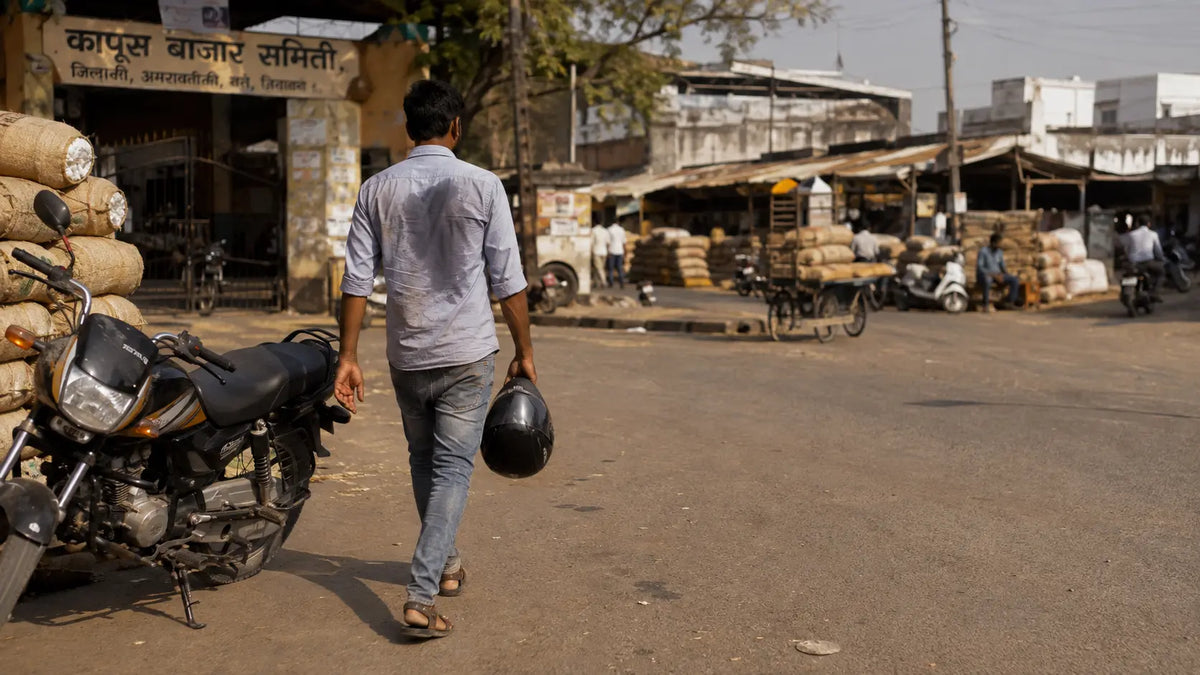
In the last week of April 2026, Amravati hit 46.6°C, the hottest reading anywhere in Vidarbha that day. Your helmet felt every degree of it.
Type "helmet cleaner Amravati" into Google and you'll find plenty of sprays promising a fresh-smelling shell by evening. Most of them wipe off dust and nothing else. None of them touch what's actually multiplying inside your liner while you sit through another 46°C afternoon.
Amravati ki garmi mein, sweat builds up inside a sealed helmet faster than almost anywhere else in Maharashtra. This piece breaks down what the city's cotton-trading roots, its two-wheeler count, and that heat actually do to a helmet, and why cleaning one isn't the same as making it hygienic.
Rider Takeaways
- Official RTO data shows 8,31,793 two-wheelers registered in Amravati as of March 2025, 81.3% of all 10,22,409 vehicles on the city's roads. Source: Maharashtra Motor Transport Department, 2024-25.
- Amravati was selected in 2023 for the PM MITRA textile mega-park scheme, projected to bring 3+ lakh jobs and ₹10,000+ crore in investment to a region that already grows nearly 30% of India's cotton. Source: theNewsDirt, March 2025.
- Amravati recorded 46.6°C in the last week of April 2026, the highest temperature anywhere in Vidarbha that day. Source: Lokshahi English News, April 28, 2026.
- A cleaner wipes off dust. Only a bacteriostatic spray like Hygena stops the odor-causing bacteria growing underneath.
Just How Many Two-Wheelers Are on Amravati's Roads?
More than four out of every five registered vehicles. Official Maharashtra Transport Department data puts Amravati's total vehicle population at 10,22,409 as of March 31, 2025, and 8,31,793 of those, 81.3%, are two-wheelers. Source: Maharashtra Motor Transport Department, Statistics 2024-25.
New registrations tell the same story. Of the 53,363 vehicles registered in Amravati through 2024-25, 42,361 were motorcycles, scooters, or mopeds, nearly 80% of everything added to the road that year. For a city this size, that's an enormous share of daily riders strapping on a helmet.
Quick Fact:
Amravati's registered two-wheeler population reached 8,31,793 as of March 2025, 81.3% of the city's total 10,22,409 registered vehicles. Source: Maharashtra Motor Transport Department, RTO-wise Vehicle Statistics 2024-25
Amravati's registered two-wheeler population reached 8,31,793 as of March 2025, 81.3% of the city's total 10,22,409 registered vehicles. Source: Maharashtra Motor Transport Department, RTO-wise Vehicle Statistics 2024-25
Unique Insight
Our finding: Amravati riders think about their helmet's shell scratches and visor scuffs, the same way riders in bigger cities do, long before they think about what's growing inside the liner. With 81.3% of the city's vehicles on two wheels, that's a lot of helmets going unchecked every single day.
Why Does Amravati's Cotton City Legacy Matter Here?
Because it explains how much time riders here actually spend on the road, not just how hot it gets. Vidarbha still contributes close to 30% of India's total cotton crop, and Amravati has been a trading hub for that cotton since well before the railways arrived. Source: theNewsDirt, "The Rise of Amravati as a Modern Textile Hub," March 2025.
That legacy is turning into fresh traffic. In 2023, Amravati was picked as a site for the PM MITRA mega textile park scheme, with 220 hectares acquired and more than ₹10,000 crore in investment projected, expected to bring over three lakh jobs to the region. Every one of those workers, contractors, and traders needs a daily commute, and most will make it on two wheels.
Quick Fact:
Vidarbha contributes close to 30% of India's total cotton crop, and in 2023 Amravati was selected for the PM MITRA textile mega-park scheme, with 220 hectares acquired and 3+ lakh jobs expected. Source: theNewsDirt, "The Rise of Amravati as a Modern Textile Hub," March 2025
Vidarbha contributes close to 30% of India's total cotton crop, and in 2023 Amravati was selected for the PM MITRA textile mega-park scheme, with 220 hectares acquired and 3+ lakh jobs expected. Source: theNewsDirt, "The Rise of Amravati as a Modern Textile Hub," March 2025
It's not just weekday commuting either. Amravati district is also home to Chikhaldara, the only hill station in Vidarbha, a favourite weekend ride for local biking groups chasing cooler air and ghat curves. Those longer touring hours mean even more sealed helmet time layered on top of the daily heat commute.
Why Is Amravati Topping Vidarbha's Heat Charts?
Because this is where the region's heatwaves peak first. In the same late-April 2026 heatwave, Amravati recorded 46.6°C, edging out Wardha at 46.5°C and Akola at 46.3°C, while Nagpur sat noticeably cooler at 45°C. Source: Lokshahi English News, April 28, 2026.
That's not a one-off spike. Climate averages built from three decades of data show Amravati's driest month, April, sitting at just 22% relative humidity while daytime highs average close to 40°C and peak higher still. A closed-face helmet turns into a small oven under those conditions, and sweat has nowhere to evaporate to.
Quick Fact:
Amravati recorded 46.6°C during the same late-April 2026 heatwave, the highest temperature anywhere in Vidarbha that day, ahead of Wardha (46.5°C), Akola (46.3°C), Chandrapur and Yavatmal (45.2°C), and Nagpur (45°C). Source: Lokshahi English News, April 28, 2026
Amravati recorded 46.6°C during the same late-April 2026 heatwave, the highest temperature anywhere in Vidarbha that day, ahead of Wardha (46.5°C), Akola (46.3°C), Chandrapur and Yavatmal (45.2°C), and Nagpur (45°C). Source: Lokshahi English News, April 28, 2026
Most Amravati riders cope the same way riders everywhere do: crack the visor at a signal, wipe their forehead, hope the next stretch of road has some shade. None of that reaches the bacteria already settling into the foam.
What's Actually Living Inside That Sweaty Liner?
Researchers who examined 130 motorcycle helmets in 2020 isolated 392 separate bacteria and 346 fungi spanning seven genera. Staphylococcus aureus alone accounted for 22.7% of the bacteria found, and a share of those isolates turned out to be drug-resistant. Source: Sapkota et al., International Journal of Microbiology, 2020.
None of that shows up on a helmet's surface. A visor wiped clean and a shell that still smells of perfume spray can sit on top of a liner that's been breeding bacteria for weeks. Dust is visible. This isn't.

In a city where daytime highs push past 40°C for weeks at a stretch, that bacterial load builds faster than it would somewhere cooler. Heat drives sweat production up. A sealed helmet traps the moisture that bacteria need to keep multiplying, and Amravati's summer gives them a longer window to do it in.
Is a Helmet Cleaner the Same as a Helmet Hygiene Spray?
No, and this is exactly where a search for "helmet cleaner Amravati" leads riders astray. A cleaner is built to lift dirt, dust, and grime off a surface. A hygiene product like Hygena is built to stop odor-causing bacteria from multiplying in the first place.
Both jobs matter on Amravati's dusty summer roads. But they solve different problems. Wiping a visor down with a cleaning spray does nothing about the Staph aureus and other bacteria living in the padding, the ones actually responsible for the smell that a wipe-down never fixes.
| Job | Helmet Cleaner | Helmet Hygiene Spray (Hygena) |
|---|---|---|
| Removes visible dust and grime | Yes | No, not its job |
| Stops odor-causing bacteria multiplying | No | Yes, bacteriostatic formula |
| Used between washes | Occasionally | Every ride |
Hygena is a bacteriostatic spray, not a cleaner. Built with tea tree extract and other natural antimicrobials, it stops bacterial growth at the source, holds up through a 46°C afternoon, and takes seconds to apply after a ride. In a city adding two-wheelers and textile jobs faster than it's adding shade, that's the fix that actually keeps pace.

The routine that actually holds up through an Amravati summer:
- Wash the removable liner every two to three weeks, weekly once the heat crosses 44-45°C.
- Spray a bacteriostatic hygiene product like Hygena after every ride, cotton-market errand or Chikhaldara weekend included.
The fix is simpler than hunting for yet another spray at the local store. Spray it after every ride, cotton season or monsoon, and you've covered the one job a cleaner never could.
Frequently Asked Questions
Does Amravati's heat make helmet bacteria worse than in cooler Maharashtra cities?
Yes. Amravati hit 46.6°C during a late-April 2026 heatwave, the hottest reading in Vidarbha that day. Source: Lokshahi English News. Heat drives up sweat production inside a sealed helmet, giving bacteria more moisture and a longer window to multiply than in cooler cities.
How many two-wheelers are actually on Amravati's roads?
Official RTO data shows 8,31,793 two-wheelers registered in Amravati as of March 2025, 81.3% of all 10,22,409 registered vehicles. Source: Maharashtra Motor Transport Department, 2024-25. That's a huge share of daily riders exposed to the same heat and dust.
Is a helmet cleaner spray enough for Amravati's summer commute?
No. A cleaner lifts dust and grime off the shell and visor. It doesn't touch Staphylococcus aureus, which made up 22.7% of the bacteria isolated in a 2020 helmet study, and that bacterial load is what actually causes the smell. Source: Sapkota et al., 2020.
Where can I buy a helmet hygiene spray in Amravati?
Hygena ships across Amravati and the wider Vidarbha region through hygena.in, with cash-on-delivery available. It's built for exactly the heat and dust Amravati sees from March through June, ahead of the monsoon reset.
How often should Amravati riders wash their helmet padding?
Wash the removable liner every two to three weeks, more often during peak summer heat. Spray a bacteriostatic hygiene product like Hygena after every ride in between, since bacteria start multiplying within hours of a sweaty, 40-plus-degree commute.
Conclusion
Amravati's helmets deal with a specific combination: a textile boom about to add hundreds of thousands of daily commutes, 8,31,793 two-wheelers already sharing the city's roads, and the hottest reading in Vidarbha this year. A cleaner spray addresses none of that.
Hygena does. Spray it on after every ride and you've stopped the bacteria before it ever starts smelling, no scrubbing required. Try it and feel what a genuinely fresh helmet is like after an Amravati summer.
Sources
1. "The Rise of Amravati as a Modern Textile Hub," theNewsDirt, March 28, 2025. Retrieved 2026-07-30.
2. "RTO-wise Vehicle Population, New Registration During the Year 2024-25," Maharashtra Motor Transport Department. Retrieved 2026-07-30.
3. "Heatwave continues in Vidarbha, highest temperature recorded in Amravati at 46.6 degrees Celsius," Lokshahi English News, April 28, 2026. Retrieved 2026-07-30.
4. "Amravati Climate," Climate-Data.org, climate averages 1991-2021. Retrieved 2026-07-30.
5. Sapkota, A. et al., "Microbial Diversity and Antibiotic Susceptibility Pattern of Bacteria Associated with Motorcycle Helmets," International Journal of Microbiology, 2020. Retrieved 2026-07-30.
Share:
Helmet Cleaner Faridabad: Smog, Sweat, and What Works
Helmet Cleaner Hubli-Dharwad: The Twin-City Commute Test