
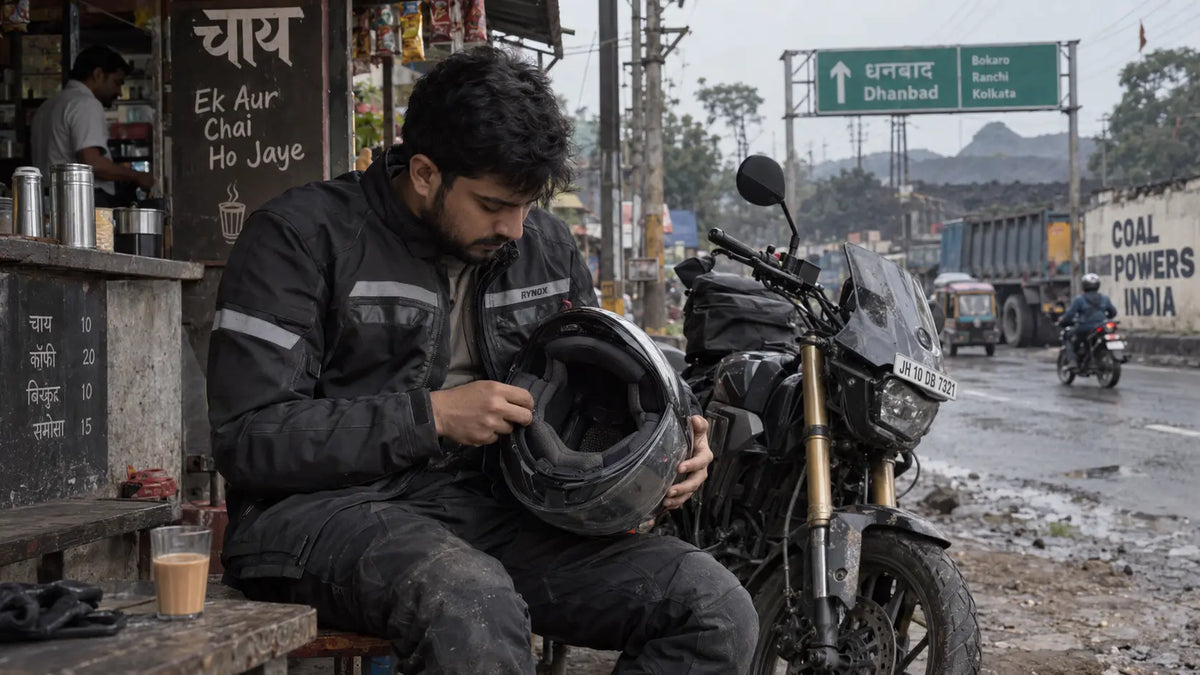
Dhanbad traffic can turn a short bike ride into a long helmet-on session.
You deal with heat, sweat, dust, and sudden monsoon moisture. Your helmet liner takes all of it in. The problem gets worse when the liner stays damp between rides.
If you're searching for a helmet cleaner Dhanbad riders can use regularly, first separate cleaning from hygiene. A cleaner removes dirt and grime. A hygiene spray helps control the bacteria linked with persistent helmet odour.
This matters in Dhanbad because local riding conditions can be hard on a helmet liner. Here's what the local data says, what happens inside your helmet, and how to build a practical routine.
- Dhanbad recorded a 42.5°C hottest day in 2025, making sweaty helmet liners a real summer concern. Source: Open-Meteo archive data.
- Dhanbad's average road speed was reported at only 10–12 km/h in 2025. Longer stop-and-go riding means more helmet-on time.
- A motorcycle helmet study found bacterial growth in 86.7% of helmets that had no cleaning or disinfection practice.
- A cleaner removes buildup. A bacteriostatic hygiene spray targets bacterial regrowth between deeper washes.
How Dhanbad riders handle helmet hygiene
Dhanbad already has a visible two-wheeler culture, so helmet hygiene isn't an abstract issue here. A local rider group called Dhanbad Bikers was listed as a club formed in 2018. In 2020, a Dhanbad helmet-junction initiative reported nine helmetless riders using its service within one hour.
Those examples show something useful. Helmets are part of everyday mobility and rider culture in the city. The hygiene habit often gets less attention than helmet availability or road safety.
A 2020 Dhanbad helmet-junction initiative started with 16 helmets and reported nine riders using the facility within its first hour. The local effort focused on helmet access and road safety. It also shows how central helmet use is to everyday two-wheeler travel in the city. Source: Telegraph India, 2020.
Our finding: Local helmet discussions often start with safety. Your next step should be hygiene. A helmet that protects your head still needs a clean, dry liner routine.
For daily riders, the practical question isn't whether you can clean a helmet. You can. The question is how you keep the liner hygienic between those deeper cleaning sessions.
Dhanbad has an established rider culture, with a Dhanbad Bikers club listed as active from 2018. A 2020 helmet-access initiative also recorded nine users within its first hour. These local examples support a simple point: helmet use is part of daily mobility, so helmet hygiene needs a repeatable routine.
Source: Bikers Club Network; Telegraph India.
Internal link: Learn how bacteriostatic helmet hygiene works.
Why Dhanbad heat and rain can make helmet smell worse
Heat and moisture create a tougher environment for a helmet liner. In 2025, Dhanbad reached 42.5°C on April 26. July recorded 431.3 mm of precipitation. Those conditions can increase sweating and make drying your liner harder.
Dhanbad's 2025 weather archive recorded an average daily high of 30.9°C. April averaged 36.9°C, while July recorded 431.3 mm of precipitation. The hottest day reached 42.5°C on April 26. These conditions can increase sweat exposure and moisture retention inside frequently worn gear. Source: Climate Yearbook, 2025.
Your liner sits against your scalp while you ride. Sweat, skin oil, dead skin, and dust can collect in its fabric and foam. If moisture stays trapped, the liner gets another problem: it doesn't dry quickly.
That doesn't mean weather alone creates the smell. Microbial activity matters too. A helmet study published in 2021 examined 130 motorcycle helmets and recovered 392 bacterial isolates and 346 fungal isolates.
The same study found bacterial growth in 86.7% of helmets with no washing or disinfection practice. Regular cleaning matters because your liner is a repeated-contact surface.
In 2025, Dhanbad's hottest recorded day reached 42.5°C, while July rainfall reached 431.3 mm. A motorcycle helmet microbiology study also found bacterial growth in 86.7% of helmets with no washing or disinfection practice. Heat, moisture, and infrequent hygiene can therefore create a poor combination for helmet freshness.
Source: Climate Yearbook, 2025; PMC motorcycle helmet microbiology study.
Internal link: Read more about why helmet hygiene matters.
What Dhanbad traffic does to your helmet liner
Dhanbad's traffic adds another layer because slow roads keep you inside the helmet for longer. A 2025 Down To Earth report measured average network speeds at only 10–12 km/h. Stop-and-go riding also means less airflow reaches your head.
A June 2025 Down To Earth report said Dhanbad's average network speed had fallen to 10–12 km/h. The report compared that figure with a 2015 projection of 23.54 km/h for 2035. Slow traffic can mean longer helmet-on sessions for daily riders. Source: Down To Earth, 2025.
Imagine a short commute that stretches because of repeated congestion. Your bike may move slowly, but your scalp still sweats. The liner stays in contact with your head throughout the delay.
That repeated exposure is why a once-a-month cleaning habit can feel inadequate. You need a deeper wash routine when the liner needs it. You also need a simple between-rides hygiene step.
Don't confuse airflow with hygiene. Leaving the helmet open can help it dry. It doesn't remove every microbial problem inside the liner.
Dhanbad's reported average network speed was 10–12 km/h in 2025. For riders, slow traffic can extend helmet-on time even when the journey distance stays unchanged. Longer wear can mean more sweat and moisture reaching the liner, so drying and between-ride hygiene become practical parts of daily helmet care.
Source: Down To Earth, 2025.
Internal link: See Hygena Helmet Deodorant.
Is a helmet cleaner enough for Dhanbad riders?
If by "helmet cleaner" you mean a product that removes dirt, grime, or residue, it's useful. But cleaning and hygiene solve different problems. A cleaner shouldn't be expected to control every bacterial change inside a damp liner.
A 2021 study of 130 motorcycle helmets recovered bacteria and fungi from helmet samples. Helmets with no washing or disinfection practice showed bacterial growth in 86.7% of cases. The study supports regular helmet hygiene, while product choice should follow the helmet maker's care guidance. Source: PMC, 2021.
Think about the jobs separately. Deep cleaning handles accumulated dirt and washable liner buildup. Drying removes retained moisture. A hygiene product can help manage bacterial regrowth between deeper cleaning sessions.
That's why searching for a helmet cleaner Dhanbad riders can use should lead to a more precise question: do you need cleaning, hygiene, or both?
If your liner is visibly dirty, follow the helmet manufacturer's cleaning instructions. Don't soak components that aren't designed for it. Don't use harsh household chemicals on helmet materials.
Cleaning and helmet hygiene are related but different tasks. A cleaner removes physical dirt and buildup, while a hygiene product can help manage microbial activity between washes. A 2021 motorcycle helmet study found bacterial growth in 86.7% of helmets with no washing or disinfection practice, supporting a regular hygiene routine.
Source: PMC motorcycle helmet microbiology study.
Our finding: Your helmet routine works better when each step has one job. Clean when the liner needs washing. Dry after sweaty rides. Add a between-rides hygiene step when odour keeps returning.

What should Dhanbad riders use between washes?
For the between-wash step, Hygena is designed as a helmet hygiene product rather than a conventional cleaner. Its bacteriostatic system is designed to help control bacterial multiplication inside frequently used helmet liners.
Hygena's product page says the spray works within 10 seconds and provides up to eight hours of protection against bacterial activity. The brand also says the formula is dermatologically tested and intended for regular use when applied as directed.
Hygena's current product page states that its bacteriostatic spray works within 10 seconds and provides up to eight hours of protection against bacterial activity. The brand positions it for helmet liners and regular rider use. These are manufacturer claims, not independent clinical findings. Source: Hygena product page, 2026.
For a Dhanbad commuter, the routine can stay simple. Let the helmet dry after the ride. Clean the liner according to the helmet manufacturer's instructions. Use a hygiene spray between deeper washes when odour keeps returning.
Hygena recommends spraying before or after every ride. Follow the product directions and allow the gear to dry properly.
Make your between-ride helmet hygiene routine easier with Hygena.
Hygena describes its helmet spray as a bacteriostatic hygiene product designed to help control bacterial multiplication inside helmet liners. Its current product page states that it works within 10 seconds and provides up to eight hours of protection against bacterial activity. These performance claims come from Hygena and should be read as manufacturer claims.
Source: Hygena Helmet Deodorant product page.
Internal link: Explore Hygena's bacteriostatic technology.
Frequently asked questions about helmet cleaner Dhanbad
Does Dhanbad heat make helmet smell worse?
Heat can increase sweating and moisture inside a helmet. Dhanbad reached 42.5°C on April 26, 2025. A motorcycle helmet study also found bacterial growth in 86.7% of helmets without washing or disinfection. Keep the liner dry and maintain a regular hygiene routine.
Does Dhanbad traffic affect helmet hygiene?
It can increase helmet-on time. A 2025 report placed Dhanbad's average network speed at 10–12 km/h. Longer slow rides can mean more time sweating inside the liner. Dry the helmet after riding and clean it according to the manufacturer's instructions.
Is a helmet cleaner the same as a deodorizer?
No. A cleaner removes physical dirt and buildup. A deodorizer or hygiene product addresses odour and microbial activity. The distinction matters because a 2021 helmet study found bacterial growth in 86.7% of helmets without washing or disinfection.
Can I use Hygena in Dhanbad every day?
Hygena says its spray is designed for regular use on helmet liners when used as directed. Its product page states that it works within 10 seconds. Follow the application directions and let your helmet dry properly after spraying.
Where can I buy helmet hygiene products for Dhanbad?
You can buy Hygena's helmet deodorant directly from the brand's website. The current listed price is ₹599 for 100 ml. The product page also lists larger packs. Check the current page for availability and delivery details.
Build a helmet hygiene routine that fits Dhanbad riding
Dhanbad riders deal with heat, monsoon moisture, slow traffic, and repeated helmet use. Your liner absorbs the impact of those conditions long before you notice the smell.
That makes the routine straightforward. Clean when the liner needs a deeper wash. Dry it properly after sweaty rides. Use a dedicated hygiene product between washes when odour keeps returning.
If you're looking for a helmet cleaner Dhanbad riders can use, start by identifying the job. Dirt needs cleaning. Moisture needs drying. Persistent odour needs source control.
Try Hygena for your between-ride helmet hygiene routine.
You can also learn how Hygena's bacteriostatic technology works before adding it to your gear routine.

Sources
- Climate Yearbook. "Dhanbad weather in 2025." 2025. Source. Retrieved September 17, 2026.
- Down To Earth. "How India moves: The average speed on the roads of Dhanbad." 2025. Source. Retrieved September 17, 2026.
- Microbial Diversity and Antibiotic Susceptibility Pattern of Bacteria Associated with Motorcycle Helmets. 2021. PMC source. Retrieved September 17, 2026.
- Telegraph India. "Free helmet facility at petrol pump in Dhanbad." 2020. Source. Retrieved September 17, 2026.
- Bikers Club Network. "Motorcycle Clubs in Jharkhand." Accessed September 17, 2026. Source.
- Hygena. "Helmet Deodorant 100ml." 2026. Source. Retrieved September 17, 2026.
- Hygena. "The Science." 2026. Source. Retrieved September 17, 2026.
Share:
Helmet Sanitizer Chandigarh: A Rider's Guide to Helmet Hygiene
Helmet Cleaner Raipur: What Riders Actually Need