
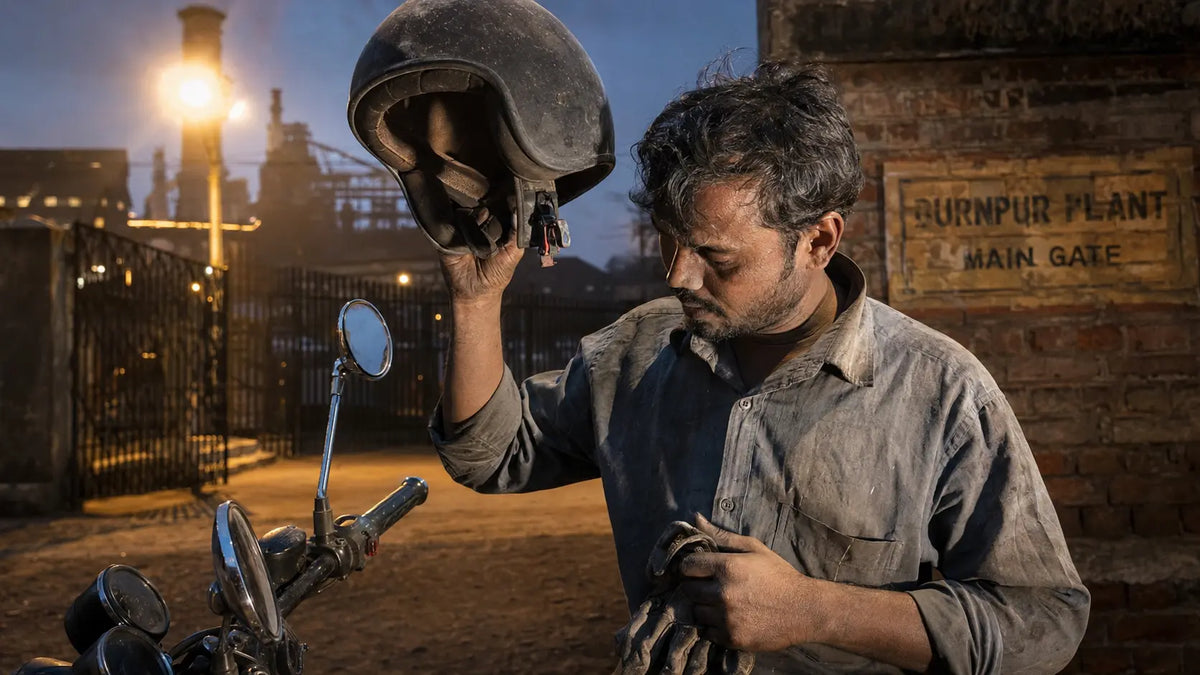
You wipe your visor at a Burnpur signal and your glove comes away grey. That's not road dust. That's Asansol.
This city runs on coal and steel. Both leave a residue that settles on everything, including the padding inside your helmet. Most riders here reach for a "helmet cleaner" to deal with it. That's only half the job.
Here's what Asansol's industrial air actually does to your helmet. Wiping off the dust isn't the same as dealing with what's growing underneath it.
Rider Takeaways
- Asansol's industrial sector puts out 45,750 tons of PM2.5 a year. That's 66% of the city's total, per UrbanEmissions.info's 2018 inventory.
- A 2025 study found particulate pollution directly enriches Acinetobacter and Pseudomonas bacteria on human skin during high-pollution days.
- Humidity here swings from 45% in March to 85% in August, a 40-point jump. That keeps sweat from evaporating out of the padding.
- A cleaner wipes off the visible coal dust. It does nothing to the bacteria multiplying in the foam underneath.
Why Is Asansol's Air So Different From Every Other City?
Coal mining in India started here. The Raniganj Coalfield, just outside the city, is where regular commercial mining began in 1820. As of the last full count in 2012-13, it was running 98 mines, 77 underground and 21 open-pit. That workforce numbered close to 73,000.
Then there's Burnpur, a few kilometres from the city centre. SAIL's IISCO Steel Plant runs Blast Furnace Kalyani there. At 4,160 cubic metres, it was India's largest operating blast furnace when commissioned in 2014. The plant's saleable steel capacity grew from 0.4 million tonnes to 2.5 million tonnes after a modernisation drive. The Prime Minister inaugurated it in May 2015.
Two heavy industries, one city. If your helmet feels grimier here than it did in your last posting, that's not in your head.
Quick Fact:
The Raniganj Coalfield holds 49.17 billion tonnes of coal reserves and has been mined continuously since 1820, making it India's oldest working coalfield. Source: Wikipedia, Raniganj Coalfield.
The Raniganj Coalfield holds 49.17 billion tonnes of coal reserves and has been mined continuously since 1820, making it India's oldest working coalfield. Source: Wikipedia, Raniganj Coalfield.
Where Does That Dust Actually Come From?
Most Indian cities blame their air on traffic. Asansol doesn't fit that pattern. A 2018 emissions inventory from UrbanEmissions.info's India APnA programme put the city's total PM2.5 output at 69,400 tons a year. Industry alone accounted for 45,750 tons of that, about 66%. Transport contributed just 4,500 tons, roughly 6.5%.
That's the opposite ratio from a city like Delhi or Bengaluru, where vehicles do most of the damage. Here, it's the mines and the furnace.
IQAir's data shows the swing across a year. Asansol's PM2.5 averaged 55.3 µg/m³ in 2020, but January alone hit 89.2 µg/m³ against September's 36.7 µg/m³. That gap traces back to winter's stiller air trapping industrial haze closer to the ground. On the evening this was checked, the live reading sat at 21.9 µg/m³, over four times the WHO's annual guideline.
What Does That Dust Do Once It's Inside Your Helmet?
Sweat has always fed the bacteria that cause helmet odor. In an industrial city, sweat isn't the only thing feeding them.
A study in Ecotoxicology and Environmental Safety, April 2025 (Yan et al.), looked at particulate pollution and skin bacteria. It found particulate matter significantly enriches two bacterial genera, Acinetobacter and Pseudomonas, on human skin during high-haze periods. Lab tests in the same study confirmed the particulates directly promote growth of these strains. The enriched populations also carried more antibiotic-resistance genes than skin exposed to cleaner air.
Translate that to a helmet. Coal and furnace dust settling on your scalp during a Burnpur commute isn't just grime sitting on sweat. It's actively feeding bacterial growth on the same skin your helmet padding presses against for hours.
Unique Insight
Our finding: most Indian cities' helmet-hygiene problem is sweat plus humidity. Asansol's is sweat, humidity, and industrial particulate acting on skin bacteria at the same time, a three-part load few other Indian cities carry.
Long Rides in Asansol's Heat and Humidity Make It Worse
Asansol sits in a tropical Aw zone: dry, scorching pre-monsoon heat followed by a wet, sticky monsoon. Average highs climb from 17.3°C in January to 30.8°C in May. Locals report peak summer days crossing 45°C in dry spells.
Humidity tells the other half of the story. It runs from 45% in March, the driest month, to 85% in August, the wettest. That's a 40-point swing over the monsoon. Annual rainfall lands around 1,294 to 1,430mm depending on the dataset, most of it packed into June through September.
That combination is dry heat that makes you sweat hard, followed by monsoon humidity that stops the sweat from evaporating. The padding inside your helmet rarely gets a chance to fully dry between rides.
Quick Fact:
Asansol's relative humidity swings from 45% in March to 85% in August, a 40-point range, on top of average highs that reach 30.8°C in May and summer peaks past 45°C. Source: Climate-Data.org and Wikipedia, Asansol.
Asansol's relative humidity swings from 45% in March to 85% in August, a 40-point range, on top of average highs that reach 30.8°C in May and summer peaks past 45°C. Source: Climate-Data.org and Wikipedia, Asansol.
How Does Asansol's Traffic Add to Your Helmet-On Hours?
A traffic study of Asansol's Bus Stand to Durga Mandir corridor counted 3,247 vehicle movements in one peak hour. That hour ran 9:30 to 10:30 AM, at just one junction. Noise during office hours crossed 90 decibels, driven by stop-and-go traffic, illegal roadside parking, and irregular bus service.
That's not a citywide congestion index like you'd see for Kolkata or Mumbai. It's one junction, in a city of roughly 12.4 lakh people. That's still enough traffic to keep a helmet strapped on far longer than the ride itself needs.
Every extra minute at a red light near Court More or B.N.R. More is another minute of trapped heat, sweat, and dust sitting against your scalp. West Bengal's without-helmet fine runs ₹1,000, with a three-month licence disqualification on top. Almost nobody in that queue risks a bare head just to cool off early.
Is a Helmet Cleaner the Same as a Helmet Hygiene Spray?
No, and in a city where the dust is this visible, that mix-up is easy to make. A cleaner is built to lift dirt: coal soot, road grime, sweat stains on the padding fabric. It doesn't claim to do anything about bacteria.
Hygena isn't a cleaner. It's a bacteriostatic hygiene spray. It stops odor-causing bacteria from multiplying rather than just lifting visible dirt off the surface. Wiping coal dust off your padding without treating what's growing underneath is like sweeping a floor without ever mopping it.
| What you need | A cleaning spray | Hygena hygiene spray |
|---|---|---|
| Removes visible coal dust | Yes | Partial, not its main job |
| Stops bacteria from multiplying | No | Yes, bacteriostatic action |
| Safe on foam padding daily | Varies by formula | Yes, dermatologically tested |
| Addresses the odor source | Masks it temporarily | Yes, targets bacteria directly |

What Actually Fixes This for an Asansol Rider
You can't stop the Raniganj coalfield from producing dust or the furnace at Burnpur from running. What you can control is what happens inside your own helmet after every ride.
Two steps, about two minutes, right after you park the bike:
- Wipe the shell and visor down to clear the visible coal dust and grime.
- Spray Hygena's bacteriostatic formula into the padding to stop bacteria feeding on sweat and industrial particulate underneath. It's built to hold up through a humid Asansol monsoon between rides.
Unique Insight
Our finding: in cities where transport drives the pollution, helmet hygiene is mostly about sweat and monsoon humidity. In Asansol, it's a three-front problem, industrial dust, humidity, and sweat, which is exactly why a wipe-and-forget cleaner falls short here.

Frequently Asked Questions
Does Asansol's coal dust actually get inside a sealed helmet?
Yes. Vents designed for airflow let fine particulate in too. Industrial sources here produce 45,750 tons of PM2.5 a year, per UrbanEmissions.info's 2018 inventory. Much of it is fine enough to pass straight through a standard helmet vent.
Is a helmet cleaner spray the same thing as a hygiene spray?
No. A cleaner removes visible dirt and dust. A hygiene spray like Hygena is bacteriostatic. It stops odor-causing bacteria from multiplying in the padding, a job cleaning alone doesn't do.
How often should riders in Asansol spray their helmet?
Spray after every ride during peak winter haze months, December through February, and through monsoon season, June to September. IQAir data shows PM2.5 and humidity both run highest then. A daily commuter should treat it as a post-ride habit, not a weekly one.
Can I use Hygena on a helmet shared between family members or coworkers?
Yes, and shared helmets need it more, not less. A shared helmet doubles the sweat and skin contact one person's helmet sees. That's exactly the setup bacteria multiply fastest in.
Where can I buy helmet deodorant spray in Asansol?
Hygena ships pan-India, including Asansol and the wider Paschim Bardhaman district, through hygena.in.
Conclusion
Asansol's helmet problem isn't like Mumbai's or Bengaluru's. It's not traffic exhaust and it's not just monsoon sweat. It's a coalfield and a steel plant putting two-thirds of the city's PM2.5 into the air. Your helmet breathes it right alongside you.
A cleaner gets the visible dust off. It won't touch the bacteria that dust helps feed. Spray Hygena into your padding after every ride, especially through winter haze and monsoon humidity. You're treating the actual problem instead of just wiping the surface. Grab a bottle and make it part of your routine, the way you check tyre pressure before a long ride.
Sources
1. "Raniganj Coalfield," Wikipedia. Retrieved 2026-08-24.
2. "IISCO Steel Plant," Wikipedia. Retrieved 2026-08-24.
3. "Air Quality Analysis for Asansol-Durgapur," UrbanEmissions.info, India APnA Programme, 2018 inventory. Retrieved 2026-08-24.
4. "Asansol Air Quality Index (AQI)," IQAir. Retrieved 2026-08-24.
5. Yan, D. et al., "Particulate matter pollution alters the bacterial community structure on the human skin with enriching the Acinetobacter and Pseudomonas," Ecotoxicology and Environmental Safety, April 2025 (via DOAJ). Retrieved 2026-08-24.
6. "Asansol Climate Data," Climate-Data.org. Retrieved 2026-08-24.
7. "Asansol," Wikipedia. Retrieved 2026-08-24.
8. Maji, S., "Traffic Congestion and Possible Solutions: A Case Study of Asansol," Academia.edu. Retrieved 2026-08-24.
9. "Without Helmet Fine in West Bengal," TATA AIG. Retrieved 2026-08-24.
Share:
How to Prevent Helmet Hair on Long Rides
Helmet Cleaner Salem: What Steel City's Dust Does to Your Helmet