
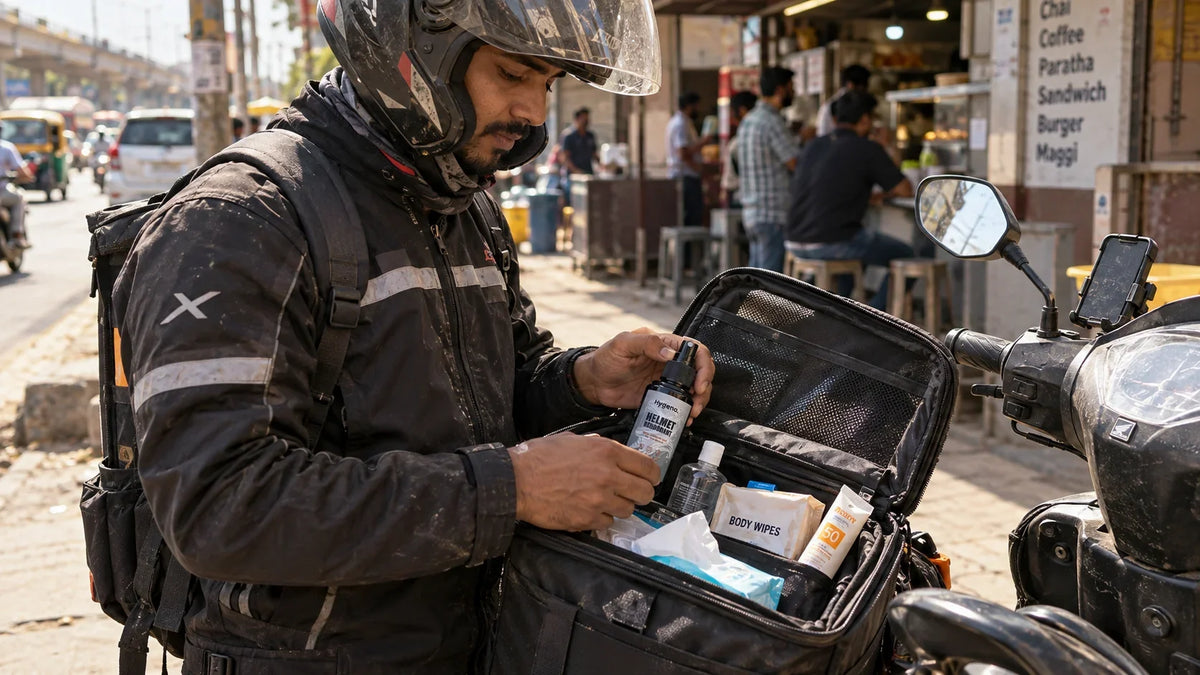
Your shift doesn't pause just because you need to freshen up.
You move between restaurants, traffic lights, apartment lobbies, and roadside waiting spots. Your helmet stays on through heat, sweat, dust, and long hours. A 2026 study of 10 Indian food-delivery riders in Tamil Nadu reported 8 to 13 hour workdays. Source: 2026 PMC study.
That makes rider hygiene different from normal office grooming. You need products that are cheap, small, quick, and easy to carry.
This list focuses on budget hygiene products delivery riders can actually use during a shift. It also covers the one area many riders forget: helmet hygiene.
- Long delivery shifts make compact hygiene products more useful than large bottles.
- Soap and water remain the first choice for handwashing.
- When water isn't available, CDC recommends sanitizer with at least 60% alcohol.
- Your helmet needs its own hygiene habit because sweat and microbes build inside it.
What should a delivery rider carry every day?
Your daily kit should cover hands, skin, sweat, sun, and helmet freshness. You don't need a full bathroom in your delivery bag. You need a few products that solve the problems you face repeatedly.
Start with products you can use in under two minutes. Choose travel sizes whenever possible. Refill them when they run out instead of buying a new pouch every time.
A useful rule is simple: carry one product for each repeated hygiene problem. Don't fill your bag with products you'll use once a week.
Our finding: The best budget kit isn't the one with the most products. It's the one you can reach without unpacking your delivery bag.
A 2020 study examined 130 motorcycle helmets and recovered 392 bacterial and 346 fungal isolates. The study found higher microbial growth in helmets that were never washed or disinfected. Source: Sapkota et al., International Journal of Microbiology, 2020.
INTERNAL LINK: how to clean your motorcycle helmet liner
1. Why carry pocket hand sanitizer?
Keep a small hand sanitizer in the pocket you can reach while stopped. It's useful when a proper sink isn't nearby.
CDC guidance says soap and water are the best option in most situations. When they're unavailable, use an alcohol-based sanitizer containing at least 60% alcohol. Let it dry fully instead of wiping it off.
Your hands touch phones, fuel pumps, door handles, payment devices, bike controls, and food packaging.
Don't use sanitizer as a replacement for washing visibly dirty or greasy hands. Find soap and water when your hands have grime on them.

CDC recommends hand sanitizer with at least 60% alcohol when soap and water aren't available. Sanitizer works less effectively on visibly dirty or greasy hands. Source: CDC, 2024. CDC hand sanitizer guidance.
Budget move: Buy a small refillable bottle if the product label allows safe transfer. Keep it upright and closed.
INTERNAL LINK: motorcycle rider hygiene guide
2. When are pocket body wipes useful?
Body wipes are useful when you can't shower between a long shift and your next break. Use them on areas that collect sweat.
Focus on your neck, underarms, and other sweaty areas. Choose gentle wipes if your skin reacts easily. Avoid using strongly fragranced wipes on irritated skin.
Wipes don't replace a shower. They are a temporary cleanup tool when your route doesn't give you that option.
Keep used wipes in a small waste pouch until you find a bin. Don't throw them beside the road.
Budget move: Buy a small pack first. If you use several wipes every shift, compare larger packs by cost per wipe.
INTERNAL LINK: how to stay clean on a long motorcycle ride
3. Why keep travel-size soap?
A tiny soap container costs little space and gives you a better option whenever you find a washroom.
Wipes are convenient. Soap and water are still the better routine when they're available.
WHO's 2025 community hand hygiene guidance recommends plain soap and water for hand hygiene. It also recognizes alcohol-based hand rub at 60% alcohol or higher when hands aren't visibly dirty.
For a delivery rider, this means you don't need to choose one product forever. Carry sanitizer for gaps between stops and use soap when you get proper access to water.
WHO's 2025 community hand hygiene guidance recommends plain soap and water. It also identifies alcohol-based hand rub with at least 60% alcohol as an effective alternative when hands aren't visibly dirty. Source: WHO, 2025. WHO community hand hygiene guidance.
Budget move: Refill a small leak-proof container instead of carrying a full-size bottle.
4. Which sunscreen should you carry?
Riding exposes your face, neck, and other uncovered skin to daylight for long periods. A small sunscreen tube is easier to use consistently.
Look for broad-spectrum protection and choose a formula you can comfortably reapply. Your best choice depends on your skin type, exposure, and local conditions.
Don't treat sunscreen as a one-time morning step if you're riding for many hours. Sweat, rubbing, and time can change how long protection lasts.
Budget move: A smaller tube can reduce waste if you're still testing what suits your skin.
Our finding: For riders, portability often matters more than bottle size. A sunscreen you carry can beat a larger tube sitting at home.
5. Why carry lip balm?
Wind, sun, and long hours outdoors can leave your lips feeling dry. A small lip balm takes almost no space.
Choose one with SPF if you're spending long periods outdoors. Reapply based on the product directions and your exposure.
Don't share lip balm during shifts. Keep your own stick in a clean pocket.
Budget move: Skip fancy multi-purpose balms if a basic product already solves your problem.
6. Do you need a small hand cream?
Your hands deal with grips, controls, dust, repeated washing, and sanitizer. A small hand cream can help when your skin feels dry.
Use it after your shift or during a longer break. Avoid applying a greasy layer immediately before riding.
A slippery grip isn't worth a few minutes of comfort.
Budget move: Pick a small tube with a simple formula. You don't need a large cosmetic bottle in your delivery bag.
7. Why carry a clean microfiber cloth?
A small microfiber cloth is one of the cheapest useful items in your kit. Use it for sweat and surface moisture around your personal gear.
Don't use the same dirty cloth repeatedly on your face. Keep it dry between uses and wash it regularly.
This isn't a substitute for cleaning helmet padding. It's a quick utility item for the rider.
Budget move: Carry two small cloths. One can dry while you use the other.
8. Why pack a small waste pouch?
Your hygiene kit needs a place for used tissues, wrappers, and wipes. A reusable zip pouch keeps that waste away from clean items.
This sounds boring. It also stops your sanitizer bottle from sharing space with used wipes.
Empty the pouch whenever you reach a suitable bin. Wash it if anything leaks.
Budget move: Reuse a washable pouch you already own.
9. Are spare tissues worth carrying?
Tissues are useful for quick cleanup, drying wet hands, or handling small spills. Keep them sealed inside your bag.
They weigh almost nothing. That makes them an easy backup when your main hygiene product runs out.
Carry enough for the shift, but don't turn your delivery bag into a tissue warehouse.
10. Why does your helmet need its own hygiene spray?
Your helmet deserves its own hygiene product because it sits against your face, hair, and scalp for hours.
The 2020 motorcycle helmet study found bacterial growth in 86.7% of helmets that had no washing or disinfection practice. The washed group had bacterial growth in 57.1% of samples.
That study doesn't prove every dirty helmet causes illness. It does show why the inside of a frequently worn helmet deserves attention.
Hygena is designed for the inside of your helmet. It targets odor-causing bacteria rather than covering the smell with perfume.
In a 2020 study of 130 motorcycle helmets, 86.7% of helmets with no washing or disinfection practice showed bacterial growth. The washed group showed 57.1%. Source: Sapkota et al., 2020. International Journal of Microbiology.
Make this easier: Keep Hygena with your daily riding gear. A short helmet hygiene routine fits better into delivery work than waiting for the helmet to smell bad.
INTERNAL LINK: why your helmet smells
The 2020 helmet study reported bacterial growth in 86.7% of helmets without hygiene practice. Washed helmets showed 57.1% growth. The disinfected group contained only five helmets, so its percentage needs cautious interpretation.
INTERNAL LINK: motorcycle helmet liner cleaning guide
How much should a budget rider hygiene kit cost?
You can build a useful kit without buying ten premium products. Start with the items you use every shift.
| Item | Priority | How often you may use it | Budget approach |
|---|---|---|---|
| Hand sanitizer | High | Multiple times | Small bottle or refill |
| Body wipes | High | As needed | Small pack first |
| Soap | High | At washrooms | Travel container |
| Sunscreen | High | Before and during long exposure | Carry-size tube |
| Lip balm | Medium | As needed | Basic stick |
| Hand cream | Medium | After shifts | Mini tube |
| Microfiber cloth | Medium | Daily | Reusable |
| Waste pouch | Medium | Daily | Reuse one you own |
| Tissues | Medium | As needed | Pocket pack |
| Helmet hygiene spray | High | As part of helmet care | One dedicated bottle |
The cheapest approach is to buy fewer things and use them consistently. A ₹100 product that stays unused isn't saving money.
If you're starting from zero, build the kit in stages. Buy hand hygiene first. Add body wipes and sunscreen next. Then add the rider-specific items.
What should you skip from a budget hygiene kit?
Skip anything that adds weight without solving a real problem during your shift.
- Large bottles that you can refill into travel containers.
- Multiple fragrances that only mask sweat smells.
- Products you only use once a month.
- Duplicate wipes, sprays, or creams with the same purpose.
- Strongly scented products if your skin or breathing reacts to fragrance.
Your kit should feel boring. That's a good sign. It means every item has a job.

How do you pack the kit for a delivery shift?
Keep the kit divided into clean-use and waste-use sections. Put sanitizer, sunscreen, lip balm, and cream in the clean section.
Keep wipes and tissues easy to reach. Put the waste pouch somewhere separate. Your helmet hygiene product should stay protected from leaks and heat.
Don't leave products loose under heavy items. A crushed bottle can turn a cheap hygiene kit into a sticky delivery-bag problem.
Before leaving, check four things: sanitizer, wipes, tissues, and your helmet hygiene product. Add sunscreen if you're riding in daylight.
A 2026 qualitative study of 10 food-delivery riders in Tamil Nadu reported daily working hours from 8 to 13 hours. Long shifts make portable hygiene more practical than routines that depend on frequent access to home. Source: PMC, 2026. Study of food-delivery riders in urban India.
For delivery riders working long shifts, a compact kit can reduce dependence on home-based hygiene routines. A 2026 qualitative study of 10 Indian food-delivery riders reported 8-13 hour workdays. Portable products can therefore fill short gaps between proper washroom and shower access.
INTERNAL LINK: motorcycle hygiene kit
Frequently Asked Questions
What is the cheapest hygiene product for riders?
Start with soap and water when available. Add a sanitizer with at least 60% alcohol for situations without a sink. CDC recommends sanitizer as an alternative when soap and water aren't available. Source: CDC, 2024.
Should delivery riders carry body wipes?
Body wipes can help during long shifts when you can't shower. They work as a temporary cleanup step. They don't replace normal bathing. Choose gentle wipes and avoid using them on irritated skin.
How do delivery riders keep helmets fresh?
Build helmet hygiene into the daily routine. A 2020 study found bacterial growth in 86.7% of helmets with no washing or disinfection practice. Regular helmet care can reduce microbial buildup. Source: Sapkota et al., 2020.
Is sanitizer better than washing hands?
No. Soap and water are the preferred option in most situations. CDC recommends sanitizer with at least 60% alcohol when soap and water aren't available. Sanitizer also works less effectively on visibly dirty or greasy hands.
Do I need every product on this list?
No. Start with the products you use every shift. Hand hygiene, basic cleanup, sun protection, and helmet hygiene usually deserve priority. Add other items when your route and skin needs justify them.
Conclusion: keep your hygiene kit small and useful
Delivery riding already puts enough gear in your bag. Your hygiene kit shouldn't become another burden.
Start with the basics. Carry hand sanitizer, wipes, tissues, sunscreen, and a few small personal-care items. Keep your helmet hygiene routine separate because your helmet stays against your skin for hours.
Hygena is built for that part of the routine. It gives your helmet its own hygiene step instead of relying on perfume to cover yesterday's sweat.
Pack smart. Refill what you can. Use soap and water whenever you have proper access. And don't wait for a bad smell before you start caring for your helmet.
CTA: Build your rider hygiene routine with Hygena.
Next reads: Why does your helmet smell? · How to stay clean on a long motorcycle ride
Sources
- Sapkota, S. et al. (2020). Microbial Diversity and Antibiotic Susceptibility Pattern of Bacteria Associated with Motorcycle Helmets. International Journal of Microbiology. Retrieved October 3, 2026.
- Centers for Disease Control and Prevention (2024). Hand Sanitizer Guidelines and Recommendations. Retrieved October 3, 2026.
- World Health Organization (2025). New guidelines on community hand hygiene to help governments reduce the spread of infectious diseases. Retrieved October 3, 2026.
- PMC (2026). Invisible burdens of platform work: a qualitative study of food-delivery riders' lived experiences in urban India. Retrieved October 3, 2026.
Share:
Helmet Cleaning Spray: How to Use It Safely
How the Hygena Helmet Deodorant Kills Bacteria Without Damaging Your Liner