
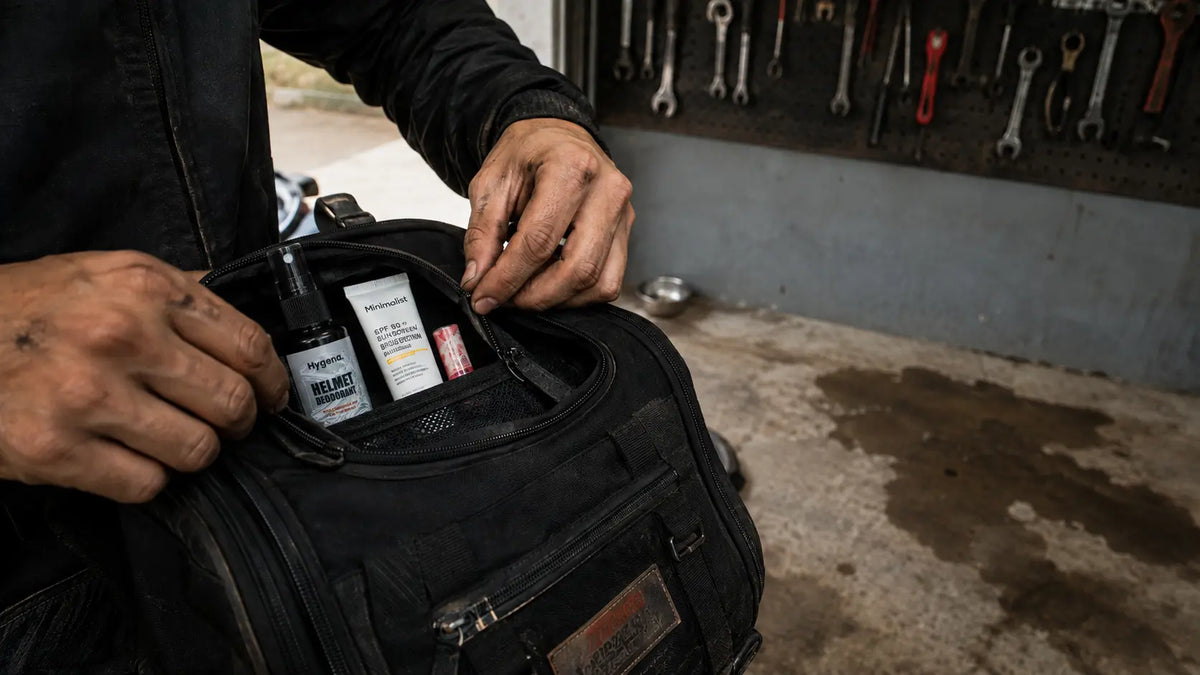
You unclip your helmet after a three-hour ride and the smell hits you first.
Sweat, sunscreen, and road dust are all still trapped in there. Whatever bacteria moved in last week is too. Most riders own gloves, rain covers, and tool kits for the bike. Almost nobody owns a kit for themselves.
That's the gap this list fixes. Here's exactly what belongs in a rider's hygiene kit and why each item earns its spot. It also covers how the kit changes for a daily commute versus a long tour.
Rider Takeaways
- A rider's hygiene kit needs 8 core items, not 20. Helmet deodorant spray is the one non-negotiable item. A 2014 East African Medical Journal study found motorcycle crash helmets carried more bacteria than ATMs or public toilets.
- The full kit routine takes under 3 minutes, spray to wipe-down.
- A daily commute kit and a long-tour kit share 5 items. The other 3 are tour-only additions.
Why Does a Rider Even Need a Hygiene Kit?
In 2014, researchers at Kigali's public health labs tested three everyday surfaces for bacteria. Commercial motorcycle helmets, ATM keypads, and public toilets were the three surfaces tested (Nigatu et al., East African Medical Journal). The helmets came out dirtiest of the three. That's the surface sitting against your forehead every ride.
Heat makes it worse. In hot conditions, hard physical activity can push sweat loss to 3 to 4 liters an hour. That's per a report from the U.S. National Academies' Institute of Medicine. Riding in Indian summer traffic isn't a lab-controlled workout. But the mechanism is the same: trapped sweat under a sealed helmet becomes bacteria's favorite meal.
Delivery and gig riders feel this hardest. Workers described "fatigue, dizziness, headaches and dehydration" during India's 2026 heatwaves, per reporting by WRI India. Many delivery riders spend 8 to 10 hours a day in a sealed helmet. So the smell isn't really the problem. It's the symptom.
So what actually stops it?
Quick Fact:
A 2014 study in the East African Medical Journal (Nigatu et al.) tested bacterial contamination on three surfaces. ATM keypads, public toilets, and commercial motorcycle crash helmets in Kigali, Rwanda were compared. The helmets showed the highest contamination of the three. Source: PubMed
A 2014 study in the East African Medical Journal (Nigatu et al.) tested bacterial contamination on three surfaces. ATM keypads, public toilets, and commercial motorcycle crash helmets in Kigali, Rwanda were compared. The helmets showed the highest contamination of the three. Source: PubMed
What Should Be in Every Rider's Hygiene Kit?
Eight items cover almost everything a rider's body deals with between the helmet clip and the shower at home. Keep them together in one small pouch, so packing takes no thought at all.
- Helmet deodorant spray. This is the one item that isn't optional. It targets the bacteria living inside the liner, not just the smell they produce. A Hygena spray takes about 5 seconds, and the shell airs out while you're parking.
- Broad-spectrum sunscreen, SPF 50+. A 2025 study in the Journal of Cosmetic Dermatology tracked 379 cyclists. Only 67.3% used sunscreen at all, and under half reapplied more than once a day. Riders in open helmets and mesh gear face similar exposure.
- SPF lip balm. Wind strips moisture from lips faster than most riders notice, until it cracks. Keep it in the same pocket every time, so you actually reach for it.
- Alcohol-based hand sanitizer or wipes. Handwashing education cuts respiratory illness by 16 to 21% and diarrheal illness by 23 to 40%, per the CDC. Useful before every dhaba stop.
- Travel-size deodorant or antiperspirant. A helmet traps heat at the scalp, but the rest of the ride still sweats. This is the item riders forget until they're standing in a meeting.
- No-rinse body wipes. For the days a proper shower isn't happening: a fuel stop, a dusty campsite, a delayed flight home. Wipe down the neck, underarms, and feet.
- Anti-chafe balm. Saddle time past 2 to 3 hours is when chafing usually starts. A thin layer on inner thighs before a long tour beats treating the damage after.
- Dry shampoo or a thin cotton skull cap. Helmet hair isn't just cosmetic. Trapped sweat at the scalp is part of the same bacterial problem as item one. A cap keeps hair off the liner. Dry shampoo resets it fast at a rest stop.

Quick Fact:
Hard physical activity in hot conditions can push sweat loss to 3 to 4 liters an hour. Over a full day, that can reach 10 liters, per a report from the U.S. National Academies' Institute of Medicine. That sweat, trapped under a sealed helmet, is exactly what feeds the bacteria a helmet deodorant is built to stop. Source: National Academies Press / NCBI Bookshelf
Hard physical activity in hot conditions can push sweat loss to 3 to 4 liters an hour. Over a full day, that can reach 10 liters, per a report from the U.S. National Academies' Institute of Medicine. That sweat, trapped under a sealed helmet, is exactly what feeds the bacteria a helmet deodorant is built to stop. Source: National Academies Press / NCBI Bookshelf
Daily Commute Kit vs. Long-Tour Kit — What Changes?
A 20-minute office commute and a 12-day Ladakh run don't need identical kits. Five items carry over either way. Three only earn their weight on a tour.
Skip the anti-chafe balm and body wipes for a daily ride. You'll shower at home anyway. Keep them zipped into the tank bag the moment a trip crosses a single day.
Why keep the split this strict? A bulging pouch is a pouch nobody opens. Fewer items in the daily kit means the habit actually survives a busy Monday morning.
Unique Insight
Our finding: The helmet deodorant spray is the only kit item riders reach for on every single ride. That's true across the questions Hygena hears most, not just on hot days or long trips. Everything else in the kit is situational. That's the difference between an occasional habit and a routine one.
Where Does Hygena Fit Into This Kit?
Every item on this list solves a real problem. Only one solves the problem riders don't see coming. That's the bacteria growing inside the one piece of gear touching their skin for hours at a time.
Hygena's helmet deodorant spray is bacteriostatic. It stops odor-causing bacteria from multiplying, rather than masking the smell they've already made. Riders don't need to remove the liner or wait for it to dry. A few sprays after a ride, and the helmet's ready for tomorrow.
Bhai, jo cheez roz ride pe jaati hai, use roz clean rakhna padta hai. The thing that rides with you every day needs daily attention. That's the whole logic behind putting it first in the kit, not last.
It's dermatologically tested and backed by over 10,000 riders with a 4.8-star rating. Nothing else in this kit replaces it. Sunscreen doesn't clean a liner, and wipes can't reach inside a shell.

How Do You Actually Carry This Kit on the Bike?
Where the kit lives matters as much as what's in it. A pouch buried under tools never gets opened.
Keep the daily-commute five in a small zip pouch inside the tank bag or top box. Pick a spot you touch every time you park. For tours, add the other three items to a separate dry bag. That way a wet pannier never soaks the sunscreen through the deodorant.
Where should the helmet spray specifically live? Right next to the ignition key, if there's room. That location alone turns it into a post-ride habit instead of a someday task.
Restock the kit once a month, not once a year. Sunscreen and lip balm run out fast in summer, and an empty pouch is worse than no pouch at all. It gives a false sense that the kit's still doing its job.
Unique Insight
Our finding: The two items riders forget to restock most are sunscreen and lip balm, not the helmet spray. Both run out fast and both are easy to overlook in a pouch you don't open daily. Keeping a spare of just those two, rather than doubling the whole kit, closes that gap.
Frequently Asked Questions
How many items should be in a rider's hygiene kit?
Eight core items cover most riding scenarios. That's helmet deodorant, sunscreen, lip balm, hand sanitizer, deodorant, body wipes, anti-chafe balm, and dry shampoo or a skull cap. The last three are tour-specific.
What's the single most important item in a hygiene kit?
Helmet deodorant spray. A 2014 East African Medical Journal study found motorcycle helmets carried more bacteria than ATMs or public toilets. That surface sits against skin every ride.
How often should the helmet deodorant spray be used?
After every ride, ideally. Sweat can reach 3 to 4 liters an hour in heat, per the U.S. National Academies. That moisture feeds bacteria within hours of a ride ending.
Can sunscreen alone replace a full skincare step in the kit?
No. Only 67.3% of outdoor riders in a 2025 Journal of Cosmetic Dermatology study used sunscreen at all. Fewer still reapplied it. Lip balm and a wipe-down cover what sunscreen misses.
Does a hygiene kit replace regular helmet liner washing?
No, they solve different problems. Washing removes buildup already there. The kit's helmet spray works between washes, so bacteria doesn't get the chance to multiply.
Conclusion
A rider's hygiene kit doesn't need to be complicated. Eight items, one small pouch, under three minutes a ride.
Start with the one non-negotiable item: helmet deodorant spray. Then build the rest of the kit around whichever ride is on the calendar this week. Grab Hygena's helmet deodorant spray to cover the item every helmet needs and nothing else can replace.
Sources
1. Nigatu, W. et al. "Comparative Study on the Level of Bacteriological Contamination of Automatic Teller Machines, Public Toilets and Public Transport Commercial Motorcycle Crash Helmets in Kigali City, Rwanda." East African Medical Journal, 2014. Retrieved 2026-08-29.
2. "Water Requirements During Exercise in the Heat." Nutritional Needs in Hot Environments, Institute of Medicine (US), National Academies Press. Retrieved 2026-08-29.
3. "Sunscreen Use Among Cyclists Falls Short." Dermatology Times, summarizing a 2025 study in the Journal of Cosmetic Dermatology. Retrieved 2026-08-29.
4. "Handwashing: A Family Activity." CDC Clean Hands. Retrieved 2026-08-29.
5. "Rising Heat's Invisible Burden on Delivery Workers." WRI India, 2026. Retrieved 2026-08-29.
Share:
Motorcycle Packing List for Long-Distance Touring
Best Earplugs for Motorcycle Riders (That Stay Hygienic)