
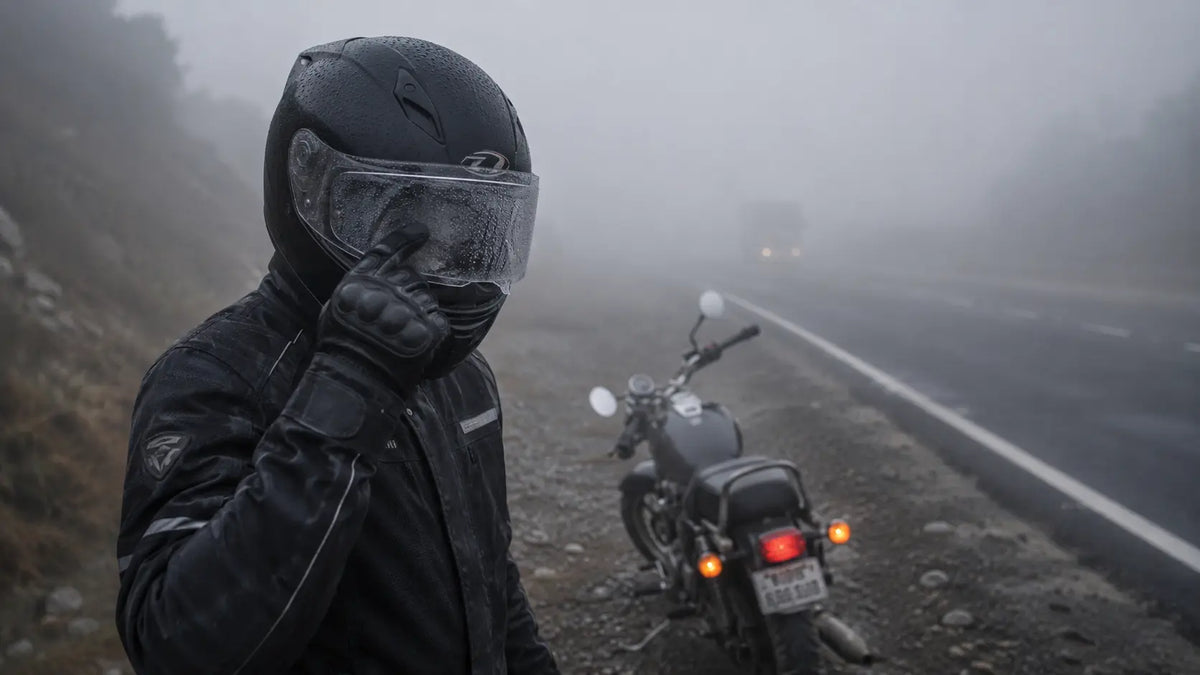
You're doing 40 on the highway when a truck's taillight up ahead just vanishes. One second it's there, the next there's only white. Fog does that on Indian highways every winter, and it's not just an inconvenience.
India loses 14 lives every single day to fog-related road accidents, according to the Ministry of Road Transport and Highways. Riders on two wheels are the most exposed. No windscreen, no crumple zone, nothing between you and zero visibility.
These riding-in-fog motorcycle tips are built for Indian winters. You'll find out what actually clears a fogged visor. You'll also see what makes you visible when a truck driver can't see past his own bonnet. Your helmet's liner takes more damage on foggy mornings than most riders realize.
Rider Takeaways
- Fog-related crashes kill 14 people a day on Indian roads, per Ministry of Road Transport and Highways data.
- Your visor fogs because warm breath hits a cold outer shell. A cracked visor or Pinlock insert fixes it fast.
- Reflective gear cut crash-injury risk by 37% in a landmark BMJ study on motorcyclists.
- Trapped humidity inside a fogged helmet also feeds bacteria in the liner, not just the visor.
Why Does Fog Make Indian Highways So Dangerous for Riders?
In 2023, the Ministry of Road Transport and Highways reported 5,740 deaths from 7,994 fog-related accidents over seven years. That's an average of 14 lives lost every day. The figure comes from "Road Accidents in India," the ministry's own report, cited by The Tribune in January 2023.
Visibility during a bad fog spell isn't a slight haze. In December 2025, several north Indian cities recorded near-zero visibility. Delhi's Safdarjung area measured just around 100 metres one morning. At highway speed, 100 metres disappears in under 10 seconds.
Assam tells a similar story, just with hill-terrain fog instead of the Indo-Gangetic plain's smog-fog mix. Fog-related deaths there climbed from 401 in 2020 to 634 in 2024. That's a five-year total of 2,476 lives, per data reported by The Sentinel. The trend is going the wrong way, not the right one.
Quick Fact:
Fog-related road accidents kill an average of 14 people every day in India. That's based on seven years of Ministry of Road Transport and Highways data: 7,994 accidents, 5,740 deaths. Riders face the highest exposure of any road user in these conditions. Source: The Tribune, 2023
Fog-related road accidents kill an average of 14 people every day in India. That's based on seven years of Ministry of Road Transport and Highways data: 7,994 accidents, 5,740 deaths. Riders face the highest exposure of any road user in these conditions. Source: The Tribune, 2023
Why Does Your Visor Fog Up the Moment You Hit Cold Air?
Your breath is warm and humid. The outer shell of your visor is cold. The instant that warm air touches the cold surface, moisture condenses into the fine mist you're squinting through. That's the whole mechanism, per SMK Helmets' 2025 breakdown of visor fogging.
Three things make it worse on a foggy Indian winter morning. Breathing inside a sealed helmet raises internal humidity fast. Closed vents trap that warm air instead of letting it escape. And the fog outside is already near-saturated air, so there's extra moisture working against you from both sides.
Kohre mein visor saaf rakhna sabse bada struggle hai. Keeping your visor clear in fog is genuinely one of the hardest parts of a winter ride. It's not something willpower fixes.
Quick Fact:
Helmet visors fog because warm, humid breath condenses on a colder outer shell. Pinlock inserts combine moisture-absorbing nanotechnology with an airtight air pocket. SMK Helmets rates them "Excellent" for fog resistance, "Moderate" for basic pre-treated visors. Source: SMK Helmets, 2025
Helmet visors fog because warm, humid breath condenses on a colder outer shell. Pinlock inserts combine moisture-absorbing nanotechnology with an airtight air pocket. SMK Helmets rates them "Excellent" for fog resistance, "Moderate" for basic pre-treated visors. Source: SMK Helmets, 2025

How Do You Stop Visor Fogging Before It Blinds You Mid-Ride?
Crack your visor half an inch at low speed and most of the fog clears within seconds. It's the fastest fix you have, and it costs nothing. Keep your chin vents open too — sealing every gap only traps more of your own breath inside.
If you ride the same fog belt every winter, a Pinlock-style anti-fog insert is worth fitting once and forgetting. That covers Delhi-NCR, the Grand Trunk Road stretch, or anywhere across the Indo-Gangetic plain. It outlasts spray-on treatments by entire seasons, not weeks.
A neck gaiter pulled up over your nose also helps more than most riders expect. It redirects your breath downward instead of straight up into the visor. Small change, real difference on a cold morning commute.
Unique Insight
Our finding: Most riders treat visor fog as a gear problem alone. It's also a breathing-direction problem. Where your exhale actually goes matters as much as what coating is on the visor.
What Should You Wear to Actually Be Seen in Fog?
A landmark 2004 BMJ study looked at New Zealand motorcycle crashes. Riders wearing reflective or fluorescent clothing had a 37% lower risk of crash-related injury. White helmets showed a 24% lower risk, and daytime headlight use came in at 27% lower.
None of that requires expensive gear. A reflective strip across your jacket's back and sleeves does most of the work. That's what a driver's headlights catch first. Keep your headlight on at all times in winter, fog or not. It's the cheapest visibility upgrade you own.
Ever notice how a black jacket just disappears in grey fog? That's the exact problem the study measured, and it's an easy one to fix before your next ride.
Quick Fact:
A BMJ-published study tracked 463 motorcycle crash victims against 1,233 control riders. Reflective or fluorescent clothing cut crash-injury risk by 37%. White helmets cut it by 24%, and daytime headlight use by 27%. Source: BMJ, 2004
A BMJ-published study tracked 463 motorcycle crash victims against 1,233 control riders. Reflective or fluorescent clothing cut crash-injury risk by 37%. White helmets cut it by 24%, and daytime headlight use by 27%. Source: BMJ, 2004
Is Your Helmet Liner Making Winter Rides Worse?
A fogged-up visor means trapped, humid air, and that air isn't just blurring your view. It's sitting against your scalp and your liner too. A 2022 peer-reviewed study looked at humidity and bacterial growth. Raising relative humidity from 50% to 90% multiplied bacterial growth up to 92 times at warmer temperatures.
Apply that principle to a helmet. Sweat from the ride, fog condensation, and body heat from a closed-up jacket all combine inside your liner. That's a warmer, wetter environment than any summer commute produces, even though it doesn't smell as strong right away.
This is where a helmet hygiene routine earns its place in your winter riding kit, not just your summer one. Hygena's bacteriostatic spray goes on before you close your visor. It keeps working on the bacteria multiplying inside, not masking anything, just stopping it at the source.
Quick Fact:
Raising humidity from 50% to 90% multiplied bacterial growth up to 92 times at warmer temperatures, per controlled lab study. A fogged, sweat-damp helmet liner sits well inside that same humidity range on a foggy ride. Source: International Journal of Environmental Research and Public Health, 2022
Raising humidity from 50% to 90% multiplied bacterial growth up to 92 times at warmer temperatures, per controlled lab study. A fogged, sweat-damp helmet liner sits well inside that same humidity range on a foggy ride. Source: International Journal of Environmental Research and Public Health, 2022

What's the Safest Way to Actually Ride Through Fog?
NHAI's own winter safety guidance is blunt. Keep your speed at 30 km/hr or under in dense fog. Increase your following distance well beyond what feels normal. At that visibility, "normal" following distance isn't enough time to stop.
Use your low beam, not high beam — high beam bounces straight back off fog and blinds you further. Fog lights, if your bike has them, sit lower and cut under the mist instead of into it. Hazard lights help other vehicles spot you from behind.
Skip overtaking entirely until visibility improves. You can't see what's coming from the other direction, and neither can the vehicle you're trying to pass. If the fog is bad enough that you can't see 50 metres, delay the ride. Twenty minutes is safer than guessing what's ahead.
Unique Insight
Our finding: Riders consistently underestimate how much stopping distance fog costs them, because the danger is invisible until it isn't. Treat every foggy stretch as if your brakes are already 30% weaker. Your reaction time effectively is.
Frequently Asked Questions
What speed should I ride at in dense fog on Indian highways?
NHAI recommends 30 km/hr or under in dense fog, with extended following distance. This guidance was issued in the agency's December 2025 winter road safety measures for national highways.
Why does my visor fog up worse in winter than in the monsoon?
Winter creates a bigger gap between your warm breath and the cold outer shell, which speeds up condensation. Monsoon air is humid too, but the temperature difference driving winter fogging is usually sharper, per SMK Helmets' 2025 explainer.
Does a Pinlock insert actually stop visor fogging?
Yes. Pinlock-style inserts combine moisture-absorbing nanotechnology with a sealed air pocket. SMK Helmets rates them "Excellent" for fog resistance, against "Moderate" for basic pre-treated visors, in a 2025 review.
Is reflective gear really worth it for fog riding?
Yes. A BMJ-published 2004 study found reflective or fluorescent clothing cut crash-injury risk by 37% for motorcyclists. That's one of the largest gear-based safety gains ever measured.
Can foggy rides damage my helmet liner over time?
Trapped humidity from a fogged visor keeps your liner warmer and wetter for longer. Higher humidity is proven to accelerate bacterial growth. A quick spray before you ride helps keep that growth in check.
Conclusion
Fog turns an ordinary commute into the most dangerous ride of your week. Fourteen lives lost a day isn't a statistic you want to test. Crack your visor. Fit a Pinlock if you ride this belt often. Wear something reflective, and keep your speed honest.
Here's the one thing riders forget. That same fog is quietly feeding bacteria inside your liner while you're focused on the road ahead. A quick spray of Hygena before you close your visor handles that half of the problem. Then you only have to think about the ride.
Sources
1. "14 Lives Lost Daily in Fog-Related Mishaps," The Tribune, 2023. Retrieved 2026-08-31. Link
2. "Assam Fog-Related Road Accidents: 2,476 Deaths in 5 Years as Visibility Crisis Grows," The Sentinel, 2026. Retrieved 2026-08-31. Link
3. "Visibility Drops as Dense Fog Blankets North India; Delhi on Orange Alert," Business Standard, 2025. Retrieved 2026-08-31. Link
4. "NHAI Takes Measures to Enhance Visibility Due to Foggy Conditions," Press Information Bureau, 2025. Retrieved 2026-08-31. Link
5. "Anti-Fog Visors: How They Work & Best Solutions for Clear Vision," SMK Helmets, 2025. Retrieved 2026-08-31. Link
6. "Bright Clothing and White Helmets Cut Motorcycle Deaths," BMJ, 2004. Retrieved 2026-08-31. Link
7. "The Effects of Ventilation, Humidity, and Temperature on Bacterial Growth and Bacterial Genera Distribution," International Journal of Environmental Research and Public Health, 2022. Retrieved 2026-08-31. Link
Share:
Why Riding Jackets Cause Bra-Line Chafing (And the Fix)
Why Every Rider Should Do a Solo Trip at Least Once