
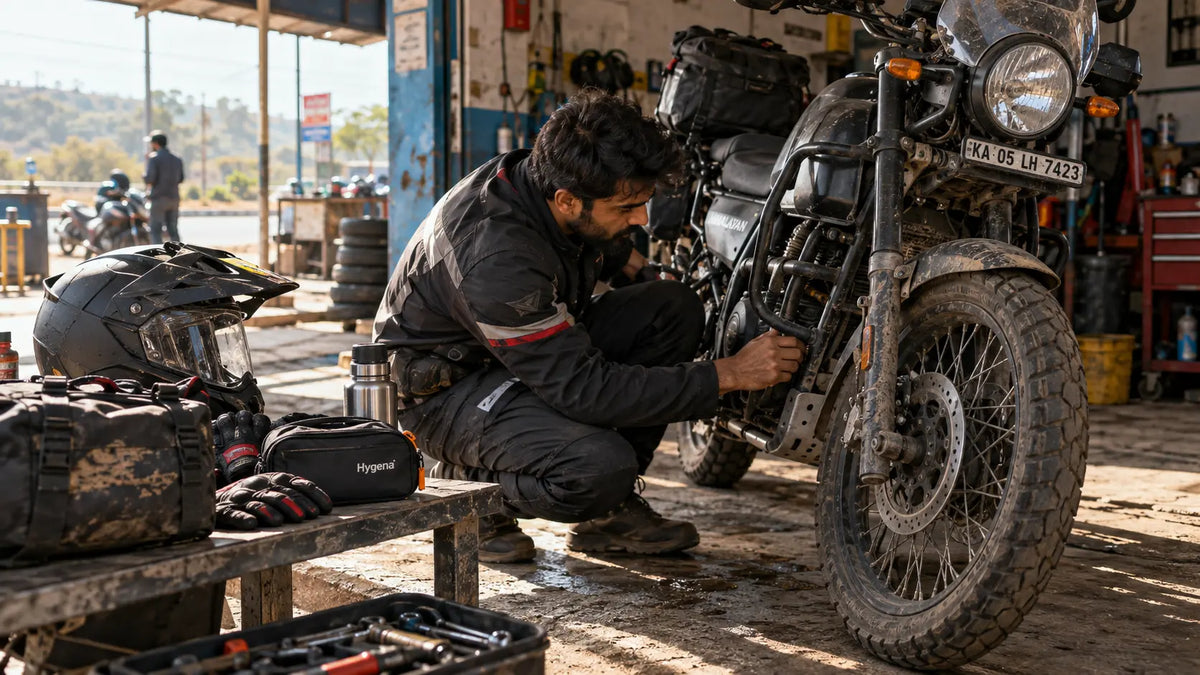
You've packed the bags, charged your phone, and planned the route. Then you spot one loose mirror.

That small check can change your whole departure routine. A long ride deserves more than a quick fuel stop and a helmet grab. You need a repeatable pre-ride check covering the motorcycle, riding gear, and your personal hygiene kit.

The Motorcycle Safety Foundation's T-CLOCS checklist groups motorcycle inspection around tyres, controls, lights, fluids, chassis, and stands. It gives you a useful structure for a long-ride check.

Your hygiene kit belongs in that same routine. Hours inside a helmet can mean sweat, damp liners, and stale gear. So, before you roll out, check your ride and your freshness.

Rider Takeaways
- The Motorcycle Safety Foundation's T-CLOCS checklist covers six major inspection areas.
- Check tyres, brakes, controls, lights, fluids, chain or belt, and stands before departure.
- Heat can increase rider strain during long rides, especially with protective clothing.
- Pack water, basic personal-care items, and a helmet hygiene product for longer stops.
What belongs in your pre-trip bike checklist?
Start with the motorcycle's basic roadworthiness before checking luggage or accessories. In its T-CLOCS guide, the Motorcycle Safety Foundation lists tyres, controls, lights, fluids, chassis, and stands.

That structure keeps your inspection simple. You don't need to stare at every bolt for an hour. You need a consistent sequence that catches obvious problems before the ride starts.

1. Tyres and wheels

Check both tyres while they're cold. Look for low pressure, uneven wear, cracks, cuts, bulges, or embedded objects.

Check the valve area too. A slow leak can become a serious problem several hours into a tour.

Look around the rims for dents or visible damage. If your motorcycle uses spokes, check for damage or obvious looseness.

The exact tyre pressure should come from your motorcycle manufacturer. Don't copy another rider's pressure because the bike or load may differ.

2. Brakes

Test the front and rear brakes separately while the motorcycle is stationary. The controls should feel normal and firm.

Look at the pads and discs for obvious wear. Check the brake fluid reservoir if your motorcycle uses hydraulic brakes.

A pre-trip check isn't a replacement for scheduled service. If the brakes feel unusual, stop the inspection and get the motorcycle checked.

3. Controls

Move the handlebars through their normal range. Check the throttle, levers, switches, cables, and visible hoses.

The throttle should move freely and return when released. Controls shouldn't bind when you turn the handlebar.

This check takes little time. It can also reveal a problem that feels very different once you're riding.

4. Lights and electricals

Turn on the headlight, tail light, brake light, indicators, and other essential switches.

Check the mirrors while you're seated in your normal riding position. The Motorcycle Safety Foundation also recommends checking wiring, battery condition, and electrical connections.

Don't leave this for the first fuel stop. A failed light can matter most after sunset.

5. Fluids

Check the engine oil using your motorcycle manufacturer's procedure. Check coolant, brake fluid, and fuel levels where applicable.

Look for fresh leaks around the engine, hoses, reservoirs, and fuel system. Your owner's manual should decide the correct inspection method.

6. Chain, belt, chassis, and stands

If your bike uses a chain, inspect its tension, lubrication, and sprockets. Belt-drive motorcycles need a different inspection approach.

Check the frame, suspension, fasteners, and steering area for obvious damage. Finish by checking the side stand and centre stand.

Quick Fact:
The Motorcycle Safety Foundation's T-CLOCS checklist uses six inspection areas: tyres, controls, lights, fluids, chassis, and stands. Source: Motorcycle Safety Foundation, "T-CLOCS Pre-Ride Inspection Checklist," 2023. https://msf-usa.org/documents/library/t-clocs-pre-ride-inspection-checklist/
<!-- CITATION CAPSULE -->
A long-ride motorcycle inspection should cover tyres and wheels, controls, lights and electrics, fluids, chassis, and stands. The Motorcycle Safety Foundation's T-CLOCS checklist uses these six areas. Source: Motorcycle Safety Foundation, 2023. https://msf-usa.org/documents/library/t-clocs-pre-ride-inspection-checklist/
How can your pre-trip bike checklist include gear?
Your motorcycle can be ready while your riding kit is still causing problems. Check the helmet, gloves, jacket, boots, and rain layer before loading the bike.

Heat can make protective riding clothing physically demanding. In a 2019 study, riders in motorcycle PPE completed a 90-minute trial at 35°C and 40% relative humidity. Core temperature rose by 2°C, while skin temperature rose by 3°C.

That matters on Indian long rides. Your gear protects you, but heat and sweat still need managing.

Helmet

Check the helmet shell, visor, strap, and closure. Make sure nothing feels loose or damaged.

Then check the inside. Look at the liner, cheek pads, chin area, and strap for sweat buildup or dampness.

A helmet that smells before the ride rarely gets better after six hours. Give it time to dry before packing it.

Gloves

Check the palms, fingers, closures, and stitching. Make sure the gloves still give you normal control feel.

Don't pack wet gloves into a sealed bag. Damp gear becomes a problem quickly during a multi-day tour.

Jacket and riding pants

Check closures, armour placement, pockets, and visible damage. Confirm your protective inserts are where they should be.

For hot-weather rides, choose a setup that gives protection without creating unnecessary heat stress. The 2019 motorcycle PPE study found that thermal strain can affect workload, mood, and reaction time.

Boots

Check the soles, fasteners, laces, and ankle area. Make sure the boots feel secure before you leave.

If the inside already smells strongly, don't trap that odour inside your luggage. Clean and dry the boots before departure.


Quick Fact:
A 2019 study of motorcycle protective clothing tested a 90-minute exposure at 35°C and 40% relative humidity. Core temperature increased by 2°C, and reaction time fluctuated by 36 milliseconds. Source: Taylor et al., "Could wearing motorcycle protective clothing compromise rider safety in hot weather?", 2019. https://pubmed.ncbi.nlm.nih.gov/31071655/

Unique Insight
Our finding: Treat your gear check like a departure ritual, not a final-minute packing task. Your helmet and gloves should be ready before your luggage goes on the bike.
<!-- CITATION CAPSULE -->
Hot-weather riding can increase physiological strain while you wear protective motorcycle clothing. In a 2019 controlled study, 90 minutes at 35°C and 40% relative humidity increased core temperature by 2°C. Reaction time also fluctuated during the trial. Source: Taylor et al., 2019. https://pubmed.ncbi.nlm.nih.gov/31071655/
What personal hygiene kit should you pack?
Your pre-trip bike checklist should include a small hygiene kit. Long rides create repeated contact between sweat, skin, helmet liners, gloves, and clothing.

A tropical motorcycle study measured sweat rates of 1.01 litres per hour during practice. It measured 0.90 litres per hour during qualifying. Riders also reached median post-session gastrointestinal temperatures near 39°C.

You don't need a giant toiletry bag. You need the items you'll actually use.

PUT THESE BASICS:
- Water: Keep enough accessible for regular hydration stops.
- Face and body wipes: Useful when a full wash isn't available.
- Small towel: Keep one separate from your wet riding gear.
- Deodorant: Choose a product suited to your normal riding routine.
- Helmet hygiene spray: Carry Hygena when you want to manage odour-causing bacteria between rides.
- Hand sanitiser: Useful after fuel stops and roadside meals.
- Small waste bag: Keep used wipes and damp items away from clean gear.
Pack the kit somewhere reachable. You shouldn't need to unpack your entire saddlebag for a five-minute refresh.

Your helmet deserves its own routine
Your helmet sits close to your scalp for hours. Sweat and skin oils collect around the liner and contact points.

That's where a helmet hygiene habit helps. Hygena is designed for helmet hygiene and targets the bacteria associated with helmet odour.

Use it as part of your routine before or after rides, following the product directions. It isn't a replacement for cleaning or manufacturer-approved helmet care.

Quick Fact:
A tropical motorcycle racing case study recorded sweat rates of 1.01 L/h during practice. Qualifying measured 0.90 L/h. Median heart rates were about 164 and 160 beats per minute. Source: Edwards et al., 2014. https://pubmed.ncbi.nlm.nih.gov/24413968/
<!-- CITATION CAPSULE -->
A tropical motorcycle case study measured 1.01 L/h during practice. Qualifying measured 0.90 L/h. The same study recorded median heart rates near 160–177 beats per minute. Long rides can therefore create a meaningful sweat burden for riders and their gear. Source: Edwards et al., 2014. https://pubmed.ncbi.nlm.nih.gov/24413968/
Make this easier with Hygena
A long ride already has enough things to remember. Your helmet hygiene routine shouldn't become another complicated task.

Hygena is made for the inside of your helmet. Add it to your pre-ride kit so you have a dedicated hygiene step when your helmet needs freshening.

CTA: Keep your bike checked, your gear ready, and your helmet routine packed. [Hygena Helmet Deodorant](https://hygena.in/) can fit into that routine without taking up much space.
What should you check before loading the luggage?
Pack only after the motorcycle and gear pass your inspection. Then check how the load sits on the bike.

A government road-safety guide advises riders to maintain their vehicle by checking brakes, tyres, lights, and signals. It also warns against overloading because handling can worsen.

Use this loading sequence
- Heavy items: Place dense items low and close to the motorcycle's centre.
- Frequently used items: Keep rain gear, water, documents, and hygiene supplies accessible.
- Loose items: Secure every strap, buckle, and external bag.
- Balance: Check that luggage isn't pulling noticeably to one side.
- Final controls: Turn the handlebar fully and confirm nothing interferes.
Don't put a heavy hygiene bag somewhere awkward just because it's easy to reach. Keep the kit compact instead.

If you use panniers, check their locks and mounting points. If you use a tail bag, confirm the straps can't contact the wheel or chain.

Quick Fact:
Delhi Traffic Police's safety guidance tells riders to maintain their vehicles by checking brakes, tyres, lights, and signals. The same guidance warns that overloading can worsen vehicle handling. Source: Delhi Traffic Police, General Safety Guidelines, accessed 2026. https://www.parivahan.gov.in/delhitrafficpolice/en/general-safety-guidelines

<!-- [UNIQUE INSIGHT] -->
A good luggage setup has two tests: nothing moves unexpectedly, and the things you need during stops stay reachable.

<!-- CITATION CAPSULE -->
Before loading for a long ride, check the motorcycle's brakes, tyres, lights, and signals. Then secure the luggage and avoid excessive loading. Delhi Traffic Police guidance specifically notes that overloading can worsen handling. Source: Delhi Traffic Police, General Safety Guidelines. https://www.parivahan.gov.in/delhitrafficpolice/en/general-safety-guidelines
How can you turn this into a five-minute pre-ride habit?
The best checklist is the one you actually repeat. Use the same order before every long ride, then slow down when something looks wrong.

A 2024 Bengaluru study observed helmet use among 98,021 motorized two-wheelers. Helmet use among riders was 92.4%, but correct helmet use was only 38%.

That gap shows why "wearing the gear" isn't the whole routine. Fit, condition, and correct use matter too.

Your five-minute sequence
- Walk around the bike: Look at tyres, leaks, damage, and loose parts.
- Check controls: Test brakes, throttle, clutch, steering, and switches.
- Check lights: Test headlight, brake light, tail light, and indicators.
- Check fluids: Confirm levels and look for fresh leaks.
- Check gear: Helmet, gloves, jacket, pants, boots, and rain layer.
- Check hygiene: Water, wipes, towel, sanitiser, and helmet hygiene spray.
- Check luggage: Secure every bag and confirm nothing interferes with controls.
- Start smart: If anything feels wrong, fix it before you leave.
Quick Fact:
A 2024 observational study in Bengaluru examined 98,021 motorized two-wheelers. It reported helmet use among 92.4% of riders, while correct helmet use was 38%. Source: Sukumar et al., 2024. https://pubmed.ncbi.nlm.nih.gov/39183529/

<!-- CITATION CAPSULE -->
A 2024 Bengaluru observational study sampled 98,021 motorized two-wheelers. It found helmet use among 92.4% of riders, while correct helmet use was 38%. The finding supports checking helmet fit and use, rather than treating helmet presence alone as a complete gear check. Source: Sukumar et al., 2024. https://pubmed.ncbi.nlm.nih.gov/39183529/

[INTERNAL-LINK: motorcycle helmet maintenance India → helmet care guide]
Frequently Asked Questions
What should I check first before a long ride?

Start with tyres and wheels, then brakes and controls. Continue with lights, fluids, chassis, and stands. The Motorcycle Safety Foundation uses this sequence through its T-CLOCS framework. Your owner's manual should control any model-specific inspection steps. Source: Motorcycle Safety Foundation, 2023. https://msf-usa.org/documents/library/t-clocs-pre-ride-inspection-checklist/

Should helmet hygiene be part of bike prep?

Yes. Your helmet stays close to your scalp for long periods, especially on touring days. Tropical motorcycle research has recorded sweat rates around 0.90–1.01 L/h during racing sessions. Pack a dedicated helmet hygiene product alongside your other personal-care essentials. Source: Edwards et al., 2014. https://pubmed.ncbi.nlm.nih.gov/24413968/

How often should I use my helmet hygiene spray?

Use it according to the product directions and your riding routine. Frequent riders may need a more consistent hygiene habit because sweat and skin oils repeatedly reach the liner. Hygena is designed for helmet hygiene rather than replacing manufacturer-approved cleaning methods.

What should I pack for a long motorcycle trip?

Carry water, basic personal-care items, a small towel, wipes, sanitiser, and a helmet hygiene product. Keep these items accessible during stops. Also pack rain gear and any motorcycle-specific essentials required for your route.

Should I ride if something feels wrong during the check?

No. A pre-ride check is useful because it gives you a chance to fix obvious problems before departure. If a brake, tyre, control, fluid system, or structural component seems unsafe, get it inspected before riding.

The pre-trip bike checklist you actually need

A long ride doesn't start when you turn the key. It starts when the motorcycle, gear, luggage, and rider are ready.

Use the same inspection order every time. Check the tyres, brakes, controls, lights, fluids, chassis, and stands. Then check your helmet and protective gear.

Finally, pack your personal hygiene kit. Sweat is part of riding, especially when the weather is hot. A tropical motorcycle study recorded sweat rates close to one litre per hour during racing sessions.

Your checklist doesn't need to be complicated. It needs to be repeatable.

Add helmet hygiene to the routine. Keep Hygena with your touring essentials, and deal with helmet odour before it becomes the ride's unwanted passenger.

[INTERNAL-LINK: motorcycle hygiene kit → complete hygiene kit guide]

[INTERNAL-LINK: helmet hygiene → helmet hygiene pillar]
Sources
1. Motorcycle Safety Foundation. "T-CLOCS Pre-Ride Inspection Checklist." 2023.
2. Taylor, N. A. S., et al. "Could wearing motorcycle protective clothing compromise rider safety in hot weather?" 2019.
3. Edwards, A. M., et al. "Responses of elite road motorcyclists to racing in tropical conditions: a case study." 2014.
4. Sukumar, G. M., et al. "Prevalence and patterns of helmet use among motorized two-wheelers." 2024.
5. Delhi Traffic Police. "General Safety Guidelines." Accessed 2026.
6. Hygena. Product and brand information.
Share:
How to Revive Leather Riding Gear After Rain
Windburn on Your Face After Riding? Here's What to Do