
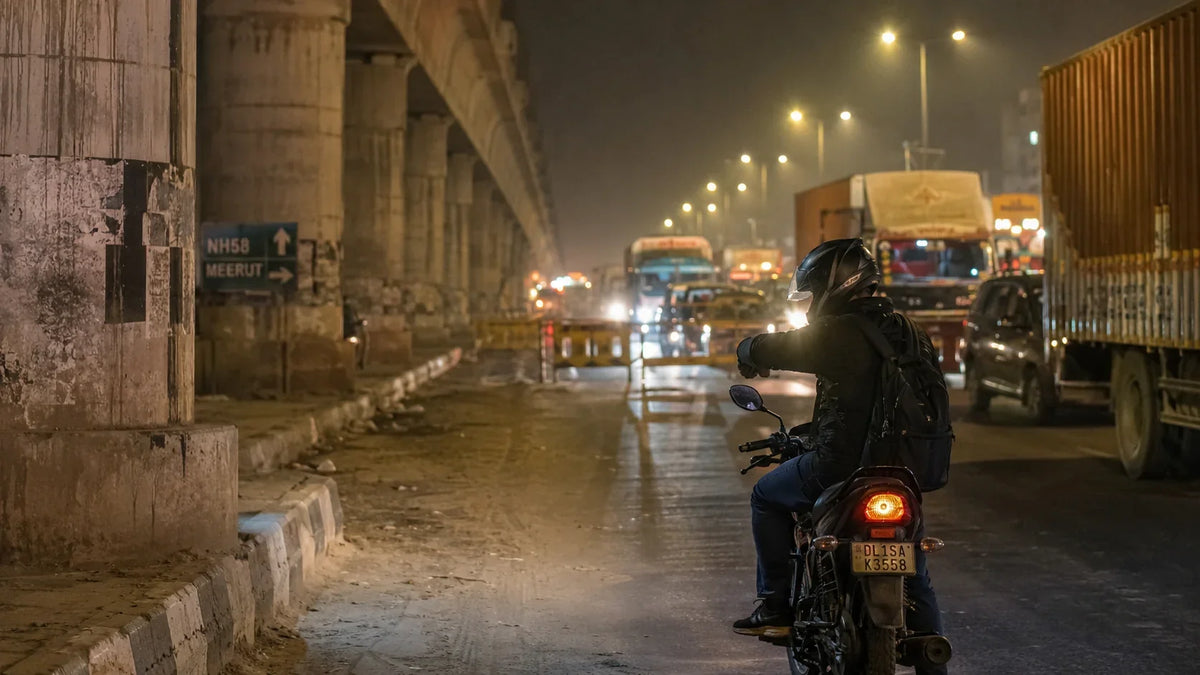
You're stuck at the Meerut South barrier, waiting to merge onto GT Road.
Your helmet's already damp from the ride, and it's not even noon. Dust off the road and sweat under the padding are a rough combination. Your helmet smells worse every week, no matter how often you wipe it down with a cleaner spray. That's because a cleaner and a hygiene spray solve two different problems. This article breaks down what's actually happening inside your helmet in Meerut, and what fixes it.
Rider Takeaways
- Two-wheelers are officially banned from the Delhi-Meerut Expressway, yet 6 riders still died on it in the past year.
- Meerut's live PM2.5 reading hit 89.4 µg/m³ this week, 17.9 times the WHO's annual guideline, per IQAir.
- A 2024 Indian Journal of Microbiology study found sweat drives the heaviest bacterial growth on polyester. That's the same material lining most helmets.
- Wiping with a cleaner clears visible grime. It does nothing to the bacteria living underneath, which is Meerut's real odor source.
Why Are So Many Meerut Riders Stuck Between the Expressway and GT Road?
Quick Fact:
Two-wheelers remain officially banned from the Delhi-Meerut Expressway. Despite ₹20,000 automatic-camera fines, six riders died on it in the past year alone. Source: The Daily Jagran
Two-wheelers remain officially banned from the Delhi-Meerut Expressway. Despite ₹20,000 automatic-camera fines, six riders died on it in the past year alone. Source: The Daily Jagran
The ban was meant to protect riders from a road built for 100 km/h car speeds. In practice, it's pushed most two-wheeler traffic onto the older GT Road and NH58 stretches instead. Both routes stay crowded with trucks, e-rickshaws, and local traffic.
Three Kanwariyas died in a motorbike accident near a Noida sector on this expressway in July 2025. Days later, another rider was killed by a lorry on the same stretch. Riders who sneak on face high speeds with nowhere to pull over.
Meerut got a real alternative in February 2026. The Namo Bharat RRTS corridor's final stretch opened, connecting Meerut South to Modipuram at speeds up to 180 km/h. Ridership crossed one lakh on its first full day.
That's good news for commuters who can leave the bike at home. It doesn't help riders who still need two wheels for the last few kilometers. They're sweating through helmet straps at every signal along the way.
What Does Meerut's Sports City Identity Have to Do With Helmet Hygiene?
Quick Fact:
Meerut's 2,550 registered and 7,000 unregistered sports goods units employ roughly 3.9 lakh people and produce 45% of India's sports goods exports. Source: Present Scenario of Sports Industry in District Meerut
Meerut's 2,550 registered and 7,000 unregistered sports goods units employ roughly 3.9 lakh people and produce 45% of India's sports goods exports. Source: Present Scenario of Sports Industry in District Meerut
Meerut makes cricket bats, hockey sticks, and rackets for players across Australia, England, and the West Indies. It's earned the nickname "Sports City of India." That comes with a workforce used to synthetic grips, cane bindings, and sweat-soaked padding all day.
That's the same material problem your helmet has. Bat grips, racket handles, and helmet liners are mostly polyester or synthetic foam, exactly the surface sweat clings to hardest.
A worker or rider in Meerut isn't dealing with an occasional damp glove. Sweat is a daily constant here. It doesn't matter if you're gripping a bat handle in a workshop or handlebars on GT Road.
Unique Insight
Our finding: Meerut's sports goods industry runs on the same sweat-and-synthetic-fabric combination that makes helmets smell. Nobody's connected the two before, but the mechanism is identical.
Why Does Sweat Make Helmet Bacteria So Much Worse?
Quick Fact:
A 2024 study found all four tested bacteria strains grew heaviest on polyester fabric exposed to sweat, with Staphylococcus aureus and Pseudomonas aeruginosa forming strong biofilms. Source: Indian Journal of Microbiology
A 2024 study found all four tested bacteria strains grew heaviest on polyester fabric exposed to sweat, with Staphylococcus aureus and Pseudomonas aeruginosa forming strong biofilms. Source: Indian Journal of Microbiology
Researchers tested cotton, polyester, and a poly-cotton blend against four bacteria types, then added sweat. Every strain multiplied fastest on plain polyester, the exact material used in most helmet liners.
Two of those bacteria, S. aureus and P. aeruginosa, didn't just grow. They built biofilms, thin protective layers that shield bacteria from being wiped away easily. Once a biofilm forms, a quick wipe barely touches it.
That's the part a cleaning spray misses. Sinha se helmet ko roz saaf karna kaafi nahi hai, agar andar bacteria pehle se jam chuka hai. You need something that stops the colony from forming, not just something that removes what's already visible.
How Bad Is Meerut's Air for Your Helmet Right Now?
Quick Fact:
Meerut's annual average AQI improved from 144 in 2020 to 117 in 2025, a 13% year-on-year drop from 2024. November 2025 still spiked to 254, "Very Poor," against an August 2020 low of just 51. Source: aqi.in
Meerut's annual average AQI improved from 144 in 2020 to 117 in 2025, a 13% year-on-year drop from 2024. November 2025 still spiked to 254, "Very Poor," against an August 2020 low of just 51. Source: aqi.in
The five-year trend looks encouraging on paper. But the swing between Meerut's best and worst months tells the real story riders live through every year.
As of today, August 29, 2026, IQAir clocked Meerut's live PM2.5 at 89.4 µg/m³, 17.9 times the WHO's annual guideline. That's during what should be one of the cleaner months of the year.
Dust off unpaved stretches near the expressway construction adds another layer. Riders in Delhi or Noida don't deal with this as much. That dust settles into the same padding the bacteria are already colonizing.

Is a Helmet Cleaner Spray the Same as a Helmet Hygiene Spray?
No. A cleaner lifts dirt and dust off a surface. A hygiene spray targets the bacteria living in the padding underneath, which is what actually causes the smell.
In Meerut, both problems are real. Road dust and pollution grime sit on the surface, while sweat-fed bacteria build up in the foam. Cleaning handles the first. It leaves the second completely untouched.
| What you're solving | Cleaning spray | Hygiene spray (Hygena) |
|---|---|---|
| Visible dust and grime | Removes it | Not designed for this |
| Sweat odor | Masks it briefly | Targets the bacteria causing it |
| Bacterial biofilm in padding | Barely touches it | Bacteriostatic, stops bacteria multiplying |
| Best used | On the shell and visor | Inside the padding, after every few rides |
Wipe the outer shell down when it's dusty from GT Road. Spray the padding underneath with something built to stop bacteria, not just move it around.
How Hygena Fits Into a Meerut Commute
Once you know cleaning and hygiene are separate jobs, the fix is simple. Hygena's bacteriostatic spray goes straight into the padding your cleaner never reaches.
It's built to survive exactly what a Meerut ride throws at it. That means a stalled wait near the expressway barrier or a dusty stretch of NH58. It also means a helmet zipped in your bag through a humid August afternoon. A few sprays after your ride, and the bacteria don't get a chance to build up again.
It doesn't replace wiping down your shell when it's caked in road dust. It handles the part a wipe-down never could.

Frequently Asked Questions
Does Meerut's dust make helmet smell worse than in other cities?
Yes. Road dust from expressway construction adds surface grime on top of sweat-fed bacteria. Meerut helmets often need both a wipe-down and a hygiene spray more often than helmets in less dusty cities.
Where can I buy a helmet hygiene spray in Meerut?
Hygena ships across Meerut through its website, hygena.in, with standard delivery timelines for Uttar Pradesh pin codes.
Is it safe to ride a two-wheeler on the Delhi-Meerut Expressway?
No. Two-wheelers are officially banned. Six riders still died on it in the past year despite ₹20,000 fines, per The Daily Jagran. Use GT Road, NH58, or the Namo Bharat RRTS instead.
How often should I use a helmet hygiene spray?
After every three to four rides is a reasonable starting point. Spray more often during Meerut's humid monsoon months when sweat builds up faster.
Can I just clean my helmet with soap and water instead?
Soap and water can damage EPS foam and glue if it gets soaked through. A hygiene spray is built to work on padding without breaking down the materials inside.
Conclusion
Meerut riders deal with a specific mix. Expressway restrictions push traffic onto older roads. A sports-goods economy runs on the same sweat-and-synthetic-fabric problem your helmet has. Air quality stays rough even in a supposedly cleaner month. None of that gets solved by wiping your visor down.
A cleaner handles what you can see. Hygena's bacteriostatic spray handles what's actually causing the smell. Spray it into your padding after your next ride on GT Road. Give your helmet the hygiene routine the dust and sweat here actually demand. Check the sibling post on for how another UP city compares.
Sources
1. "Delhi-Meerut Expressway Sees Free Movement of Two-Wheelers Despite Ban, Six Deaths Reported in One Year," The Daily Jagran, 2026. Retrieved 2026-08-29.
2. "Delhi-Meerut Namo Bharat RRTS Ridership Surpasses One Lakh on First Day After Launch," India TV News, 2026. Retrieved 2026-08-29.
3. "Present Scenario of Sports Industry in District Meerut," IndexCopernicus. Retrieved 2026-08-29.
4. "Biofilm Formation on Different Fabrics in the Presence of Sweat," Indian Journal of Microbiology, 2024. Retrieved 2026-08-29.
5. "Meerut Air Quality Index Dashboard," aqi.in. Retrieved 2026-08-29.
6. "Meerut Air Quality," IQAir. Retrieved 2026-08-29.
7. "Meerut Climate," Climate-Data.org, 1991-2020 averages. Retrieved 2026-08-29.
Share:
How to Prevent and Fix Helmet Hair: Tips That Work
How to Stay Clean on a Long Motorcycle Ride (No Shower)