
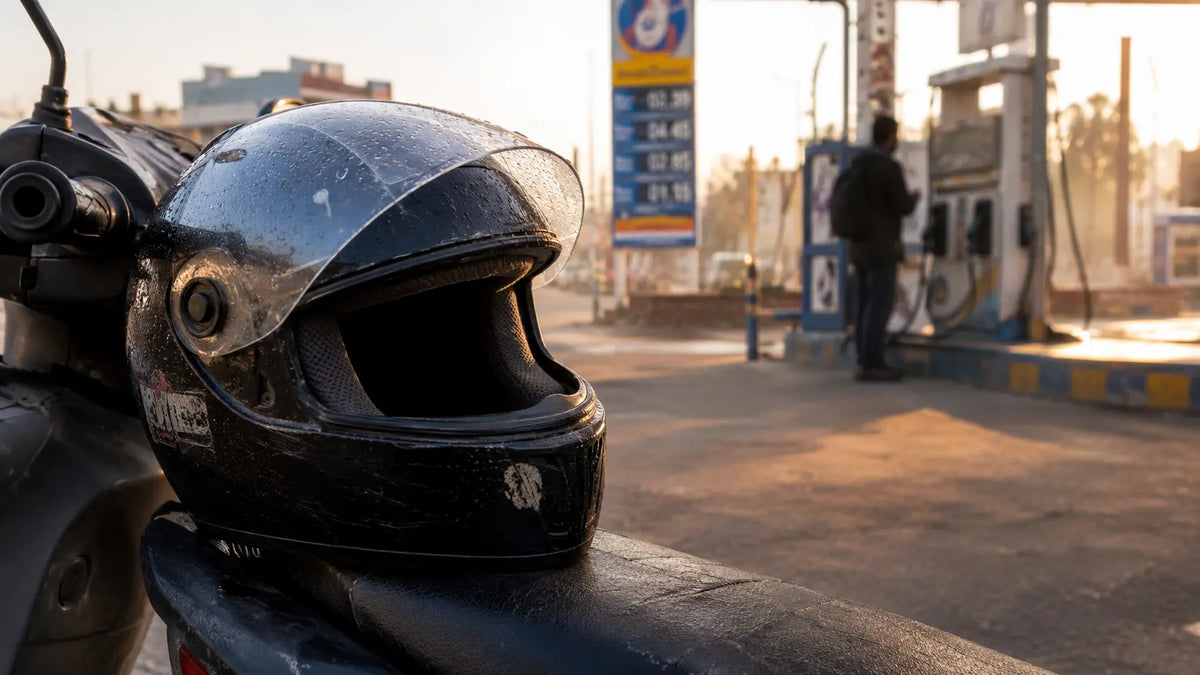
From January 1, 2026, every new two-wheeler above 50cc in India has to ship with ABS as standard. The law keeps regulating what happens on the bike. Nobody had built anything for what happens inside the helmet.
That gap is the entire reason Hygena exists. Not as another fragrance spray, but as helmet hygiene products for a country where over 2 crore people bought a two-wheeler in 2025 alone.
This is the story of how we got there: what riders told us, why the formula took nine months, and why we still get asked if we're "just a helmet cleaner."
Rider Takeaways
- India registered roughly 2.02 crore two-wheelers in 2025, up from 1.89 crore in 2024 (Autocar India, 2026).
- On Indian roads, about 20 deaths and 50 injuries are reported every hour, and two-wheeler riders make up roughly 45% of them, on average (BikeDekho, 2025).
- Hygena spent 9+ months and 10+ formula iterations before launch, built after speaking to 250+ riders directly (hygena.in, 2026).
- It's now used by 1,200+ riders across India, rated 4.8★ on average (hygena.in, 2026).
Why Does the Law Protect Your Head But Not What's Growing Inside the Helmet?
Under Section 129 of the Motor Vehicles Act, 1988, every rider and pillion on a moving two-wheeler in India must wear a helmet, and only ISI-certified helmets meeting the BIS IS 4151:2015 standard can legally be sold (BikeDekho, 2025). Bajaj hi nahi, koi bhi brand isse escape nahi kar sakta.
The government has also proposed requiring every two-wheeler manufacturer to supply two BIS-certified helmets at the time of purchase, one per seat, under a draft amendment to the Central Motor Vehicle Rules (The Tribune/ANI, June 2025). The law keeps getting stricter about the shell. It says nothing about what builds up inside the padding, ride after ride.
We've written before about what that padding actually holds. Short version: it's bacteria feeding on sweat, not the sweat itself, and no traffic rule addresses that.
Quick Fact:
About 20 deaths and 50 injuries are reported every hour on Indian roads, and two-wheeler riders make up roughly 45% of them, on average. A good standard helmet cuts head injury risk by up to 70% and serious head trauma by around 40%, while a loosely fastened one doubles head injury risk. Source: BikeDekho, Helmet Laws in India 2025, December 2025.
About 20 deaths and 50 injuries are reported every hour on Indian roads, and two-wheeler riders make up roughly 45% of them, on average. A good standard helmet cuts head injury risk by up to 70% and serious head trauma by around 40%, while a loosely fastened one doubles head injury risk. Source: BikeDekho, Helmet Laws in India 2025, December 2025.
What Made Us Realize Helmet Hygiene Was a Real Rider Problem?
In 2023, we noticed something odd: riders who polished their bikes every weekend never touched the inside of their helmet. Not because they didn't care, but because nobody had told them there was anything to do about it.
So in early 2024, we went and asked. Not in a survey form, at fuel stations, parking lots, and riding meetups, over 250 riders in multiple cities (hygena.in, 2026). One thing came up again and again.
Riders already knew their helmet smelled. That was never the gap. The gap was that every existing fix, washing the liner, drying it, spraying perfume, needed time they didn't have between rides.
Quick Fact:
Before building a single formula, Hygena spoke to 250+ riders across fuel stations, riding meetups, and daily commute routes in early 2024. The consistent finding: riders wanted helmet hygiene that took seconds, not a washing routine. Source: Hygena, Our Story, 2026.
Before building a single formula, Hygena spoke to 250+ riders across fuel stations, riding meetups, and daily commute routes in early 2024. The consistent finding: riders wanted helmet hygiene that took seconds, not a washing routine. Source: Hygena, Our Story, 2026.

Why Did the Formula Take 9+ Months and 10+ Iterations to Get Right?
Hygena went through 9+ months of testing and 10+ formula iterations before its first bottle shipped, built around Bacteriostasis® technology, neem extract, and a pH-balanced base (hygena.in, 2026). None of that happens overnight.
Every combination was tested for drying time, fragrance balance, and how it behaved inside an actual helmet, not a lab beaker. The target was never a strong scent. It was something a rider would use before every single ride.
By 2025, that testing moved onto real Indian roads: city traffic, peak summer heat, long highway stretches. Riders' feedback on drying speed and helmet feel directly shaped the final formula (hygena.in, 2026).
Unique Insight
Our finding: Across 250+ rider conversations, not one person asked us for a stronger fragrance. Every request was about effort. That single pattern is why Hygena became a 10-second spray instead of a wash-and-dry product.
Is Hygena Just Another Helmet Cleaner Spray?
Riders searching for a "helmet cleaner spray" are usually solving the wrong layer of the problem. A cleaner lifts dirt, road grime, and visor smudges off the shell and padding surface. It doesn't stop what's growing underneath.
Hygena isn't a cleaning product, and we don't position it as one. It's a leave-on hygiene spray built to work between washes, targeting the bacteria that feed on sweat and moisture inside the liner.
Think of it the way you'd think about a deodorant versus soap. One removes what's visible. The other manages what regrows in between. Riders need both, and they're not the same job.
Quick Fact:
A helmet cleaner addresses surface dirt and visor grime. A bacteriostatic hygiene spray like Hygena targets bacterial regrowth inside the foam liner between washes. The two solve different problems, and neither replaces the other. Source: Hygena, How It Works, 2026.
A helmet cleaner addresses surface dirt and visor grime. A bacteriostatic hygiene spray like Hygena targets bacterial regrowth inside the foam liner between washes. The two solve different problems, and neither replaces the other. Source: Hygena, How It Works, 2026.
What Do 1,200+ Riders Say After Actually Using It?
Hygena is now used by 1,200+ riders across India, holding a 4.8★ average rating, with each application rated for up to 30 days of protection depending on use (hygena.in, 2026). That's daily commuters, weekend tourers, and delivery riders alike.
The application itself stayed simple on purpose: spray from 30cm, wait 10 seconds, ride out. Zero drying time was a hard requirement from the very first rider conversations in 2024, not an afterthought.
Kya aapne kabhi socha tha ki itni chhoti si cheez itna fark degi? Riders on 40-50km daily commutes report the same pattern: a fresh helmet without adding a single extra chore to their morning.

What's Next for India's First Rider Hygiene Brand?
India's men's grooming market was valued at roughly ₹18,165 crore in 2025 (Expert Market Research, 2025). Almost none of it was built for the specific problems a helmet, riding gear, and long commutes create.
Hygena started with the helmet because that's where the gap was most obvious. The same bacteria-not-sweat logic applies to gloves, jackets, and riding boots, and we've already had riders tell us they use it there too.
The goal isn't to become another grooming brand. It's to make helmet and rider hygiene as automatic as checking your tyre pressure before a ride.
Frequently Asked Questions
Is Hygena a helmet cleaner or a helmet cleaning spray?
No. Hygena is a leave-on hygiene spray, not a cleaner. It targets bacteria inside the liner between washes rather than removing surface dirt, which is what a cleaner is built for.
What makes Hygena different from a regular deodorant spray?
Hygena uses Bacteriostasis® technology and neem extract to slow bacterial regrowth, not just mask smell with fragrance. It's built specifically for the sealed, sweaty environment inside a helmet (hygena.in, 2026).
How long does one application of Hygena protect a helmet?
Protection lasts up to 30 days per use depending on riding frequency and weather, based on Hygena's own product testing. Daily riders in hot, humid cities may need more frequent application.
Is Hygena only meant for helmets?
No. Riders also use it on jackets, gloves, boots, and other fabric-based riding gear. It was designed for helmets first, since that's where the hygiene gap was largest.
Why did it take Hygena so long to launch?
Because 9+ months of testing and 10+ iterations went into getting drying time, fragrance, and safety right before shipping a single bottle, based on feedback from 250+ riders (hygena.in, 2026).
Conclusion
India mandates a helmet for every rider on the road. It says nothing about what happens to that helmet after a hundred sweaty commutes. That silence is the whole reason Hygena got built.
It took 250+ rider conversations, 9+ months of testing, and a decision to build a hygiene product rather than another cleaner. 1,200+ riders and a 4.8★ average later, that bet is paying off.
If your helmet's never been sprayed with anything but perfume, that's the gap Hygena was built to close. Start with your next ride.
Sources
1. "Two-wheeler sales surpass 2 crore units in 2025," Autocar India, December 2025. Retrieved 2026-07-26.
2. "Helmet Laws in India 2025: Updated Rules, Fines And Safety Standards Explained," BikeDekho, December 2025. Retrieved 2026-07-26.
3. "Govt proposes to make two helmets mandatory for new 2-wheelers," The Tribune (ANI), June 2025. Retrieved 2026-07-26.
4. "India Men's Grooming Market Size & Industry Analysis," Expert Market Research, 2025. Retrieved 2026-07-26.
5. "Our Story," Hygena, 2026. Retrieved 2026-07-26.
6. Hygena homepage, hygena.in, 2026. Retrieved 2026-07-26.
Share:
Helmet Deodorant Spray: How to Choose and Use One Right
How Often Should You Really Clean Your Motorcycle Helmet?