
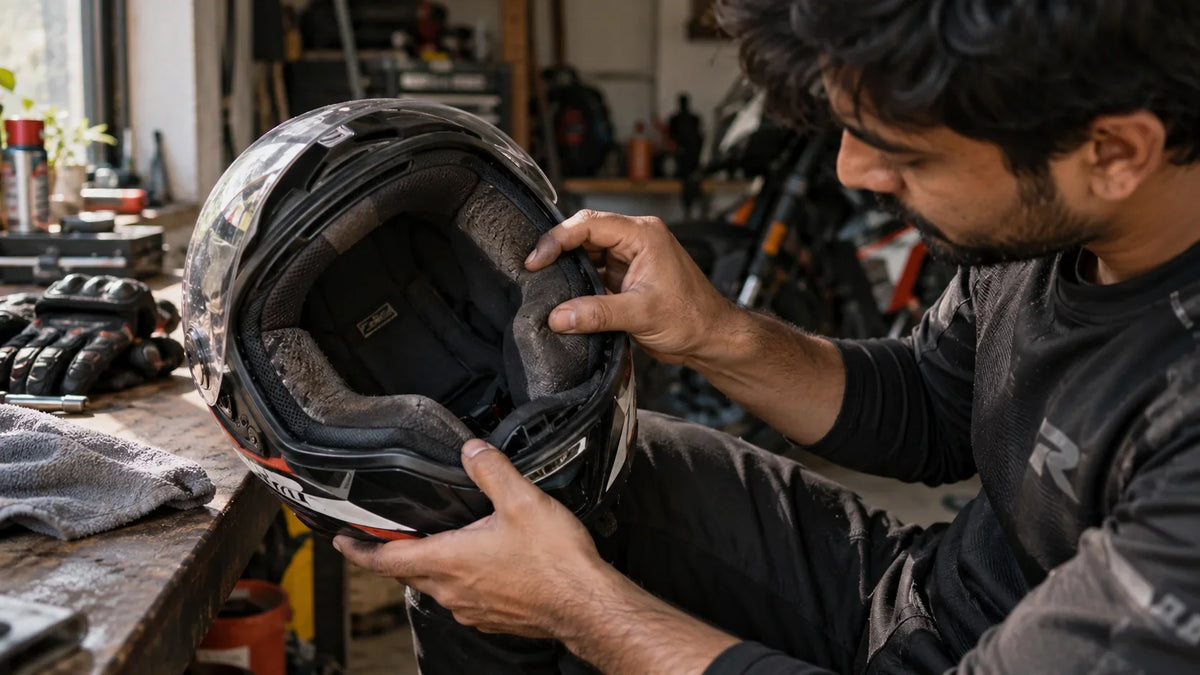
You pull on your helmet and notice it feels looser than it used to.

Maybe the cheek pads feel flat. Maybe the crown padding looks tired. Or maybe the inside still smells strange after washing.

That raises a simple question: how often should helmet padding be replaced
There isn't one universal replacement interval for comfort padding. Your riding frequency, sweat exposure, washing routine, and the manufacturer's design all matter. More importantly, worn padding can change how your helmet fits.

SHOEI says comfort padding should be replaced when it becomes loose or shows deterioration. It also sells model-specific replacement pads for worn or uncleanable interiors.

This guide will help you decide whether your padding needs cleaning, replacement, or a complete helmet check.

Rider Takeaway
- There isn't one fixed replacement date for helmet comfort padding.
- Replace worn, compressed, damaged, or uncleanable padding.
- A looser fit can be a warning that your interior padding has compressed.
- SHOEI recommends replacing the complete helmet after 5 years from retail purchase.
Is there a fixed schedule for replacing helmet padding?
No. Helmet manufacturers generally treat padding replacement as a condition-based decision rather than a universal yearly schedule.

In its maintenance guidance, SHOEI says helmet service life depends on how intensely and frequently you ride. It specifically recommends replacement when comfort padding becomes loose through heavy use or shows deterioration.

That's useful for daily riders. A daily commuter can put heavy wear on padding. A casual rider may wear it far less.

Your padding also has a different job from the EPS impact liner. Comfort padding controls fit and contact around your head. The EPS liner is part of the helmet's impact-management system. Don't treat the two parts as interchangeable.

NHTSA says a correctly sized helmet should feel snug and shouldn't move when you shake your head. It also warns that modifying the inside of a helmet can compromise its integrity.

So, don't wait for a calendar reminder. Check how the padding looks and, more importantly, how the helmet fits.
Quick Fact:
SHOEI recommends helmet replacement five years after retail purchase. That applies even without visible damage. Its guidance also calls for earlier replacement when comfort padding becomes loose or deteriorated. Source: SHOEI Helmet Maintenance.
SHOEI recommends helmet replacement five years after retail purchase. That applies even without visible damage. Its guidance also calls for earlier replacement when comfort padding becomes loose or deteriorated. Source: SHOEI Helmet Maintenance.
Unique Insight
Our finding: "Has my helmet fit changed?" matters more than the calendar. A looser fit can reveal worn padding.
<!-- CITATION CAPSULE -->
SHOEI's maintenance guidance doesn't give comfort padding a universal replacement interval. Instead, it recommends action when heavy use makes the padding loose or visibly deteriorated. The same guidance recommends complete helmet replacement after five years from retail purchase. Source: SHOEI Helmet Maintenance.

[INTERNAL-LINK: how often to clean your motorcycle helmet → related helmet-cleaning guide]
What signs mean your helmet padding needs replacement?
The clearest signs are compression, looseness, damage, and padding that you can't properly clean anymore. SHOEI's current replacement-pad listings describe worn or compressed interior padding as a reason for replacement. Some replacement cheek pads are also offered in different thicknesses to restore a secure, comfortable fit. Look closely at the areas that take the most contact. Your cheek pads may look flatter than before. The crown pad may feel thinner. Fabric can become torn, stretched, or permanently misshapen. Attachment points can also become weak or damaged. Then do the fit check.Put the helmet on normally and fasten the retention system. Your helmet should feel secure around the crown and cheeks. NHTSA says a correctly sized helmet should provide even pressure and shouldn't move when you shake your head. If your helmet suddenly feels loose, don't fix the problem by adding random foam or altering the liner. Use the replacement parts specified by your helmet manufacturer. A little "this feels roomier now" can be a useful warning. Your helmet shouldn't gradually become loose because the padding has flattened.
Quick Fact:
NHTSA says a correct fit should feel snug. The helmet should stay in place when you shake your head. It also notes that some manufacturers provide replaceable cheek pads and liners for fit adjustment. Source: NHTSA: Choose the Right Motorcycle Helmet.
NHTSA says a correct fit should feel snug. The helmet should stay in place when you shake your head. It also notes that some manufacturers provide replaceable cheek pads and liners for fit adjustment. Source: NHTSA: Choose the Right Motorcycle Helmet.
<!-- CITATION CAPSULE -->
Worn helmet padding can affect fit. NHTSA says a correctly fitted helmet should feel snug and shouldn't move when you shake your head. SHOEI lists loose or deteriorated padding as a replacement reason. It also provides model-specific replacement pads.

[INTERNAL-LINK: helmet liner hygiene → related helmet liner care guide]
Can you wash helmet padding instead of replacing it?
Yes, when the padding is still structurally sound and your helmet manufacturer allows washing.

Cleaning and replacement solve different problems. Washing removes accumulated sweat, grime, and odor from removable comfort padding. Replacement restores padding that has become worn, compressed, damaged, or permanently misshapen.

SHOEI says removable interior comfort-liner parts can be washed according to its instructions. It also says fixed padding should be wiped with a damp cloth and neutral cleaner.

Arai's manuals similarly describe removable comfort linings that can be washed gently and reinstalled correctly. Arai warns against solvents such as petrol, thinner, and benzene.

That means a bad smell alone doesn't automatically mean your padding is finished.

If the padding still holds its shape and your helmet fits correctly, clean it according to the manufacturer's instructions. If it stays dirty, damaged, permanently flattened, or loose after proper care, replacement makes more sense.

And don't wash the padding just because another helmet brand says it's machine washable. Your own helmet manual wins.
Quick Fact:
SHOEI permits washing removable comfort-liner parts and recommends neutral cleaning products. Arai's manuals also describe gentle washing for removable comfort linings. Both manufacturers provide model-specific handling instructions, so always follow your helmet's manual first. Sources: SHOEI and Arai Manual.
SHOEI permits washing removable comfort-liner parts and recommends neutral cleaning products. Arai's manuals also describe gentle washing for removable comfort linings. Both manufacturers provide model-specific handling instructions, so always follow your helmet's manual first. Sources: SHOEI and Arai Manual.
Unique Insight
Our finding: Washing can fix odor without fixing fit. If the helmet still feels loose, inspect the padding.
<!-- CITATION CAPSULE -->
Cleaning is appropriate when comfort padding remains intact and washable. Replacement is appropriate when padding is worn, compressed, damaged, or no longer cleanable. SHOEI and Arai both publish model-specific washing instructions, which means your helmet manual should decide how its interior is cleaned.

[INTERNAL-LINK: how to clean your motorcycle helmet liner → step-by-step liner cleaning guide]
Does helmet padding affect how your helmet fits?
Yes. Comfort padding affects helmet fit. Changes in its shape can change how snug the helmet feels. NHTSA says some helmet manufacturers provide replaceable cheek pads and liners to adjust interior fit. It also says a correctly fitted helmet should stay snug and shouldn't move when you shake your head. SHOEI's replacement cheek pads come in different thicknesses. The manufacturer says these options can help restore fit when padding becomes worn. That's why replacing only the visibly damaged piece can be useful. For example, your cheek pads may be worn while the crown pad still looks fine. If your helmet model allows individual replacement, you may not need a complete interior kit.But fit isn't the place for DIY experiments. Don't cut foam, add household padding, glue materials inside the shell, or reshape the EPS liner. NHTSA warns that alterations inside a helmet can compromise its integrity. If a replacement liner doesn't restore the fit, stop riding in that setup. Check the manufacturer's sizing and replacement-part guidance.
Quick Fact:
NHTSA says some helmets use replaceable cheek pads and liners. It warns against altering the helmet interior. Use manufacturer-approved replacement parts instead of adding or reshaping materials yourself. Source: NHTSA: Choose the Right Motorcycle Helmet.
NHTSA says some helmets use replaceable cheek pads and liners. It warns against altering the helmet interior. Use manufacturer-approved replacement parts instead of adding or reshaping materials yourself. Source: NHTSA: Choose the Right Motorcycle Helmet.
<!-- CITATION CAPSULE -->
Comfort padding contributes to helmet fit. NHTSA says correctly fitted helmets should stay snug and stable during head movement. It also warns against altering helmet interiors. Manufacturer-approved replacement cheek pads or liners are the safer route when worn padding changes the fit.

[INTERNAL-LINK: helmet hygiene routine → complete helmet hygiene guide]
When should you replace the whole helmet instead?
Replace the whole helmet after a significant impact. Do the same for EPS damage or the service limit.

This distinction matters. Comfort padding is replaceable on many helmets. The EPS impact liner is a different component and isn't something you should treat like washable foam.

SHOEI recommends helmet replacement after an impact and when the EPS liner has separated, deteriorated, melted, or developed indentations. It also recommends replacement five years after the helmet's first retail purchase.

Arai also cites five years as a suggested usable lifespan. It advises inspection or replacement after an impact.

So here's the simple rule: replace worn padding. Replace the helmet when its protective structure or service life calls for it.

Don't use fresh cheek pads to extend the life of a helmet that has already reached its replacement point.
Quick Fact:
SHOEI recommends helmet replacement after an impact or specified EPS damage. It also cites five years after retail purchase. Arai also cites five years as a suggested usable lifespan. These are manufacturer guidelines, not a universal rule for every helmet model. Sources: SHOEI and Arai.
SHOEI recommends helmet replacement after an impact or specified EPS damage. It also cites five years after retail purchase. Arai also cites five years as a suggested usable lifespan. These are manufacturer guidelines, not a universal rule for every helmet model. Sources: SHOEI and Arai.
<!-- CITATION CAPSULE -->
Fresh comfort padding cannot restore a damaged impact liner. SHOEI recommends helmet replacement after an impact or specified EPS damage. It also cites five years after retail purchase. Arai also cites five years as a suggested usable lifespan. Follow your own helmet manufacturer's current guidance.

[INTERNAL-LINK: motorcycle helmet bacteria → bacteria and helmet hygiene explainer]
Frequently Asked Questions
How often should helmet padding be replaced?

There isn't one universal interval. Replace comfort padding when it becomes compressed, loose, damaged, permanently misshapen, or difficult to clean. SHOEI specifically lists loose or deteriorated comfort padding as a replacement trigger. Check your helmet manufacturer's parts and maintenance guidance before ordering anything. Source: SHOEI Helmet Maintenance.

Can helmet padding be washed instead?

Yes, if the padding is washable and still holds its shape. SHOEI says removable comfort-liner parts can be washed, while Arai provides gentle washing instructions for removable linings. Follow your exact helmet manual because cleaning methods differ between models. Source: SHOEI Helmet Maintenance and Arai manuals.

How do I know my helmet padding is compressed?

Check whether the helmet feels looser than before. Look for visibly flattened cheek or crown padding. NHTSA says a correctly fitted helmet should feel snug and shouldn't move when you shake your head. A change in fit deserves attention, especially if the padding looks worn. Source: NHTSA.

Should I replace padding after every few years?

Not automatically. Padding replacement depends on condition and fit, not just age. Your helmet itself may have a separate service-life recommendation. SHOEI recommends five-year helmet replacement from retail purchase, while also calling for earlier replacement when specific damage or deterioration appears. Source: SHOEI Helmet Maintenance.

Can a deodorizer replace worn helmet padding?

No. A hygiene product can help manage odor, but it can't restore compressed foam, damaged fabric, or a loose fit. If the padding is worn, replace it with the correct manufacturer-approved part. Keep hygiene as a routine alongside proper cleaning and part replacement.

The simple rule: replace the padding when the padding is done

You don't need to replace helmet padding just because the calendar says so.

Check the fit. Check the shape. Check the fabric. Check whether you can still clean it properly.

Replace padding when it is compressed, loose, torn, misshapen, or uncleanable. Use the correct part for your helmet.

Replace the whole helmet after a significant impact. Do the same for EPS damage or the service limit.

And remember, fresh padding isn't a substitute for regular helmet hygiene. Sweat and odor still build up between rides.

Hygena helps you keep that interior fresher between deeper cleaning sessions by targeting the hygiene problem inside your helmet.

The fix is simpler than you think. Build helmet hygiene into your riding routine.

[INTERNAL-LINK: how to clean your motorcycle helmet liner → keep your removable padding clean]

[INTERNAL-LINK: motorcycle helmet smell removal → deal with recurring helmet odor]
Sources
1. SHOEI. "Helmet Maintenance." Accessed October 6, 2026. https://shoei-helmets.com/support/helmet-maintenance.html
2. NHTSA. "Choose the Right Motorcycle Helmet." Accessed October 6, 2026. https://www.nhtsa.gov/motorcycle-safety/choose-right-motorcycle-helmet
3. SHOEI. "Neotec 3 Cheek Pad Set Type Q." Accessed October 6, 2026. https://shoei-helmets.com/products/neotec-3-cheek-pad-set-type-q.html
4. SHOEI. "Hornet X2 2025 Standard Center Pad Top." Accessed October 6, 2026. https://shoei-helmets.com/products/hornet-x2-2025-standard-center-pad-top.html
5. Arai Americas. "Warranty Information." Accessed October 6, 2026. https://www.araiamericas.com/warranty-information
6. Arai Americas. "Road Models Operation Instructions." Accessed October 6, 2026. https://www.araiamericas.com/sites/default/files/2019-10/roadmodelsenglishonly.pdf
Share:
Personal Hygiene Kit for Motorcycle Riders
Motorcycle Gear Hygiene: Clean Your Riding Gear