
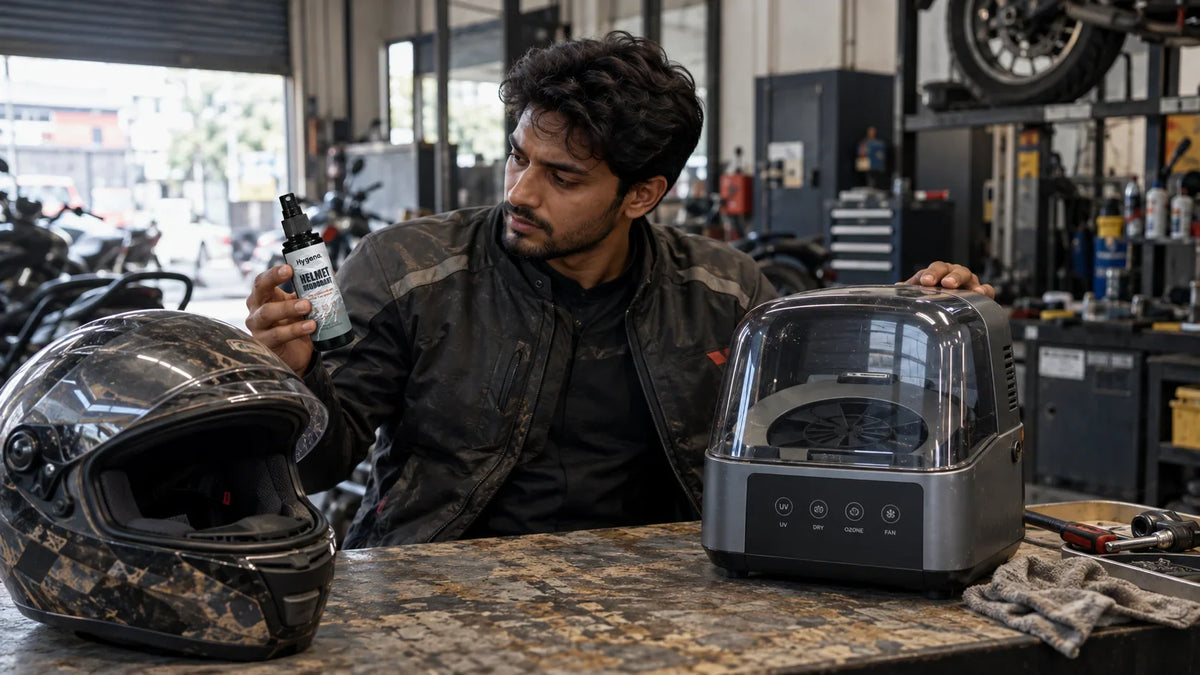
You pull off your helmet after a hot ride, and the smell hits before the visor lifts fully. You want the inside fresh again, but now there are two options: a deodorant spray or a machine that claims to disinfect helmets.
For most individual riders, the decision comes down to how often you ride, where you can access a machine, and what its process actually does. A spray is portable and easy to use between rides. A machine may combine several processes, such as misting, UV-C treatment, or drying. Those features don't automatically prove that every surface receives the same treatment.
This helmet disinfectant comparison breaks down cost, convenience, evidence, and safety checks. You'll be able to choose a routine that fits your riding life instead of paying for features you don't need.
- A deodorant spray is usually easier for regular, personal use because you can keep it at home or in your riding kit.
- A machine may add controlled misting, UV-C treatment, or drying, depending on its design.
- Don't judge either option by fragrance or a headline germ-reduction claim alone. Check the method, test evidence, and helmet-manufacturer guidance.
What is the difference between helmet deodorant and a disinfectant machine?
Helmet deodorant is a product you apply to help manage interior odour. A helmet disinfectant machine is a device that runs a treatment cycle, often combining technologies such as a disinfectant mist, UV-C light, airflow, or drying.
The labels aren't interchangeable. Deodorizing focuses on smell. Disinfection refers to reducing or inactivating microorganisms under defined conditions. Cleaning removes soil and residue. Drying reduces moisture. One product or machine may perform more than one task, but you should check which tasks are actually validated.
A 2022 study published in the Asian Journal of Biomedical and Pharmaceutical Sciences examined microorganisms associated with motorcycle helmets and the antibacterial activity of a helmet disinfectant spray. It supports taking helmet hygiene seriously, but it doesn't establish that every spray or machine works equally well. Read the specific study and product test before drawing a conclusion. Source: Shahina et al., 2022.
A helmet deodorant and a disinfectant machine may have different goals and methods. Deodorant products target unwanted smell, while machines may combine disinfection and drying technologies. Check the product's intended use and evidence instead of assuming that a stronger-sounding label means better results. Source: Shahina et al., 2022.
| What matters | Helmet deodorant spray | Helmet disinfectant machine |
|---|---|---|
| Access | Keep it at home or in your kit | Requires buying, installing, or finding a machine |
| Routine | Apply according to label directions | Place helmet inside and run the specified cycle |
| Main purpose | Often odour management; formula varies | May combine sanitizing, deodorizing, and drying |
| Coverage | Depends on application and formula | Depends on chamber design, treatment method, and exposure |
| Upfront cost | Usually lower than purchasing a machine | Can be substantial for a personal unit; public-use pricing varies |
| Best fit | Individual riders and frequent commuters | Shared helmets, rental fleets, shops, or high-throughput use when validated |
Which option works better for helmet smell?
For routine smell management, choose the option whose method suits your helmet and whose claims are supported by clear evidence. Fragrance alone doesn't show that an odour source has been addressed. Likewise, a machine's UV-C or ozone label doesn't prove that every liner fold receives an effective treatment.
Sweat, skin oils, and trapped moisture can build up in helmet padding. Airing your helmet out after a ride helps moisture escape, but it isn't a replacement for cleaning or an appropriate hygiene routine. Follow your helmet maker's care instructions, especially for removable liners, adhesives, electronics, and delicate materials.
A spray may be more practical when you want a repeatable routine after regular rides. Look for directions that clearly identify compatible materials, application amount, drying time, and whether the formula is intended for helmet interiors. Don't substitute household perfume or an unrelated fabric product unless the helmet manufacturer says it's suitable.
A machine may offer a more consistent process if it controls the cycle and reaches the surfaces that need treatment. Ask for independent test results on the exact model, including the organisms tested, test conditions, cycle duration, and surfaces sampled. A broad "99.9%" statement without this context isn't enough to compare real-world performance.
Our finding: Compare the whole routine, not just the headline feature. If a machine needs a detour and a paid cycle after every ride, a portable product used consistently may fit your life better. If you manage a fleet of shared helmets, a validated machine may make standardization easier.
Are helmet disinfectant machines worth the money?
They can be worth considering when you process helmets frequently, share them among users, or need a standardized cycle. A motorcycle rental operator, riding school, or gear-rental business has different needs from someone who wears one personal helmet every day.
Before buying a machine, ask what the cycle includes. Some systems advertise UV-C, ozone, atomized disinfectant, and warm-air drying. These methods have different limitations. UV-C effectiveness depends on factors such as exposure, distance, and shadowing. A mist's performance depends on its chemistry and contact time. Drying can help manage moisture, but it doesn't by itself prove disinfection.

Be especially careful with ozone. The US Environmental Protection Agency warns that inhaled ozone can harm the lungs and irritate the respiratory system. Don't operate an ozone-generating machine in a way that exposes you or bystanders. Check the manufacturer's safety instructions, ventilation requirements, and any applicable local requirements. Source: US EPA, “Ozone Generators that are Sold as Air Cleaners”.
For a personal rider, a machine is harder to justify unless it solves a recurring problem that a simple routine can't. If you do choose one, confirm that your helmet materials and accessories are compatible with its process. Never assume a treatment is safe for every helmet just because the machine accepts its shape.
Ozone is a respiratory irritant, not a harmless freshness feature. The US EPA states that inhaled ozone can damage lungs and cause symptoms including coughing, chest pain, and throat irritation. For any ozone-based helmet machine, review exposure controls and the full operating instructions before use. Source: US EPA, “Ozone Generators that are Sold as Air Cleaners.”
What should you check before buying either option?
Start with your helmet's care manual. The inner liner may include materials that don't tolerate every chemical, heat level, or treatment process. If the liner is removable, follow the manufacturer's washing and drying instructions. Avoid soaking components or applying products to electronics unless the maker explicitly allows it.
Next, check what the product is designed to do. Does it deodorize, clean, disinfect, dry, or combine several functions? Look for a named test method and the exact conditions behind any germ-reduction claim. Prefer test results from an independent laboratory over a number with no supporting detail.
Then consider convenience. How often will you use it? Can you use it immediately after a ride? Do you need consumables, refills, maintenance, or replacement lamps? For a machine, ask about cycle time, power needs, ventilation, maintenance, and safe operation. For a spray, read the label for compatible materials, directions, and drying time.
Finally, don't treat either option as a fix for a soaked or visibly dirty liner. Remove and wash padding only as your helmet maker permits. Let the helmet dry fully before wearing it again.
Our finding: A machine's feature list is not a substitute for a test report. Ask whether the test covered the inside padding, hard-to-reach seams, and the actual cycle you plan to use. Those details are more useful than comparing two large percentage claims from different tests.
Is a helmet deodorant the better choice for everyday riders?
For many solo riders, yes: a helmet deodorant is the more practical starting point when the main issue is recurring odour and you want a portable routine. It takes up little space and doesn't require access to a dedicated machine. Still, check its stated purpose and use it exactly as directed.
Hygena is a helmet deodorant spray designed around helmet hygiene and odour control. If you want an easy-to-carry option for your regular routine, review the product details and usage directions before deciding whether it suits your helmet. It isn't a substitute for washing a liner when washing is needed, and no spray should override the helmet manufacturer's care instructions.

Want to build a more consistent helmet hygiene habit? Explore Hygena's helmet deodorant and check the product instructions before use.
Frequently asked questions
Does a helmet deodorant disinfect a helmet?
Not necessarily. Deodorizing and disinfection are different claims. Check the product label and supporting test evidence to see whether it is intended only to manage odour or has validated antimicrobial performance. Follow the helmet maker's care instructions and don't infer disinfection from a fresh scent.
Can UV-C machines treat every part of a helmet?
Not automatically. UV-C needs suitable exposure, and shadows or blocked surfaces can reduce how much light reaches a target. Ask for test results covering the actual helmet interior and the exact machine cycle. Follow compatibility guidance for liners, visors, electronics, and other components.
Are ozone-based helmet machines safe?
Ozone can harm the respiratory system when inhaled. The US EPA warns that exposure can cause coughing, throat irritation, chest pain, and breathing difficulty. Use an ozone-generating device only as its manufacturer directs, with the required controls and ventilation. Don't breathe ozone intentionally.
Should I wash my helmet liner instead?
If the liner is dirty or heavily sweat-soaked, follow the helmet manufacturer's cleaning instructions. Some liners are removable and washable; others require specific care. A deodorant or machine shouldn't replace cleaning when the manufacturer recommends it. Dry every component fully before wearing the helmet.
Which option should a daily commuter buy?
Start with the problem you need to solve. If you own one helmet and mainly want a convenient odour-management routine, a compatible spray may be the simpler choice. If you manage shared helmets at scale, evaluate a machine's independent evidence, safety controls, maintenance, and cost per cycle.
The verdict: choose the routine you'll use correctly
For everyday personal riding, a compatible helmet deodorant spray is usually the simpler option to keep close and use as directed. A disinfectant machine may make more sense for rental operators, riding schools, or other settings processing many helmets. Its value depends on the verified process, not the number of technologies in its brochure.
Whichever option you choose, check your helmet's care manual, let damp padding dry fully, and don't confuse fragrance with hygiene. For more practical advice, read our guides on and . If you want a portable routine, explore Hygena and confirm the instructions suit your helmet.
Sources
- Shahina, S. K. et al. (2022). “Motorcycle Helmets as Potential Fomites in Transmission of Pathogenic Micro-organisms and Antibacterial Activity of Helmet Disinfectant Spray.” Asian Journal of Biomedical and Pharmaceutical Sciences. https://www.ajbls.com/article/11/1/144.pdf
- US Environmental Protection Agency. “Ozone Generators that are Sold as Air Cleaners.” https://www.epa.gov/indoor-air-quality-iaq/ozone-generators-are-sold-air-cleaners
- HelmetSani manufacturer product and technology information (manufacturer claims; not independent verification). https://www.helmetsani.com/
- US Environmental Protection Agency. “A Guide for Consumers: Pesticide Devices.” https://www.epa.gov/pesticides/pesticide-devices-guide-consumers
Verify current product pricing, local machine availability, and the exact helmet manufacturer's care guidance before publication. Manufacturer performance claims in this article are described as claims, not independently confirmed findings.
Share:
How to Prevent Blisters: Motocross & Long Rides
Motorcycle Knee Guards Armour: What Riders Skip