
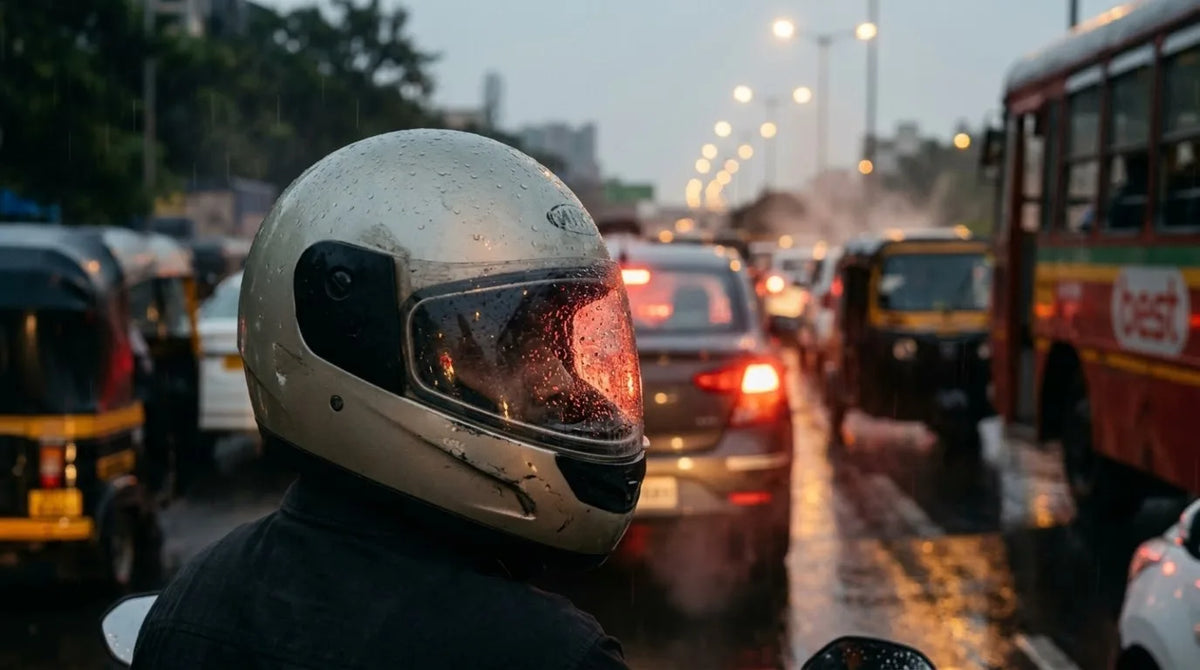
Andheri to Bandra some evenings takes 35 minutes for 10 kilometres. Your helmet stays sealed shut for every one of them.
That's not really about sweat. Mumbai's traffic keeps a helmet on your head longer than almost any other Indian city, and the city's humidity means whatever's trapped inside barely dries before your next ride. Put those two things together and you get a smell that perfume won't fix.
This piece walks through why Mumbai helmets go bad faster than most, what's actually growing in there, and the habit that keeps it from coming back.
Rider Takeaways
- Mumbai riders lost 126 hours to traffic in 2025, per TomTom's Traffic Index. That's 126 hours your helmet spent sealed shut.
- Average humidity sits at 71% year-round and hits 86% in July, so sweat trapped in the liner barely dries between monsoon rides.
- A 2020 study found Staph aureus in 22.7% of 392 helmet bacteria, and a third of that was drug-resistant.
- Wash your liner on a schedule. Spray a bacteriostatic deodorant like Hygena after every ride to slow what builds up in between.
How Much Time Does Mumbai Traffic Really Add to Your Helmet?
In 2025, TomTom's Traffic Index clocked Mumbai's evening rush hour at 35 minutes 30 seconds to cover 10 kilometres. Average speed dropped to 16.9 km/h. Riders lost 126 hours to congestion across the year. Every one of those hours is time your helmet spends sealed against your scalp, with zero airflow reaching the padding.
Compare that to a quiet commute. A 10-minute ride means 10 minutes of trapped heat. A single Andheri-to-Bandra crawl during evening rush hour can outlast that more than threefold. It happens twice a day for most riders.
Morning rush hour isn't much kinder. TomTom measured the same 10km stretch at 32 minutes 26 seconds during the morning peak, with congestion above 80%. Your helmet is on the whole time. It doesn't matter if you're moving or sitting at a signal on the Eastern Express Highway.
Quick Fact:
In 2025, Mumbai riders lost 126 hours to traffic congestion, and evening rush hour stretched a 10km ride to 35 minutes 30 seconds at an average speed of 16.9 km/h. Source: TomTom Traffic Index, Mumbai 2025
In 2025, Mumbai riders lost 126 hours to traffic congestion, and evening rush hour stretched a 10km ride to 35 minutes 30 seconds at an average speed of 16.9 km/h. Source: TomTom Traffic Index, Mumbai 2025
Does Mumbai's Humidity Make Helmet Smell Worse?
Yes. Mumbai's average humidity sits at 71% year-round and climbs to 86% in July. That's the peak of a monsoon that runs June through September. High humidity slows evaporation, so sweat trapped inside a liner stays wet for hours instead of drying between rides.
That matters more than it sounds like. Bacteria don't need much to multiply: just warmth, moisture, and time. Mumbai's air supplies that moisture even when your helmet sits untouched on a hook, not just while you're riding.
Monsoon adds a second problem. Liners get rained on during the ride, then don't fully dry before the next commute. A helmet that would air out fine in Pune's drier climate never gets the chance to reset here.
Quick Fact:
Mumbai's average humidity is 71% year-round, peaking at 86% in July at the height of monsoon season. Source: Weather and Climate, historical data 1990–2020
Mumbai's average humidity is 71% year-round, peaking at 86% in July at the height of monsoon season. Source: Weather and Climate, historical data 1990–2020
Unique Insight
Our finding: Riders logging peak monsoon months alongside evening rush-hour commutes stack Mumbai's two worst factors at once: 86% humidity plus 35-plus minutes of sealed helmet time. Neither is unusual on its own for an Indian city. Together, they compress a week's normal bacterial buildup into a few days.
What's Actually Growing Inside an Unwashed Helmet?
In 2020, a study published in the International Journal of Microbiology tested 130 motorcycle helmets and isolated 392 bacteria. Staphylococcus aureus was the most common strain at 22.7%, and 33.7% of those isolates were MRSA, a drug-resistant strain. That bacteria is what actually causes the smell, not sweat by itself.
Sweat is just the food source. Bacteria already living on your scalp and in the foam feed on it. Warm, damp conditions, exactly what a Mumbai commute produces, let them multiply fast.
A more recent study backs this up from a different angle. In 2025, the Indian Journal of Microbiology linked Staphylococcus hominis most strongly to odour intensity on sweat-soaked sportswear. The correlation was 0.706. Helmet foam isn't sportswear, but the setup is identical: fabric, sweat, and heat, for hours at a stretch.
Quick Fact:
A 2020 study of 130 motorcycle helmets isolated 392 bacteria, led by Staphylococcus aureus at 22.7%, with 33.7% of those isolates confirmed as MRSA. Source: Sapkota et al., International Journal of Microbiology, 2020
A 2020 study of 130 motorcycle helmets isolated 392 bacteria, led by Staphylococcus aureus at 22.7%, with 33.7% of those isolates confirmed as MRSA. Source: Sapkota et al., International Journal of Microbiology, 2020

How Are Mumbai Riders Actually Dealing With This?
Mumbai's vehicle population crossed 50 lakh in 2024-25. Two-wheelers made up 59.34% of that, close to 30 lakh bikes and scooters, according to the BMC's Environment Status Report. That's a lot of helmets doing daily duty in exactly the traffic and humidity conditions above.
Since June 2022, Mumbai Traffic Police has also made helmets mandatory for pillion riders, not just the person driving. Two helmets now do rush-hour duty on plenty of bikes that used to carry one. That means twice the sealed hours per household.
Bike-taxi apps add a newer wrinkle. Uber Moto, Rapido, and Ola bike became far more common around the same time as the pillion mandate. Riders on forums like Team-BHP have started asking an obvious question. What happens when the helmet handed to you was worn by a stranger an hour earlier?
Quick Fact:
Mumbai's vehicle population crossed 50 lakh in 2024-25, with two-wheelers accounting for 59.34% of the total, roughly 30 lakh bikes and scooters. Source: BMC Environment Status Report 2024-25, via Deccan Herald
Mumbai's vehicle population crossed 50 lakh in 2024-25, with two-wheelers accounting for 59.34% of the total, roughly 30 lakh bikes and scooters. Source: BMC Environment Status Report 2024-25, via Deccan Herald
Unique Insight
Our finding: The pillion mandate and Mumbai's bike-taxi boom landed in the same stretch of years, so more helmets now change hands than they did before 2022. A quick spray before you put one on isn't paranoia. It's just responding to a genuinely new Mumbai-specific hygiene pattern.
The Fix That Actually Survives a Mumbai Commute
Washing your liner solves the visible problem, but it doesn't stop bacteria from rebuilding between washes. Mumbai's humidity barely lets anything dry, and rush hour keeps a helmet sealed for 35-plus minutes at a stretch. That rebuild happens fast here.
That's the gap Hygena is built for. It's a bacteriostatic spray you use between washes, not instead of them. The bacterial count stays down while your liner tries to dry through a humid Mumbai evening. Wash on a schedule. Spray after every ride, especially through June to September.

Frequently Asked Questions
Does Mumbai's humidity make helmet smell worse?
Yes. Average humidity is 71% year-round and hits 86% in July. High humidity slows how fast sweat evaporates from the liner, so bacteria get more time to multiply between rides.
Where can I buy helmet deodorant spray in Mumbai?
Hygena ships across Mumbai directly from hygena.in, with cash-on-delivery available. There's no dedicated helmet-hygiene retail counter in most Mumbai markets yet, so online is the fastest route.
How often should I clean my helmet in Mumbai's climate?
Weekly if you ride daily through monsoon or peak summer, given how long humidity keeps the liner from fully drying. A 2020 study found bacteria in the majority of tested helmets, so waiting longer usually means waiting too long.
Is it safe to wear a bike-taxi or rented helmet in Mumbai?
It's a real hygiene question, not an overreaction. A spray before you put on a helmet someone else just wore is a fast, low-effort precaution. It matters even more with Uber Moto and Rapido now common across the city.
Does a helmet deodorant spray replace washing?
No. A deodorant like Hygena works between washes to slow bacterial buildup, but it isn't a substitute for actually washing the liner on a regular schedule.
Conclusion
Mumbai's helmet problem isn't really about how much you sweat. It's traffic keeping your helmet sealed for 35-plus minutes at a stretch. Add humidity that won't let anything dry, and you're feeding bacteria that were already living in the liner.
Wash your liner on a schedule, not just when you notice the smell. Between washes, a bacteriostatic spray like Hygena keeps the bacterial count from climbing back to where it started. It holds up even through a humid evening crawl on the Eastern Express Highway.
Sources
1. "Mumbai Traffic Report," TomTom Traffic Index, 2025. Retrieved 2026-07-30.
2. "Mumbai Humidity by Month," Weather and Climate, historical data 1990–2020. Retrieved 2026-07-30.
3. "Microbial Diversity and Antibiotic Susceptibility Pattern of Bacteria Associated with Motorcycle Helmets," Sapkota et al., International Journal of Microbiology, 2020. Retrieved 2026-07-30.
4. "Association of Staphylococcus_hominis and Odor Production on Sweaty Polyester Sportswear," Yan, Wu & Ye, Indian Journal of Microbiology, 2025. Retrieved 2026-07-30.
5. "Private Vehicles Choke Mumbai's Roads, BEST Buses Account for Less Than 1%," Deccan Herald (PTI), citing BMC Environment Status Report 2024-25, 24 August 2025. Retrieved 2026-07-30.
6. "Mumbai: Helmets Compulsory for 2-Wheeler Pillion Riders," Mumbai Traffic Police notification via Team-BHP, 2022. Retrieved 2026-07-30.
Share:
Helmet Cleaner Nashik: Dust, Heat, and the Truth
Helmet Deodorant Spray Pune: Dust, Heat, Then Monsoon