
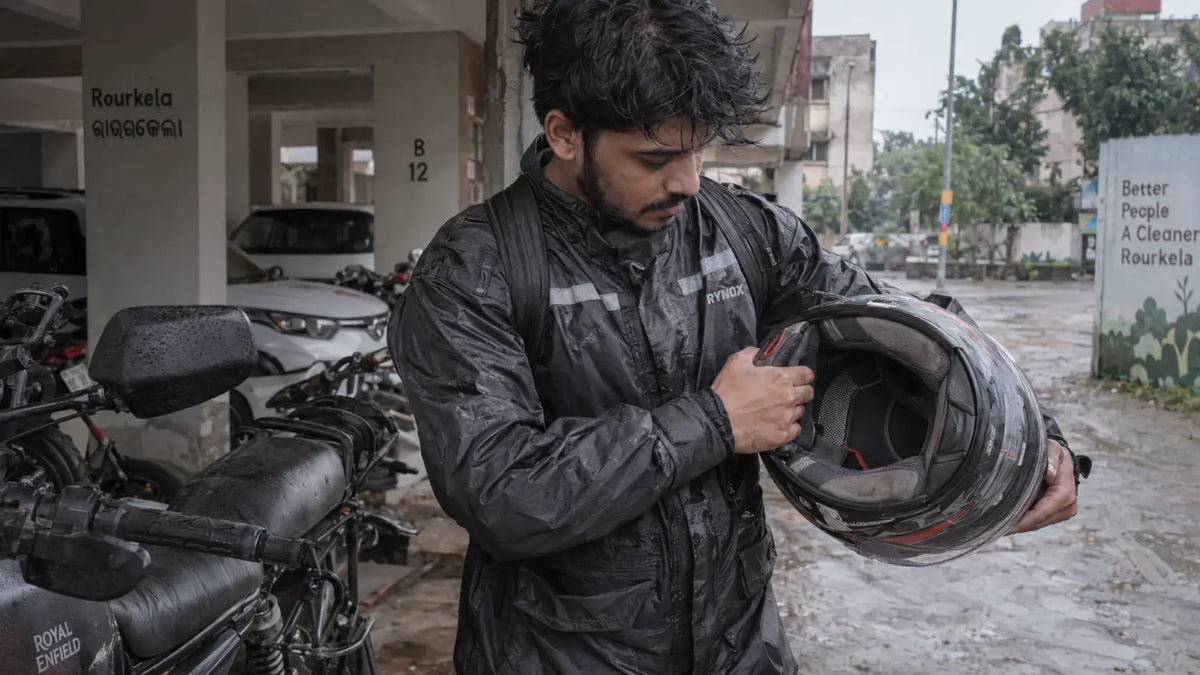
Helmet Cleaner Rourkela: What Actually Works?
Your Rourkela ride can leave more behind than dust on your bike.
If your helmet smells after a commute, the liner is holding onto sweat, skin oils, and microbes. Rourkela's warm climate and strong monsoon season can make that problem harder to ignore.
That's why searches for helmet cleaner Rourkela make sense. But there's one important distinction. Cleaning removes dirt and grime. Helmet hygiene tackles the microbes linked with persistent odor.
Here's what your helmet needs if you ride regularly around Rourkela.
- Rourkela receives about 1,389 mm of average annual rainfall, according to an Odisha pollution study.
- A 2020 motorcycle-helmet study recovered 392 bacterial isolates from 130 helmets.
- Washing removes buildup, while a hygiene routine helps control odor-causing microbes.
- Dry your helmet fully after riding, then use a product designed for helmet interiors.
Why does Rourkela's climate make helmet smell worse?
Rourkela's climate gives your helmet plenty of opportunities to stay warm and damp. An Odisha State Pollution Control Board study reports an average annual temperature of about 25.9°C and roughly 1,389 mm of annual rainfall.
Rourkela has a tropical climate with abundant Southwest monsoon rainfall. An Odisha State Pollution Control Board study reports about 1,389 mm of average annual rainfall. July receives the highest rainfall in the region. Source: OSPCB, 2025
For a rider, that matters because your helmet traps heat around your scalp. Sweat then collects against the liner during longer rides.
Monsoon riding adds another problem. If your helmet gets damp and doesn't dry properly, the liner can stay moist between rides.
That doesn't mean Rourkela weather automatically causes helmet odor. Your riding frequency, drying habits, helmet age, and hygiene routine also matter.
Rourkela's tropical climate includes substantial monsoon rainfall. The OSPCB's 2025 emission inventory reports about 1,389 mm of average annual rainfall and an average annual temperature of about 25.9°C. For riders, frequent sweating and damp conditions make regular helmet drying and interior hygiene especially useful.
Learn why helmet hygiene matters before your next ride.
How does Rourkela traffic affect helmet hygiene?
Your helmet stays on for the entire ride, even when your bike barely moves. Rourkela's 2026 Integrated Mobility Plan recorded about 953,486 daily trips during its peak-hour survey period.
Rourkela's 2026 Integrated Mobility Plan estimates about 953,486 daily trips in its survey dataset. Two-wheelers accounted for a 13.7% modal share in the peak-hour survey. Source: GIZ, Integrated Mobility Plan for Rourkela, 2026
That traffic context changes your helmet routine. A short distance can still mean extended helmet-on time.
Your scalp keeps producing sweat during that time. The liner absorbs some of it, along with skin oils and shed skin cells.
Then you park your bike, remove the helmet, and often leave it somewhere without enough airflow.
Repeat that cycle every day. Eventually, your helmet develops a smell that perfume can't really solve.
Our finding: A helmet doesn't need a long-distance ride to develop odor. Repeated short rides can create the same hygiene cycle when sweat and moisture don't get enough time to clear.
Hygena fits into this routine by focusing on helmet interior hygiene rather than exterior polish.
What is actually growing inside a motorcycle helmet?
Your helmet liner can carry a surprisingly varied microbial load. In a 2020 study, researchers examined 130 motorcycle helmets and recovered 392 bacterial isolates and 346 fungal isolates.
A 2020 study of 130 motorcycle helmets recovered 392 bacterial isolates. Staphylococcus aureus accounted for 22.7% of bacterial isolates, while Staphylococcus epidermidis accounted for 19.6%. Source: Sapkota et al., International Journal of Microbiology, 2020
The study identified several bacterial groups, including Staphylococcus, Bacillus, Micrococcus, Pseudomonas, E. coli, Enterobacter, Salmonella, and Klebsiella.
That doesn't mean every Rourkela helmet contains the same organisms. The study was conducted in Nepal, not Odisha.
It does show why helmet interiors deserve more attention than a quick spray of perfume.
The same study also found higher bacterial growth in helmets that hadn't been washed or disinfected. Helmets used for more than three years also showed higher microbial growth.
A 2020 study tested 130 motorcycle helmets and recovered 392 bacterial isolates. Staphylococcus aureus and Staphylococcus epidermidis were among the most common bacteria found. The researchers also reported higher microbial growth in helmets with poor hygiene practices. Source: Sapkota et al., 2020.
Our finding: Persistent helmet smell is easier to understand when you stop treating it as a fragrance problem. The liner is a repeat-contact surface that collects sweat, oils, moisture, and microbes.
How do Rourkela riders approach helmet care?
Rourkela has an active local riding culture, with riders discussing weekend trips, bikes, routes, and riding groups online. That community angle matters because helmet care often becomes part of a rider's broader gear routine.
Rourkela's 2026 mobility plan reports a 30.4% non-motorised transport share in its peak-hour survey. Local online communities also show riders actively looking for weekend riding groups. These sources point to a city where two-wheel travel and riding communities remain visible parts of mobility culture. Sources: GIZ, 2026 and r/Rourkela, 2025.
A 2025 Rourkela community discussion specifically asked about biking groups for weekend trips. Several users responded with interest in joining rides.
That kind of riding culture creates a simple hygiene question. If you're riding more often, are you also cleaning the inside of your helmet more often?
For many riders, the answer is probably no. The bike gets washed. The chain gets checked. The helmet interior gets forgotten.
Rourkela's climate makes that habit worth changing.

Is a helmet cleaner in Rourkela the same as a helmet hygiene product?
No. A cleaner and a hygiene product solve different problems. A cleaner is mainly intended to remove dirt, grime, or residue. A hygiene product focuses on microbial control and odor management inside the helmet.
The 2020 motorcycle-helmet study found bacterial and fungal growth across the tested helmets. It also reported significantly higher bacterial growth in helmets with no washing or disinfection compared with disinfected helmets. Source: Sapkota et al., 2020
| Need | What it addresses |
|---|---|
| Cleaning | Dirt, grime, visible buildup |
| Drying | Trapped moisture after riding |
| Helmet hygiene | Microbial control and odor management |
| Helmet replacement | Age, damage, fit, and manufacturer guidance |
So if you're searching for a helmet cleaner Rourkela because your helmet smells, don't stop at visible cleanliness.
Clean the liner when it needs washing. Let the helmet dry completely. Then add a regular hygiene step for the interior.
What should Rourkela riders do after each ride?
The simplest routine starts with drying and continues with regular interior hygiene. You don't need to turn helmet care into another weekend project.
- Remove your helmet after the ride and open the visor.
- Keep the helmet somewhere with good airflow.
- Don't store a wet helmet inside a closed bag.
- Wash removable liners according to the helmet manufacturer's instructions.
- Use a helmet-specific hygiene product when odor starts returning.
Hygena is built specifically for the inside of your helmet. Its bacteriostatic approach is designed to control odor-causing bacteria instead of covering the smell with fragrance.
For a Rourkela rider dealing with repeated heat, sweat, and monsoon moisture, that makes interior hygiene a practical part of the riding routine.
Hygena helps you control the bacteria linked with helmet odor, so your liner doesn't become the forgotten part of your riding gear.
Check out Hygena Helmet Deodorant
Frequently asked questions about helmet cleaner Rourkela
Does Rourkela's climate make helmet smell worse?
Rourkela has a tropical climate and receives about 1,389 mm of average annual rainfall. Heat, sweat, and moisture can make helmet drying harder. Your storage habits also matter. Source: OSPCB, 2025.
Where can I buy helmet deodorizer in Rourkela?
You can buy Hygena's helmet deodorant through the official Hygena website. It's designed for helmet interior hygiene and odor control rather than exterior cleaning.
Is helmet cleaner enough for helmet odor?
Not always. Cleaning removes dirt and residue, but persistent odor can involve microbial growth. A 2020 study found bacterial growth in motorcycle helmets and reported higher growth with poor hygiene practices.
How often should Rourkela riders clean helmets?
Your schedule should depend on riding frequency, sweating, weather, and liner condition. Frequent commuters should inspect the liner regularly and clean removable padding according to manufacturer instructions.
Can I use perfume inside my motorcycle helmet?
Perfume can mask an odor without addressing its source. A better routine combines proper liner cleaning, complete drying, and a helmet-specific hygiene product.
Conclusion: choose helmet hygiene, not just helmet cleaning
If your helmet smells after regular rides around Rourkela, visible dirt isn't the whole story. Sweat, moisture, and microbes can build up inside the liner over time.
Rourkela's warm climate and substantial monsoon rainfall make drying and interior hygiene especially relevant for regular riders.
So when you search for a helmet cleaner Rourkela, look beyond surface cleaning. Your helmet needs a hygiene routine too.
Clean when needed. Dry it properly. Control odor-causing bacteria. That's a much better routine for your next commute or weekend ride.
Try Hygena Helmet Deodorant and make helmet hygiene part of your riding gear routine.
For more rider-focused science, read why helmet hygiene matters.
Sources
- Odisha State Pollution Control Board. Emission Inventory and Source Apportionment Study of Rourkela Region, 2025. Source.
- GIZ. Integrated Mobility Plan for Rourkela, 2026. Source.
- Sapkota et al. Microbial Diversity and Antibiotic Susceptibility Pattern of Bacteria Associated with Motorcycle Helmets, International Journal of Microbiology, 2020. Source.
- r/Rourkela community discussion on biking groups for weekend trips, 2025. Source.
- Hygena. Official website and product information. Source.
Sources accessed September 16, 2026.
Share:
Helmet Cleaner Bilaspur: Keep Your Helmet Fresh
Helmet Cleaner Dehradun: Fix Helmet Smell at the Source