
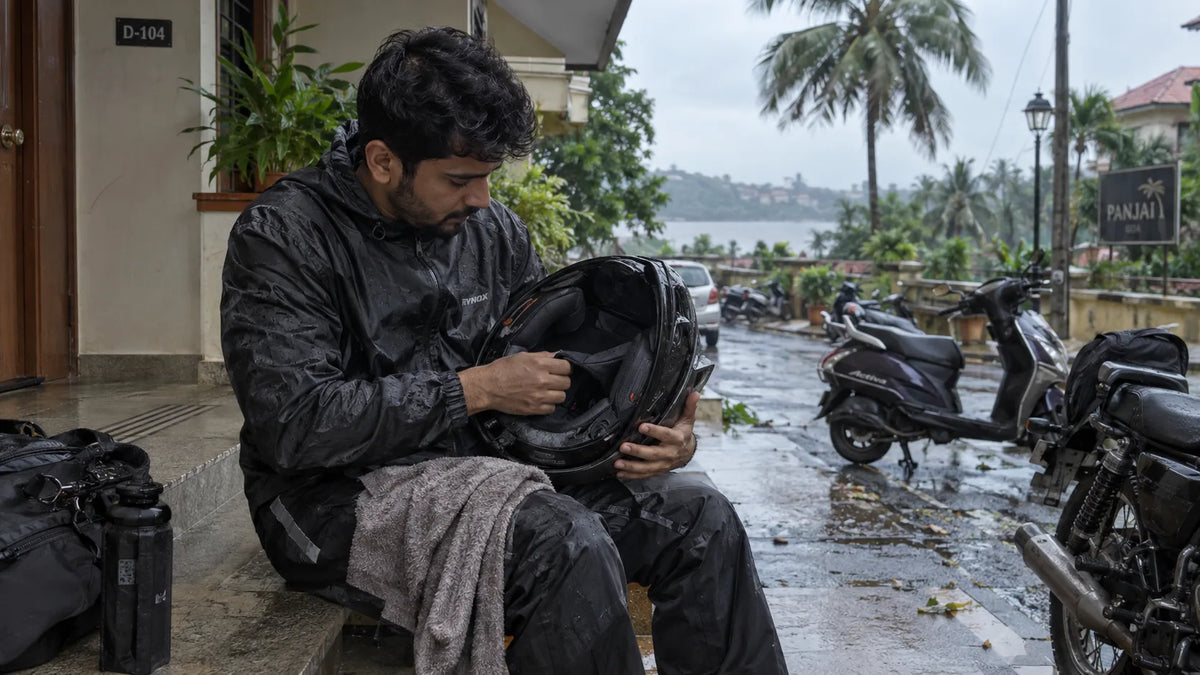
Ever finished a Panaji ride and found your helmet smelling worse than your bike?
Between Goa's heat, heavy monsoon rain, and daily two-wheeler use, your helmet liner gets plenty of sweat and moisture. The smell isn't only about sweat, though. Microbes can build up inside the liner and keep producing odor.
That's why searching for a helmet cleaner Panaji can lead you toward the wrong type of product. Cleaning removes dirt and grime. Helmet hygiene targets the microbes linked with persistent odor.
This guide explains the difference and gives you a practical Panaji helmet hygiene routine.
- Goa's 2025 records show 71,668 helmetless riding violations, confirming how central helmets are to local riding.
- IMD climate data shows Goa receives about 2,918 mm of annual rainfall in its long-term climate normal.
- A cleaner can remove grime, while a hygiene product addresses odor-causing microbial buildup.
- Dry your liner after wet rides, then use a rider-specific hygiene routine.
Why does Panaji's climate make helmet hygiene harder?
Goa's climate gives your helmet plenty of opportunities to stay warm and damp. IMD's 1981–2010 climate normal records 2,918 mm of annual rainfall for Goa. June and July alone average 892.3 mm and 907.4 mm. Source: India Meteorological Department.
Goa's IMD climate normal records 2,918 mm of annual rainfall, with July averaging 907.4 mm. That doesn't prove bacteria grow faster inside every Panaji helmet. It does show why riders regularly deal with wet riding conditions and moisture management. Source: India Meteorological Department climate table
Think about a monsoon commute. You reach home with a damp jacket, wet roads behind you, and moisture trapped around the helmet padding. If you put the helmet straight into a closed cupboard, drying slows down.
Warmth, sweat, skin oils, and moisture create a better environment for microbial contamination. The liner also touches your forehead, cheeks, and scalp every time you ride.
A 2020 study examined 130 motorcycle helmets and recovered 392 bacterial isolates and 346 fungal isolates. Staphylococcus aureus and Staphylococcus epidermidis were among the common bacterial isolates.
India Meteorological Department climate normals record 2,918 mm of annual rainfall for Goa, including 907.4 mm in July. For Panaji riders, the practical issue is moisture management. A damp liner needs time to dry before storage, especially after a wet ride.
See the science behind helmet hygiene.
What does Panaji traffic mean for your helmet liner?
Panaji's traffic environment adds another layer to helmet care. Goa's Intelligent Traffic Management System has monitored violations from 13 locations around Panaji and Porvorim. From June 2023 to May 2025, it issued 1,61,662 e-challans.
Goa's NIC ITMS profile says traffic violations were monitored from 13 locations around Panaji and Porvorim. From 1 June 2023 through 25 May 2025, the system issued 1,61,662 e-challans. The figure shows sustained traffic monitoring across the Panaji area. Source: NIC Goa State IT Projects Profile 2025
That matters because helmet use isn't limited to weekend rides. Your liner can stay against your skin through signals, short errands, office runs, and longer city trips.
Goa also had about 8.9 lakh motorcycles and scooters registered as non-transport vehicles by December 2025. That figure comes from reporting on the Goa Economic Survey 2025–26.
More riders mean more routine helmet use. More helmet use means your liner deserves the same regular attention you give other riding gear.
Our finding: Panaji helmet hygiene isn't a once-a-month task. Your routine should match how often your helmet gets wet, sweaty, and worn.
Goa's traffic systems recorded 1,61,662 e-challans through 25 May 2025 from monitoring locations around Panaji and Porvorim. Goa also had about 8.9 lakh motorcycles and scooters registered as non-transport vehicles by December 2025. Helmet use is therefore a daily reality for many riders.

Is a helmet cleaner in Panaji the same as a hygiene spray?
No. The terms sound similar, but they solve different problems. A cleaner is designed to remove dirt, grime, or residues. A hygiene product focuses on microbial control and odor prevention inside the helmet.
A 2020 study of 130 motorcycle helmets recovered 392 bacterial isolates and 346 fungal isolates. The study also found bacterial growth in 86.7% of helmets with no reported hygiene practice. Source: Sapkota et al., 2020, International Journal of Microbiology. Source: Microbial Diversity and Antibiotic Susceptibility Pattern of Bacteria Associated with Motorcycle Helmets
That distinction matters when you're searching for a helmet cleaner Panaji. You may need physical cleaning sometimes. You may also need a separate hygiene habit between deeper washes.
The same 2020 study found higher bacterial growth in helmets used for more than three years. It also reported higher bacterial growth in shared helmets.
Don't treat those findings as a direct prediction for your helmet. The study was conducted in Nepal and involved a specific group of riders. It does show that helmet interiors can carry microbial contamination.
A 2020 study tested 130 motorcycle helmets and recovered 392 bacterial isolates and 346 fungal isolates. Helmets with no reported hygiene practice showed bacterial growth in 86.7% of samples. The study supports regular helmet hygiene, while its Nepal-based sample limits direct conclusions about Panaji riders.
Read more about helmet hygiene.
How are Panaji riders dealing with helmet hygiene?
Helmet use is a visible road-safety issue in Goa, and enforcement data gives a useful picture of local riding habits. In 2025, Goa recorded 71,668 helmetless riding violations. Panaji recorded 79 helmetless cases during a four-day traffic drive in February 2025.
Goa recorded 71,668 helmetless riding violations in 2025. Panaji recorded 79 cases during a four-day February 2025 traffic drive. The figures concern helmet use, not helmet hygiene. They show how frequently helmet habits are part of local traffic enforcement. Source: Times of India, 2026 and The Goan, 2025
Local rider discussions also show that helmets have long been part of Goa's road-safety conversation. A Team-BHP discussion from 2012 included Goa riders discussing mandatory helmet use and enforcement around Panjim.
That community history is useful, but it doesn't tell us how often Panaji riders clean their liners. There's no reliable local survey in the sources reviewed for this article.
So don't assume your fellow riders have a perfect routine. Build one that works after your own commute, monsoon ride, or weekend loop.
Our finding: The local question isn't whether you need helmet hygiene. It's whether your routine fits Panaji's wet rides and frequent helmet use.
Goa recorded 71,668 helmetless riding violations in 2025, and Panaji recorded 79 cases during a February 2025 traffic drive. These figures don't measure helmet hygiene. They show that helmet use remains a significant part of Goa's riding environment.
Build a better helmet hygiene habit with Hygena.
How should you use a helmet cleaner routine in Panaji?
Start with physical cleaning when the liner has visible dirt or needs washing. Then focus on drying and routine hygiene between deeper cleans. That split keeps your routine practical without treating a deodorant as a substitute for washing.
- Air it out: Open the visor and leave the helmet in a dry, ventilated area after riding.
- Deal with wetness: If rain soaked the helmet, give the liner extra drying time before storage.
- Clean when needed: Follow your helmet maker's instructions for removable padding and liner care.
- Add hygiene: Use a helmet-specific hygiene spray when you want regular odor and microbial control.
- Repeat: Make the routine part of your ride shutdown, especially during Goa's wet season.
Hygena is built for the hygiene step. Its bacteriostatic helmet deodorant is designed for odor control rather than acting as a general surface cleaner.
After a Panaji commute, the goal is simple. Don't cover a dirty, damp liner with perfume. Clean when needed, dry properly, and maintain a hygiene routine.
Make helmet hygiene part of your ride routine. Explore Hygena Helmet Deodorant.
For Panaji riders, helmet care works best as two habits. Clean removable padding according to the helmet maker's instructions, then dry the helmet fully. A rider-specific hygiene spray can support odor-control between deeper cleaning sessions.

Frequently Asked Questions
Does Panaji's rain make helmet smell worse?
Rain doesn't automatically create odor, but trapped moisture can make drying harder. Goa's IMD normal records 907.4 mm rainfall in July. After wet rides, ventilate your helmet and let the liner dry fully before storage.
Where can I buy helmet hygiene products in Panaji?
Hygena sells its helmet deodorant online through its website. Check the current product page for pricing, delivery, and availability before ordering. This article doesn't verify stock at local Panaji retailers.
Is a helmet cleaner enough for helmet hygiene?
Not always. Cleaning and hygiene have different jobs. A 2020 study found bacterial growth in 86.7% of helmets with no reported hygiene practice. Follow your helmet maker's cleaning instructions and maintain a regular hygiene routine.
How often should I clean my helmet liner?
Use your helmet manufacturer's care instructions because liner materials differ. Clean sooner after heavy sweating or repeated wet rides. The 2020 helmet study found higher microbial growth in older and less-maintained helmets.
Can I spray perfume inside my helmet?
Perfume can mask smell without addressing its source. A 2020 motorcycle helmet study recovered hundreds of bacterial and fungal isolates. Use products designed for helmet interiors and follow the product's application instructions.
Conclusion: your Panaji helmet needs a hygiene routine
Searching for a helmet cleaner Panaji makes sense when your liner feels dirty. But cleaning is only one part of helmet care.
Panaji riders deal with a wet coastal climate and regular two-wheeler use. Goa's rainfall records and helmet-enforcement data show why your helmet can be a frequent-use piece of gear.
Keep the liner clean when needed. Dry it properly after wet rides. Then use a helmet-specific hygiene routine to manage odor between deeper cleans.
Try Hygena for your helmet hygiene routine.
For the next step, read our helmet hygiene guide and keep your riding gear fresh between rides.
Sources
- India Meteorological Department. Goa climatological table, 1981–2010. Source. Retrieved 18 September 2026.
- Sapkota et al. 2020. Microbial Diversity and Antibiotic Susceptibility Pattern of Bacteria Associated with Motorcycle Helmets. International Journal of Microbiology. Source. Retrieved 18 September 2026.
- NIC Goa State IT Projects Profile 2025. ITMS data for Panaji and Porvorim. Source. Retrieved 18 September 2026.
- Times of India. 2026. Goa helmetless riding violations in 2025. Source. Retrieved 18 September 2026.
- The Goan. 2025. Panaji traffic drive and helmetless riding cases. Source. Retrieved 18 September 2026.
- Government of Goa, Department of Transport. Helmet requirement information. Source. Retrieved 18 September 2026.
Share:
Helmet Cleaner Jamshedpur: What Actually Works?
Helmet Cleaner Shrinagar: What Actually Fixes Helmet Smell?