
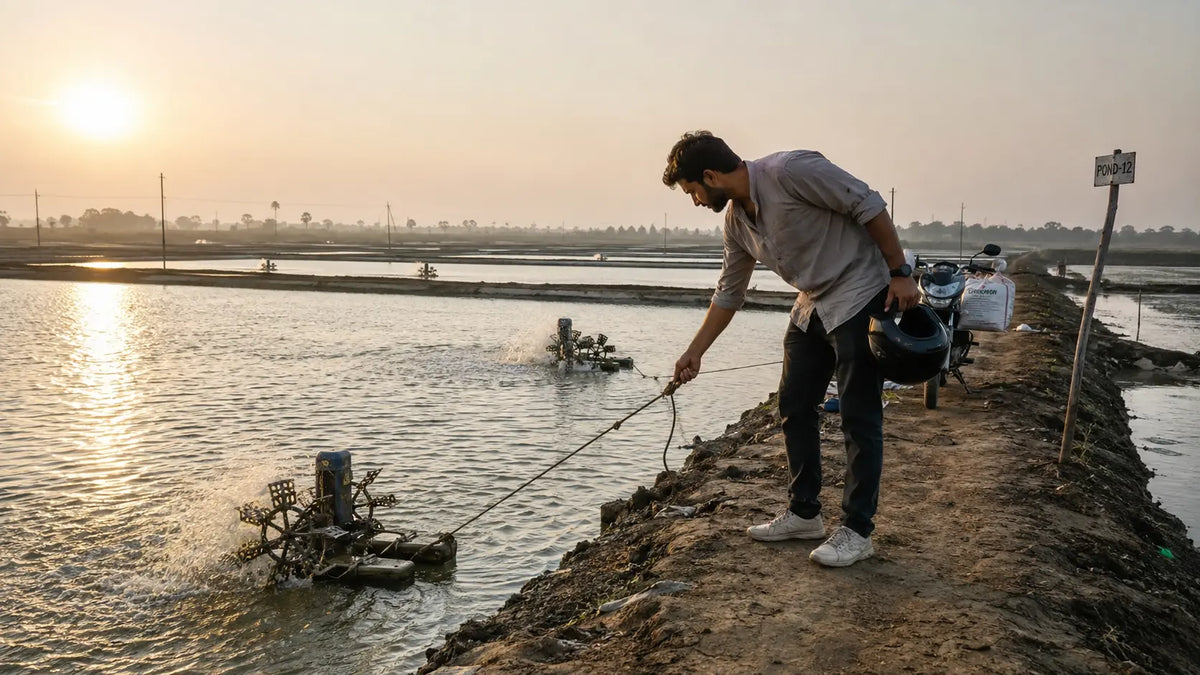
You're riding the NH16 stretch near Krishnapatnam Port. A container truck kicks up dust on one side, and a shrimp pond's brackish spray drifts in on the other.
Nellore's helmets don't just collect sweat. They collect port dust, pond salt, and diesel haze in the same week. A quick wipe or a "helmet cleaner" spray handles none of it. The real problem living inside the padding is bacteria, not dirt.
Here's what's actually happening inside a Nellore rider's helmet, and what closes the gap a cleaner can't.
Rider Takeaways
- Krishnapatnam Port's cargo grew from under 1 lakh tonnes in 2008-09 to over 4 crore tonnes by 2014-15. That freight still shares NH16 with two-wheelers daily (Wikipedia, Krishnapatnam Port).
- Nellore district holds 13,406.76 hectares of aquaculture ponds (SPS Nellore Fisheries Department). Thousands of riders commute past brackish water and feed dust every day.
- November humidity climbs to 78%, nearly 40% higher than May's dry 56% (Climate-Data.org, 1991-2021), thanks to Nellore's unusual northeast monsoon.
- A "helmet cleaner" removes visible grime. It doesn't touch the bacteria that actually cause the smell, which is where Hygena's approach differs.
Does Port Traffic Actually Make Your Helmet Worse?
Yes, and the numbers explain why. Krishnapatnam Port sits just 18 km east of Nellore city. Its cargo volume exploded from under 1 lakh tonnes in 2008-09 to roughly 4.07 crore tonnes by 2014-15. Capacity was built toward 7.5 crore tonnes a year (Wikipedia, Krishnapatnam Port).
Quick Fact:
In May 2025, the Centre approved a new 108.134 km, four-lane corridor from Badvel to Nellore feeding directly into Krishnapatnam Port, cutting travel distance by 33.9 km and travel time by about an hour. Source: Maritime Gateway, 2025
In May 2025, the Centre approved a new 108.134 km, four-lane corridor from Badvel to Nellore feeding directly into Krishnapatnam Port, cutting travel distance by 33.9 km and travel time by about an hour. Source: Maritime Gateway, 2025
That corridor exists because the current road can't absorb the freight. Around 6,000 auto-rickshaws already dominate local commuting inside city limits (Wikipedia, Transport in Nellore). Two-wheelers share the same NH16 shoulder as port-bound trucks on a Golden Quadrilateral route.
Diesel exhaust and dust don't just settle on your visor. They work into the foam padding every ride, layering on top of sweat that's already there.
What Do Nellore's Shrimp Ponds Add to the Problem?
Nellore's other defining feature isn't traffic, it's water. The district holds 13,406.76 hectares under aquaculture (SPS Nellore Fisheries Department). That splits into 8,756.85 hectares of brackish water and 4,649.91 hectares of freshwater ponds.
Riders working these ponds, feeding stock, checking aerators, moving between hatcheries, spend hours in salt-heavy air and pond mud. Nellore also runs 25,947 members across its fisheries cooperative societies, including 36 women's cooperatives (SPS Nellore Fisheries Department). Most of that workforce commutes by two-wheeler.
Saline residue dries into the same foam that's already holding sweat. It doesn't wash out with a quick interior wipe, and it gives bacteria something extra to work with.
Why Isn't the Smell Actually About Dirt?
Sweat itself has almost no smell. The odor shows up only after bacteria on your scalp break sweat down into compounds like thioalcohols and isovaleric acid. That's according to a 2025 review in the Textile Research Journal (Waqar et al., 2025).
Unique Insight
Our finding: polyester and polyamide are the exact materials used in most helmet liners. The same review found both carried the highest bacterial counts after a 24-hour sweat challenge, well above cotton. Hot, humid conditions like Nellore's push that growth further, since sweat sits on skin longer instead of evaporating.
This is the part a helmet cleaner spray can't reach. Cleaning removes visible dust and grime from the surface. It doesn't stop bacteria from multiplying inside the liner's fibers, which is where the actual smell comes from.

How Does Nellore's Monsoon Pattern Make It Worse?
Most of India dries out after September. Nellore doesn't, because it sits in the path of the northeast monsoon. Humidity climbs from 56% in dry, scorching May to 78% by November, according to 1991-2021 averages (Climate-Data.org).
Quick Fact:
Nellore's average May high touches 38.4°C with humidity at a dry 56%, but by November the average high drops to 29°C while humidity rises to 78%, a nearly opposite combination in the same city, six months apart. Source: Climate-Data.org, 1991-2021
Nellore's average May high touches 38.4°C with humidity at a dry 56%, but by November the average high drops to 29°C while humidity rises to 78%, a nearly opposite combination in the same city, six months apart. Source: Climate-Data.org, 1991-2021
Riders who assume the danger period is only peak summer are missing half the year. High humidity, not just high heat, keeps sweat sitting on skin and fabric long enough for bacteria to build up.
Is a Helmet Cleaner Spray Enough for Nellore's Roads?
No, and this is the mix-up worth clearing up. A cleaner and a hygiene product solve different problems, even when they're sprayed the same way into the same helmet.
| What you need | Helmet Cleaner | Helmet Hygiene Product |
|---|---|---|
| Removes port dust and pond residue | Yes | Partly |
| Kills odor-causing bacteria | No | Yes |
| Works between full washes | No | Yes |
| Safe for foam liner daily use | Depends on formula | Yes, when bacteriostatic |
Unique Insight
Our finding: saline pond spray and diesel dust both land in the same Nellore helmet. Treating one and not the other leaves the smell exactly where it started. The surface looks clean while bacteria keep multiplying underneath.
This is exactly why "helmet interior cleaner vs deodorant" comes up so often as a search. The two aren't interchangeable, and neither one fully replaces the other on its own.
What Actually Works Between Port Runs and Pond Visits
Hygena's bacteriostatic spray targets the bacteria directly instead of masking the smell over it. A few sprays on the liner after a port run or pond shift keep bacteria from rebuilding.
Nellore ka mausam alag hai, toh helmet ki dekhbhaal bhi alag honi chahiye. Wipe it down if there's visible mud, then spray to actually stop the smell at the source.

Frequently Asked Questions
Does Nellore's humidity make helmet smell worse than drier AP cities?
Yes. November humidity averages 78% against May's 56% (Climate-Data.org, 1991-2021). Bacteria multiply faster when sweat stays on skin longer in humid air.
Do shrimp farm workers need a different helmet routine?
Yes. Riders crossing Nellore's 13,406.76 hectares of aquaculture ponds pick up saline residue daily (SPS Nellore Fisheries Department). That residue dries into the liner alongside sweat.
Is Krishnapatnam Port traffic really bad enough to affect helmet hygiene?
Port cargo has grown past 4 crore tonnes a year (Wikipedia, Krishnapatnam Port). That freight still moves on NH16 alongside two-wheelers, adding dust and diesel exposure to every commute.
What's the actual difference between a helmet cleaner and a helmet deodorant?
A cleaner removes visible dirt from the surface. A hygiene spray targets the bacteria causing odor, which cleaning alone doesn't touch.
Where can I buy helmet hygiene spray in Nellore?
Hygena ships across Andhra Pradesh through hygena.in, with Nellore riders ordering it the same way as anywhere else in India.
Conclusion
Nellore puts two things in a rider's helmet that most Indian cities don't combine. Port-road dust from a growing freight corridor, and saline residue from thousands of hectares of aquaculture ponds. A cleaner handles the dust. It leaves the bacteria untouched.
Hygena's bacteriostatic spray closes that gap between full washes, whether your last stop was NH16 or a pond embankment. Keep it in your kit, spray after a dusty or salty ride, and let the science do the rest.
Sources
1. "Krishnapatnam Port," Wikipedia. Retrieved 2026-09-03.
2. "Centre approves 4-Lane corridor to Krishnapatnam Port," Maritime Gateway, 2025. Retrieved 2026-09-03.
3. "Transport in Nellore," Wikipedia. Retrieved 2026-09-03.
4. "Fisheries Department," Sri Potti Sriramulu Nellore District, Government of Andhra Pradesh. Retrieved 2026-09-03.
5. "Nellore Climate," Climate-Data.org, 1991-2021 averages. Retrieved 2026-09-03.
6. Waqar, S., Shaid, A., Michielsen, S., Wen, C., Wang, L. "Textile laundering and body odor: a comprehensive review," Textile Research Journal, 2025. Retrieved 2026-09-03.
Share:
Helmet Deodorizer Visakhapatnam: Beating the Coastal Humidity
Helmet Cleaner Vijayawada: Cleaning Isn't the Fix