
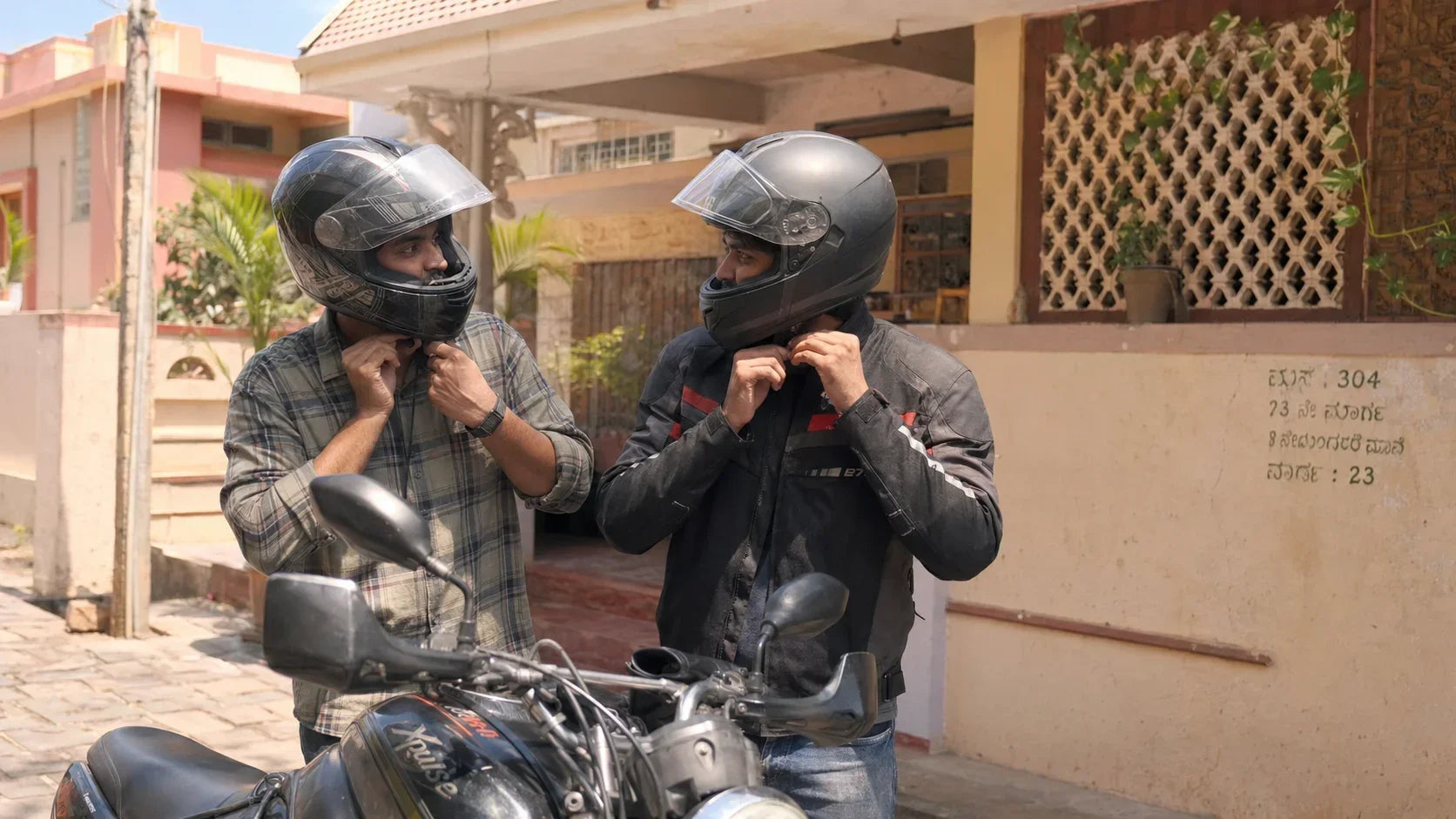
You're stopped at a Sayyaji Rao Road signal, helmet fogging up, ten minutes still to go.
Type "helmet cleaner Mysore" into Google and you'll find a dozen sprays promising a fresh helmet in seconds. Most of them lift dust off the shell. None of them touch the bacteria multiplying in your liner while you wait out that signal.
Mysuru's weather feels gentler than most Karnataka cities, but that doesn't mean your helmet gets an easy ride. This piece breaks down what the city's humidity, traffic, and rider habits actually do to a helmet. And why cleaning one isn't the same as keeping it hygienic.
Rider Takeaways
- Mysuru's humidity swings from 43% in March to 74% in July. That's a 31-point jump that keeps a helmet liner from ever fully drying out. Source: Weather and Climate, 1991-2020 averages.
- The city's vehicle count crossed 16 lakh in 2025, adding 1.7 lakh vehicles in two years. Two-wheelers make up 82% of that total. Source: Star of Mysore, March 2026.
- Only 28 of every 100 motorcyclists in Mysuru wear their helmet properly, a 2020 study found. That's despite helmet use being mandatory by law. Source: Environmental Health and Preventive Medicine, 2020.
- A cleaner wipes off dust. Only a bacteriostatic spray like Hygena stops the odor-causing bacteria underneath.
Does Mysuru's Mild Climate Still Breed Helmet Bacteria?
Yes. Mysuru's reputation as an easy-weather, "pensioner's paradise" city doesn't mean helmet bacteria gets the memo. Relative humidity here swings from a dry 43% in March to a sticky 74% in July, a 31-point jump. Source: Weather and Climate, Mysore/Mysuru climate averages, 1991-2020. That swing does the same job a heavier monsoon does elsewhere. It keeps a sweaty liner from ever drying out completely.
Daytime highs still touch 35°C through March and April, enough to keep sweat production going even without record-breaking extremes. Add rising humidity from June, and a helmet liner spends most of the year somewhere between damp and never-quite-dry. Bacteria don't need a heatwave to multiply, just moisture that doesn't go away. Mysuru supplies that quietly, without ever making headlines for it.
Quick Fact:
Mysuru's relative humidity ranges from 43% in March, the driest month, to 74% in July, with daytime highs touching 35°C in March and April. Source: Weather and Climate, Mysore/Mysuru climate averages, 1991-2020
Mysuru's relative humidity ranges from 43% in March, the driest month, to 74% in July, with daytime highs touching 35°C in March and April. Source: Weather and Climate, Mysore/Mysuru climate averages, 1991-2020
How Much Longer Are Mysuru Riders Spending Inside a Sealed Helmet?
Longer than a few years ago. Mysuru's registered vehicle count crossed 16 lakh in 2025, up from 14.54 lakh in 2023. That's an addition of 1.7 lakh vehicles in just two years. Source: Star of Mysore, citing state transport department data, March 2026. Two-wheelers account for 82% of that count, rising from 11.93 lakh to 13.29 lakh over the same period.
More vehicles on largely unchanged roads means more time stopped, not riding. Mysuru is becoming an emerging IT hub and a weekend transit point for tourists heading to Coorg, Bandipur, and Ooty. That piles extra vehicles onto roads laid decades ago, per the city's Deputy Commissioner of Police for Traffic. Vehicle density now sits between 1,250 and 1,350 per 1,000 residents, roughly 800 to 1,000 vehicles per kilometre of road.
Quick Fact:
Mysuru's registered vehicle count crossed 16 lakh in 2025, up 1.7 lakh (about 12%) in two years, with two-wheelers making up 82% of the total and vehicle density estimated at 800-1,000 per kilometre of road. Source: Star of Mysore, "Is Mysuru going the Bengaluru way?" March 2026
Mysuru's registered vehicle count crossed 16 lakh in 2025, up 1.7 lakh (about 12%) in two years, with two-wheelers making up 82% of the total and vehicle density estimated at 800-1,000 per kilometre of road. Source: Star of Mysore, "Is Mysuru going the Bengaluru way?" March 2026
Dasara adds its own spike. Heavy tourist inflow during the festival chokes city roads every year. Police respond with one-way rules and route restrictions near the Palace and other key venues. Source: Deccan Herald, September 2025. For a rider just trying to get to work, that's extra minutes stuck in traffic. A sealed helmet doesn't know the difference between a work commute and a festival crawl.
Unique Insight
Our finding: Mysuru's traffic conversation is about signals and flyovers, not about what a longer commute does inside a rider's helmet. The city is quietly stacking two risk factors, rising humidity and rising helmet-on time, that almost never appear in the same headline.
What's Actually Living Inside a Motorcycle Helmet?
A 2020 study swabbed 130 motorcycle helmets and recovered 392 separate bacterial isolates spanning seven genera, plus 346 fungal ones. Staphylococcus aureus alone made up close to a quarter of the bacteria found. Some of those isolates carried antibiotic resistance. Source: Sapkota et al., International Journal of Microbiology, 2020.
None of that shows up when you wipe a visor with a helmet cleaner spray. Surface cleaners are built to shift dust and grime off hard plastic. They were never formulated to reach the foam padding where sweat actually collects. That's exactly where this bacteria was found.

Why Do So Few Mysuru Riders Wear Their Helmet Properly?
A 2020 study observed 3,499 motorcyclists at four Mysuru traffic intersections. Effective helmet use, meaning a full-face helmet properly fastened, was just 28 per 100 riders. Tracked over time, that worked out to 19.5 instances per 100 person-minutes of observation. Source: Setty et al., Environmental Health and Preventive Medicine, 2020.
The gap wasn't even across riders. Motorcycle riders wore helmets correctly more often than pillion passengers, 34.5% versus 18.1%. Female riders outpaced male riders by a wide margin too, 51.3% versus 26.8%. Riders commuting to work or school were significantly more likely to wear one properly. So were those stopped by police in the past three months.
Back in 2016, clubs including Bulls of Mysore and Enfield Monsters rode hundreds of Royal Enfields through the city. Ten women rode among the lead riders, specifically to push helmet awareness. Source: Deccan Herald, 2016. That kind of local push exists. It just stops at getting a helmet on, not at what happens inside it after.
Unique Insight
Our finding: Mysuru riders who do wear a helmet correctly are still unlikely to think about what's growing inside it. Local safety campaigns focus entirely on getting the helmet on; none of them address what happens once it's been on for months.
Is a Helmet Cleaner the Same as a Helmet Hygiene Spray?
No, and this is where most searches for "helmet cleaner Mysore" go wrong. A cleaner is built to lift dirt, dust, and grime off a surface. A hygiene product like Hygena is built to stop odor-causing bacteria from multiplying in the first place.
Both jobs matter on Mysuru's dusty, humid roads, but they aren't interchangeable. Wiping a visor with cleaning spray does nothing about the Staph aureus and other bacteria in the padding. That's the actual source of the smell that won't wash out.
| Job | Helmet Cleaner | Helmet Hygiene Spray (Hygena) |
|---|---|---|
| Removes visible dust and grime | Yes | No, not its job |
| Stops odor-causing bacteria multiplying | No | Yes, bacteriostatic formula |
| Used between washes | Occasionally | Every ride |
The Fix Mysuru Riders Actually Need
Hygena is a bacteriostatic spray, not a cleaner. It's formulated with tea tree extract and other natural antimicrobials that stop bacterial growth at the source. A few sprays survive a Dasara-weekend traffic crawl or a 35°C March afternoon. They handle Mysuru's slow shift into July's sticky humidity just as well. In a city adding vehicles faster than it's adding traffic capacity, that's the fix that actually holds up.

The fix is simpler than hunting for another spray at a local store. Apply it after every ride, dry season or wet, and you're covering the one job a cleaner never could.
Frequently Asked Questions
Does a helmet cleaner spray kill the bacteria causing helmet smell in Mysuru?
Most helmet cleaner sprays are built to lift dust and grime, not kill bacteria. A 2020 study isolated 392 bacteria across seven genera from 130 motorcycle helmets. Staphylococcus aureus made up close to a quarter of them. Source: Sapkota et al., International Journal of Microbiology, 2020. A bacteriostatic hygiene spray targets that bacteria directly.
Why does my helmet still smell in Mysuru's relatively mild climate?
Mysuru's humidity climbs to 74% in July from a March low of 43%. That 31-point swing keeps a liner from fully drying even without extreme heat. Source: Weather and Climate, 1991-2020 averages. Moisture that lingers is enough for odor-causing bacteria to keep multiplying, mild weather or not.
How often should Mysuru riders clean or sanitize their helmet interior?
Wash the removable padding every two to three weeks, more often through the humid June-to-October stretch. Spray a bacteriostatic hygiene product like Hygena after every ride, since bacteria start multiplying within hours of a sweaty commute.
Where can I buy a helmet hygiene spray in Mysuru?
Hygena ships across Mysuru and the wider district through hygena.in, with cash-on-delivery available. It's built for exactly the humidity swings and stop-start traffic Mysuru riders deal with through the year.
Can I just use a helmet cleaner instead of washing the padding?
No. A cleaner handles surface dust on the shell and visor. The padding needs its own wash cycle plus a bacteriostatic spray between washes. That's where sweat and bacteria actually build up, not on the outer shell a cleaner reaches.
Conclusion
Mysuru's helmets deal with a quieter version of the same problem hitting every Indian city. Humidity here swings 31 points across the year. The vehicle count crossed 16 lakh in 2025. And effective helmet use sits at just 28 per 100 riders, despite the law. A cleaner spray addresses none of that.
Hygena does. It's not a cleaner, it's a hygiene habit. A few seconds after every ride, and bacteria never gets the chance to start smelling. Try it and see what a genuinely fresh helmet feels like through a Mysuru monsoon.
Sources
1. "Mysore / Mysuru Humidity by Month," Weather and Climate, climate averages 1991-2020. Retrieved 2026-07-30.
2. "Is Mysuru going the Bengaluru way?," Star of Mysore, March 22, 2026. Retrieved 2026-07-30.
3. "As tourists throng Mysuru for Dasara, city roads are choking with traffic," Deccan Herald, September 30, 2025. Retrieved 2026-07-30.
4. Setty, N.K.H. et al., "Prevalence and factors associated with effective helmet use among motorcyclists in Mysuru City of Southern India," Environmental Health and Preventive Medicine, Vol 25, Article 47, 2020. Retrieved 2026-07-30.
5. Sapkota, A. et al., "Microbial Diversity and Antibiotic Susceptibility Pattern of Bacteria Associated with Motorcycle Helmets," International Journal of Microbiology, 2020. Retrieved 2026-07-30.
6. "'Bullets' hit Mysuru roads to create awareness on helmet rule," Deccan Herald, February 7, 2016. Retrieved 2026-07-30.
Share:
Helmet Cleaner Hubli-Dharwad: The Twin-City Commute Test
Helmet Cleaner Warangal: What 5 Lakh Vehicles Miss