
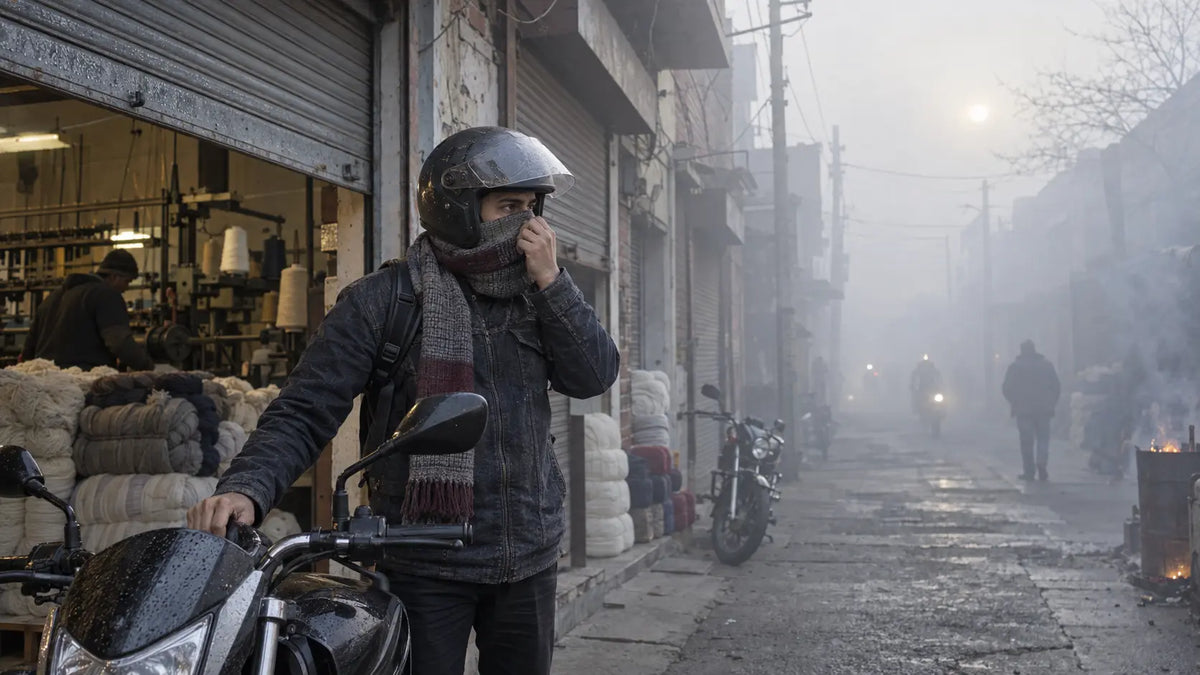
Fog on your visor. Smoke in your throat. You still can't see the truck ahead.
That's a normal November morning on Ludhiana's roads. Dense winter fog and stubble-smoke haze hit together here. Riders spend three months breathing and sweating inside a helmet that never fully dries out. So it's no surprise a lot of riders search "helmet cleaner Ludhiana" around this time of year.
Here's the part most cleaners don't tell you: cleaning the outside doesn't touch what's actually growing inside. This article breaks down why Ludhiana's fog-and-smog season is uniquely bad for helmet hygiene. It covers what a 2025 pollution study found about your skin's bacteria. And it explains what actually works better than a cleaner spray.
Rider Takeaways
- Ludhiana's AQI hit 178 as farm fires crossed 176 by mid-November 2025, per The Tribune.
- A 2025 study found winter haze enriches Acinetobacter and Pseudomonas on human skin. Both thrive in a sweaty helmet too.
- Ludhiana built Hero Cycles into the world's largest bicycle maker. It never taught riders to clean inside a helmet.
- Two-wheeler registrations here jumped 54% in six months of 2024, per district transport data.
The City That Built India's Two-Wheelers Never Taught This
Ludhiana didn't just adopt two-wheelers, it manufactured the ones the rest of India rode. In 1956, the Munjal brothers set up Hero Cycles here with a bank loan of about ₹50,000. By 1986, the factory made 18,500 cycles a day. That set a Guinness World Record for the largest bicycle manufacturer on the planet. The Better India documented this in its 2024 history of the brand.
Quick Fact:
Hero Cycles grew from a ₹50,000 bank loan in Ludhiana to the world's largest bicycle manufacturer by 1986, producing 18,500 units a day and earning a Guinness World Record. Source: The Better India.
Hero Cycles grew from a ₹50,000 bank loan in Ludhiana to the world's largest bicycle manufacturer by 1986, producing 18,500 units a day and earning a Guinness World Record. Source: The Better India.
An Avon Cycles executive put it simply. Ludhiana "is synonymous with Hero Cycles," a company that put the city on the world map. That legacy carried straight into motorcycles. Local transport data still shows two-wheelers dominating what rolls off Ludhiana's roads every year.
None of that manufacturing pride ever came with a hygiene habit. A city built around two-wheelers still treats a helmet's inside as an afterthought. At best, it gets wiped with a cloth.
Unique Insight
Our finding: the city that engineered India's two-wheeler boom never built a parallel habit for what happens inside the helmet those wheels made mandatory. Ludhiana perfected the machine, not the routine that keeps its rider healthy.

Why Ludhiana's Winter Is Rough on a Helmet
Ludhiana swings hard between seasons. Average highs run from 18°C in January to 39.2°C in May. Humidity swings even harder, from 32% in May to 82% in August, per 1991–2021 data from Climate-Data.org. That means a helmet liner rarely gets a season to fully dry out.
Winter adds fog on top of the humidity swing. In November 2023, dense fog on the Ludhiana-Delhi highway near Libra village caused a major pile-up. More than two dozen vehicles, including buses and a truck, were involved, per The Tribune. Fog season means longer, slower commutes with the visor down and the helmet sealed shut.
What Polluted Air Actually Does to Your Skin
Stubble burning stacks a second problem onto the fog. By mid-November 2025, Ludhiana district had logged 176 farm fires since September 15. That pushed the city's AQI to 178, per The Tribune. It's on top of 171 fires over the same window in 2024.
Quick Fact:
A 2025 study in Ecotoxicology and Environmental Safety analyzed 78 skin microbiota samples during haze and clear-air periods. Haze days significantly enriched Acinetobacter and Pseudomonas on the skin, and lab testing confirmed particulate matter itself fed their growth. Source: Ecotoxicology and Environmental Safety, Vol. 294, 2025.
A 2025 study in Ecotoxicology and Environmental Safety analyzed 78 skin microbiota samples during haze and clear-air periods. Haze days significantly enriched Acinetobacter and Pseudomonas on the skin, and lab testing confirmed particulate matter itself fed their growth. Source: Ecotoxicology and Environmental Safety, Vol. 294, 2025.
Those two bacteria aren't rare or exotic. They're opportunistic species already found on skin and inside sweaty gear. The study also noted enriched antibiotic-resistance genes among the haze-boosted strains. Now trap that haze against your scalp under a sealed helmet for an hour-long commute. You've built a small greenhouse for the exact bacteria that thrive when outside air turns bad.
This is a different mechanism than plain sweat odor. Sweat feeds bacteria already living in your helmet. Ludhiana's smog season adds a fresh supply of bacteria on top, riding in on every breath of hazy air.
How Much Time Ludhiana Riders Actually Spend Sealed In
Two-wheelers dominate Ludhiana's roads more than ever. In the first six months of 2024, the district registered 52,291 new vehicles. Of those, 31,785, about 61%, were motorcycles or scooters, per Regional Transport Officer data reported by The Tribune. That's a 54% jump over the same period in 2023.
More two-wheelers on the road means more hours sealed inside a helmet. That's more time breathing whatever Ludhiana's winter air happens to carry that week. Most riders still respond the same way. A quick wipe of the shell, maybe a splash of perfume near the padding. Neither one reaches the liner where sweat, dust, and haze-borne bacteria actually settle.
Helmet Cleaner Ludhiana: Is It the Same as Helmet Hygiene?
Not quite, and the difference matters more in Ludhiana's fog-and-smog months than almost anywhere else. A cleaner lifts visible dirt and dust off a surface. It doesn't claim to do anything to bacteria, and most aren't built to.
Hygena works differently. It's a bacteriostatic spray. That means it slows and stops odor-causing bacteria from multiplying, instead of just wiping away what's visible on top.
| What it does | Helmet cleaner | Hygena hygiene spray |
|---|---|---|
| Removes visible dust and grime | Yes | Not its job |
| Targets odor-causing bacteria | Rarely | Yes, bacteriostatic action |
| Works on the liner, not just the shell | Usually not | Yes |
Maybe you searched "helmet cleaner Ludhiana" to fight the smell after a foggy commute. A hygiene spray is actually the closer match. Cleaning handles the dust Ludhiana's roads kick up. Hygiene handles what that dust and moisture leave behind.
Unique Insight
Our finding: Ludhiana's fog and smog season doesn't just add dirt to a helmet, it adds a second, airborne source of bacteria on top of ordinary sweat. A cleaner addresses one problem. A bacteriostatic spray addresses both.
The Fix: A Routine That Survives Ludhiana's Swings
Hygena was built for exactly this kind of season-to-season swing, not a single climate. A few sprays inside the liner after a ride is all it takes. The bacteriostatic formula, built on tea tree and neem, keeps working between rides. That holds whether you rode through May's dry 39°C heat or November's damp, smoky fog.
It's not a replacement for wiping down the shell when Ludhiana's dust cakes on. Think of it as the step that comes after. It's what actually stops bacteria in the padding from building back up before your next commute.
Riders across India's smoggiest, foggiest, and most humid stretches use Hygena the same simple way. Spray, let it sit for a minute, then ride. No scrubbing, no soaking the padding, no waiting for it to dry.

Frequently Asked Questions
Does Ludhiana's winter fog make helmet smell worse?
Yes. Fog keeps humidity high and commute times longer, so sweat and moisture sit inside the liner without drying. Add stubble-smoke haze, which a 2025 study linked to more Acinetobacter and Pseudomonas on skin. Winter becomes Ludhiana's worst season for helmet odor, not its mildest.
Is helmet cleaner spray the same as helmet deodorant spray?
No. A cleaner lifts visible dirt off the shell or padding surface. A deodorant like Hygena is bacteriostatic, meaning it stops odor-causing bacteria from multiplying inside the liner where cleaners rarely reach.
Where can Ludhiana riders buy helmet hygiene spray?
Hygena ships pan-India, including Ludhiana, through hygena.in. Most orders from Punjab arrive within a few business days of placing the order.
Does stubble-burning smog actually get trapped inside a sealed helmet?
Fine particulate matter is small enough to pass through most helmet vents. Once inside, it settles on damp skin and padding, exactly the conditions the 2025 haze study found bacteria-friendly.
How often should a daily Ludhiana commuter spray their helmet?
After every ride during fog and smog season, roughly November through January. Two to three times a week is usually enough the rest of the year. Delivery riders logging longer hours should spray more often.
Conclusion
Ludhiana taught India how to build a two-wheeler. It never got around to teaching riders how to look after what's inside the helmet that comes with it. Fog, stubble smoke, and a humidity swing from 32% to 82% make this city's winter uniquely hard on helmet hygiene. A 2025 study now explains part of why. Haze itself feeds the bacteria that cause the smell.
A cleaner handles the dust on the outside. Hygena's bacteriostatic spray handles what's building up inside, season after season. Spray it into the liner after your next ride through Ludhiana's fog, and see the difference by the following week.
Sources
1. "Ride to Remember: How Hero Cycles Gave Wheels to Post-Independence India," The Better India, 2024. Retrieved 2026-09-04.
2. "Ludhiana Climate," Climate-Data.org, 1991-2021 averages. Retrieved 2026-09-04.
3. "Over Two Dozen Vehicles Involved in Pile-up in Punjab's Ludhiana," The Tribune, 13 November 2023. Retrieved 2026-09-04.
4. "Ludhiana AQI Rises to 178 With Spike in Stubble Fires," The Tribune, November 2025. Retrieved 2026-09-04.
5. "Particulate Matter Pollution Alters the Bacterial Community Structure on the Human Skin With Enriching the Acinetobacter and Pseudomonas," Ecotoxicology and Environmental Safety, Vol. 294, April 2025. Retrieved 2026-09-04.
6. "Over 52K Vehicles Registered in 6 Months, Highest Since 2018," The Tribune, 2024. Retrieved 2026-09-04.
Share:
Helmet Cleaner Ajmer: Dry Heat Doesn't Mean Clean
Helmet Cleaner Udaipur: Cleaning Isn't the Same as Hygiene