
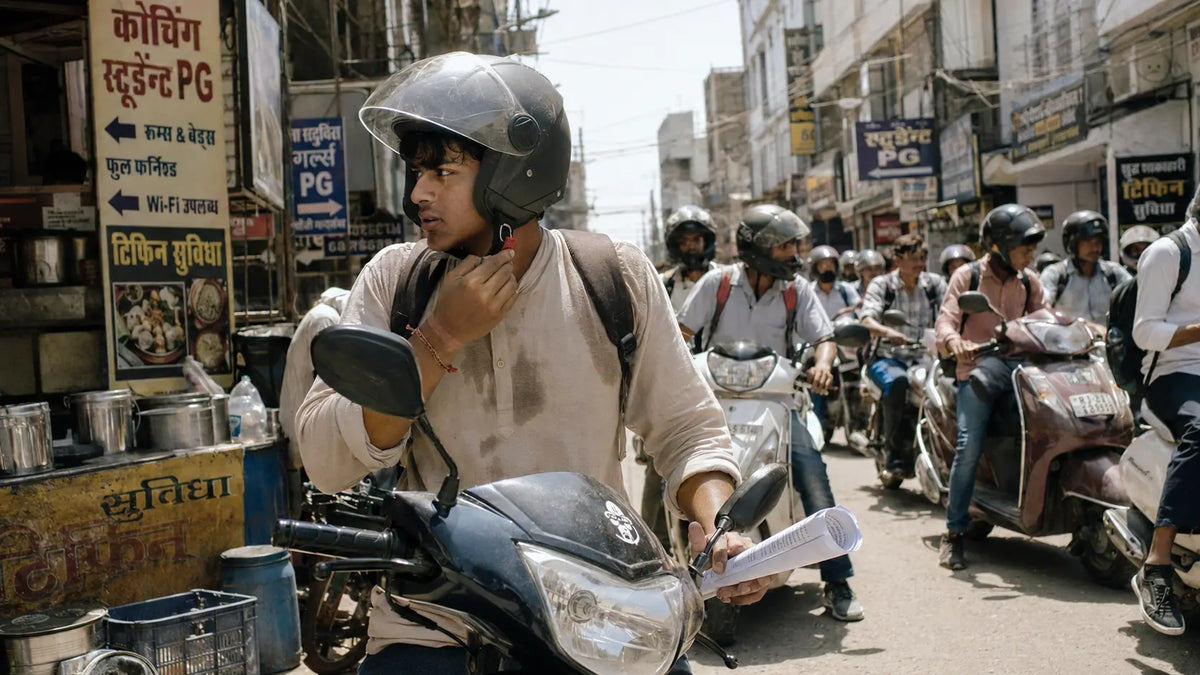
It's 11 AM in Kota and the tar on the road is starting to shimmer.
You've already ridden from your PG to one coaching center. Sat through a test. Now you're back on the scooty for round two. Helmet on, helmet off, four or five times before lunch. By evening the padding inside your helmet is damp and warm. It's starting to smell like something you'd rather not name.
That's what a helmet goes through in a city of back-to-back coaching schedules and Rajasthan's harshest summer heat. A helmet cleaner in Kota can lift the dust off the shell. It doesn't touch what's multiplying inside the padding. Here's why that gap matters here, and what actually closes it.
Rider Takeaways
- Kota's summer highs average 43.2°C in May and have hit 46.9°C on record, heat that pushes sweat production hard on every ride (Climates to Travel; Business Standard, 2019).
- Around 2.5 lakh students arrive in Kota each year for coaching, most riding a scooty several times a day between hostel and institute (The Hello World, 2026).
- A 2020 study of 130 helmets found 392 bacterial isolates inside the padding, with over a third of the Staph aureus strains drug-resistant (Sapkota et al., International Journal of Microbiology).
- A helmet cleaner removes dust and grime. It doesn't kill the bacteria feeding on sweat. That needs a hygiene product built for it.
Why Kota's Coaching-Hub Traffic Keeps a Helmet On Longer
Kota isn't a city you ride across once a day. It's a city you ride across five or six times. Short, stop-start hops between your hostel, your coaching center, and whichever test hall has the next class. That's far more cumulative helmet-on time than one long commute would give you.
Quick Fact:
Over 2.5 lakh students travel to Kota every year to prepare for JEE and NEET. Most rely on rented or personal scooters to move between hostels and coaching centers through the day. Source: The Hello World, 2026.
Over 2.5 lakh students travel to Kota every year to prepare for JEE and NEET. Most rely on rented or personal scooters to move between hostels and coaching centers through the day. Source: The Hello World, 2026.
A 2018 study of Kota's traffic by researchers Harish Uniyal and Dr. Hemlata Gandhi named the city's core mobility problem in plain terms. Not enough parking. Roads jammed by encroachment. Infrastructure that hasn't kept pace with the population squeezed onto two wheels. That's a lot of idling, sweating, and helmet-strapping in one commute.
Multiple short rides beat one long one for a different reason too. The helmet rarely gets a full chance to dry out between trips. It goes back on still warm from the last ride. The bacteria inside never really get a break either.
What "Coaching Capital of India" Actually Means for Your Gear
Kota earned that nickname the hard way. Bansal Classes opened in 1985. Four decades later, the city runs a coaching economy worth an estimated $350–450 million a year. That's spread across 300-plus institutes packed into a few dense neighborhoods (Wikipedia).
Unique Insight
Our finding: in most cities, riders wear a helmet on one or two long trips a day. In Kota's hostel-and-institute clusters, students often ride the same short stretch several times before dinner. That pattern concentrates sweat and bacteria buildup into a much shorter window than the usual daily commute.
That density means hundreds of scooters parked bumper to bumper outside every gate at class-change time. It also means a helmet spends a lot of time sitting in the heat, not resting somewhere cool. Neither helps with what's growing inside.
The Bacteria Behind the Smell, and Why Heat Speeds It Up
Sweat itself doesn't smell. Bacteria feeding on it does. A 2020 study in the International Journal of Microbiology examined 130 motorcycle helmets. It recovered 392 bacterial isolates across seven genera. Staphylococcus aureus was the single most common species, at 22.7% of the total.
Heat doesn't create bacteria out of nothing. It does push your body to produce more of what feeds it. A US National Academies review found sweating rates can climb toward a liter an hour during hot-weather exertion. Kota's summer riding conditions sit well inside that range on most afternoons.
More sweat soaking into foam that never fully dries gives bacteria exactly what they need. Moisture, warmth, and time. A helmet cleaner wipes the surface. It doesn't reach what's living inside the foam.

Kota's Heat Doesn't Let Up, Even When the Rain Comes
May is Kota's hardest month for helmets. Average highs sit at 43.2°C, with the hottest days climbing to around 46.5°C. The city has recorded an official 46.9°C on its worst summer days (Climates to Travel; Business Standard, 2019).
Quick Fact:
Kota's humidity climbs sharply once the monsoon arrives, from 43% in June to 70% in July and 77% in August. Dry heat trades for damp heat almost overnight. Source: Climates to Travel, 1991–2020 averages.
Kota's humidity climbs sharply once the monsoon arrives, from 43% in June to 70% in July and 77% in August. Dry heat trades for damp heat almost overnight. Source: Climates to Travel, 1991–2020 averages.
That shift matters because dry heat and humid heat stress a helmet differently. Dry heat bakes sweat into the foam and dries the surface fast. The smell can seem to disappear even as bacteria keep multiplying underneath. Humid heat does the opposite. Nothing dries at all, and odor shows up within a ride or two. Kota's riders deal with both, roughly four months apart.
Cleaner or Hygiene Spray, What's the Actual Difference?
Searching "helmet cleaner Kota" usually turns up products meant for the shell and visor. Dust removers, streak-free polishes, glass cleaners. Useful, but they solve a different problem than the one growing in your padding.
| What it's for | Cleaning spray | Hygiene spray |
|---|---|---|
| Removes dust, grime, streaks | Yes | Not the focus |
| Targets bacteria in the foam | No | Yes |
| Prevents odor from returning | No | Yes, with regular use |
| Where it's used | Shell, visor | Padding, liner, straps |
Both have a place in a proper routine. Wipe the shell for dust. Spray the padding for what's actually causing the smell.
The Fix That Survives a Kota Coaching Day
Between hostel, coaching center, and a couple of extra trips for tiffin or a test, your helmet needs something fast. Not a routine that only fits a weekend. Hygena's bacteriostatic spray targets the bacteria feeding on sweat, rather than masking the smell over it. A few sprays after your last class of the day keeps the padding in check before tomorrow's first ride.
It's built for exactly this kind of schedule. Quick, no water needed, and safe on the foam you're putting your head into all day.
Frequently Asked Questions
Does Kota's summer heat make helmet smell worse?
Yes. Average highs reach 43.2°C in May, and heat drives sweat production up. That feeds the bacteria responsible for helmet odor faster than in milder climates (Climates to Travel).
How often should a Kota coaching student clean their helmet?
With multiple daily rides between hostel and coaching center, spray after your last ride of the day. Do a full liner wash every one to two weeks, more often during monsoon months.
Is a helmet cleaner spray enough on its own in Kota?
No. A cleaner handles dust on the shell and visor. It doesn't reach the bacteria living in the padding, which is what actually causes the smell. That needs a hygiene-focused spray used regularly.
Where can I buy helmet deodorant spray in Kota?
Hygena ships across India, including Kota, through hygena.in. Useful if you'd rather not hunt for it between coaching batches.
Can I use a hygiene spray on a rented or shared scooter's helmet?
Yes, and it's more useful there. A shared helmet carries sweat and bacteria from more than one rider. Regular spraying matters even more here than with a helmet only you wear.
Conclusion
Kota puts a helmet through more in one day than most cities do in a week. Five short rides in 43°C heat. A quick dry-out that never quite finishes. A monsoon stretch that swaps dry heat for 77% humidity. A helmet cleaner keeps the shell looking good. It was never built to handle what's happening inside the padding.
Hygena's spray is made for that gap. A few seconds between coaching batches, and the bacteria causing the smell don't get the chance to build up. Try it here. Pair it with our guide on how often you should really clean your motorcycle helmet for a full routine. If you're riding through similarly punishing heat elsewhere, our Amravati heat guide covers the same problem from another city's angle.
Sources
1. "Kota, Rajasthan," Wikipedia. Retrieved 2026-08-31.
2. "Kota Climate: Weather by Month, Temperature, Rain," Climates to Travel, 1991–2020 averages. Retrieved 2026-08-31.
3. "At 46.9 Degrees Celsius, Kota Hottest in Rajasthan," Business Standard, June 6, 2019. Retrieved 2026-08-31.
4. "Student Hostels in Kota: The Ultimate Guide to the Coaching Capital of India," The Hello World, April 6, 2026. Retrieved 2026-08-31.
5. "Traffic Congestion - Causes and Solution: A Study of Kota City," Uniyal, H. & Gandhi, H., International Journal of Trend in Scientific Research and Development, February 2018. Retrieved 2026-08-31.
6. "Microbial Diversity and Antibiotic Susceptibility Pattern of Bacteria Associated with Motorcycle Helmets," Sapkota et al., International Journal of Microbiology, 2020. Retrieved 2026-08-31.
7. "Physiological Responses to Exercise in the Heat," Nutritional Needs in Hot Environments, Institute of Medicine (US), 1993. Retrieved 2026-08-31.
Share:
Helmet Cleaner Jodhpur: What the Blue City's Heat Hides
Helmet Deodorizer Thiruvananthapuram: Why It Never Dries