
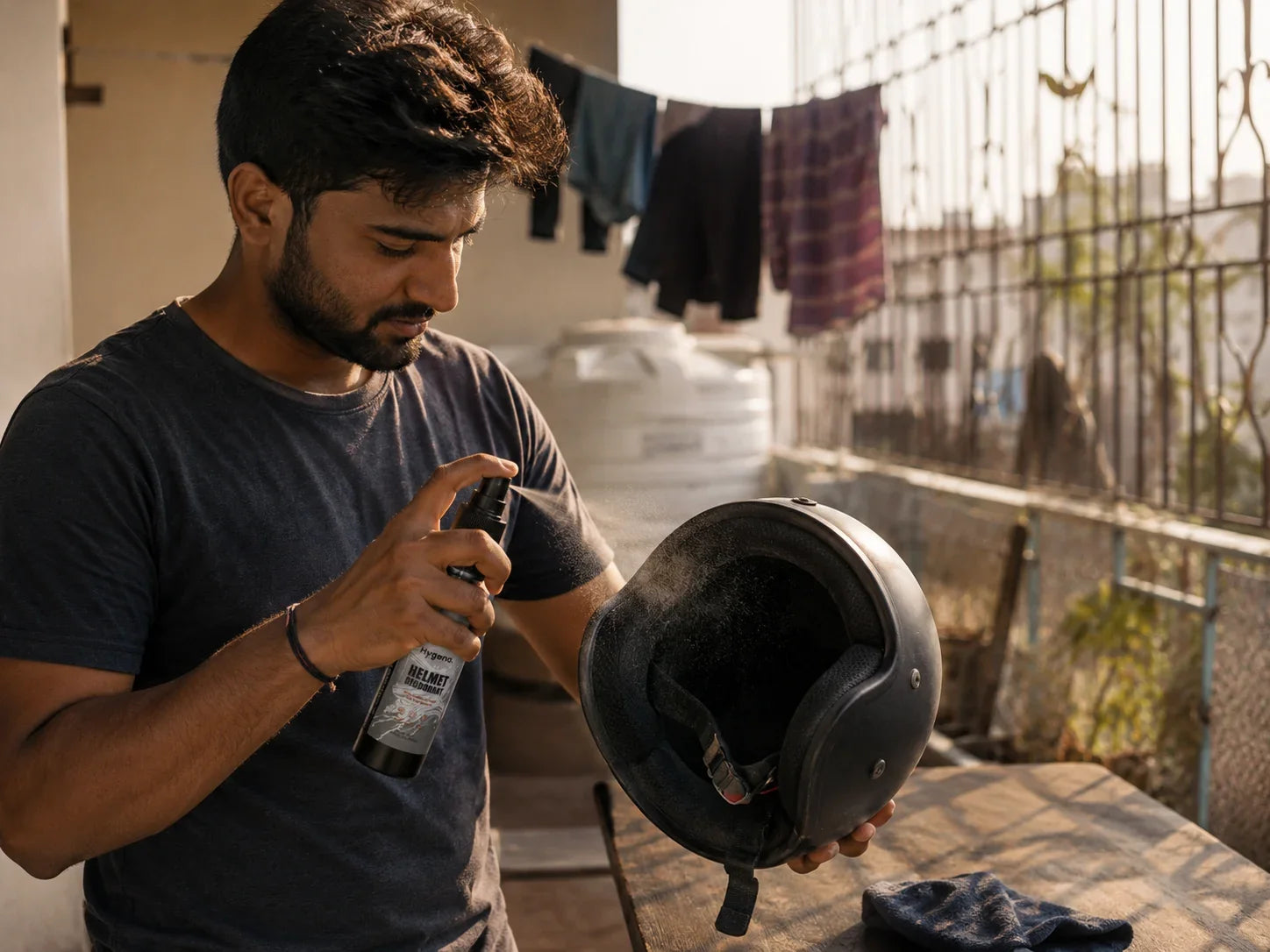
You pull your helmet off after a shift at a GIDC brass unit and there's a fine grey film across the padding, dust that wasn't there this morning. Half of Jamnagar's riders deal with this daily, and most reach for whatever's labelled "cleaner" without asking what it actually removes.
That film isn't just dirt. It's brass shavings mixed with sweat, and underneath it, bacteria that a wipe-down never touches. This article breaks down why Jamnagar's specific mix of industrial dust, coastal humidity, and a city mid-highway-construction makes helmet hygiene harder than most riders realize, and what actually solves it.
Rider Takeaways
- Jamnagar's brass sector runs 3,000+ workshops employing 200,000+ workers, and fine metal dust from those units settles into helmet padding every shift. Source: Saryu Industries.
- City humidity swings from 46% in November to 81% in August, a 35-point jump that keeps a sweat-and-dust-soaked liner damp for hours after you park. Source: Climate-Data.org.
- Helmets that are never washed or disinfected show bacterial growth in 86.7% of cases; disinfected ones drop to just 20%. Source: Sapkota et al., 2020.
- The Amritsar-Jamnagar Expressway is still under construction near the city, pushing extra freight and dust onto local roads before it opens fully in December 2026.
Why Does Jamnagar's Brass Industry Make Helmets Dirtier, Faster?
Jamnagar produces more than 60% of India's engineered brass components, spread across 3,000-plus workshops in GIDC Phase I through IV. Over 200,000 workers, directly and indirectly, depend on that trade, and a large share of them ride two-wheelers to and from the shop floor every day.
Brass turning and polishing throws off a fine metallic dust that hangs in workshop air and drifts onto anything nearby, including a helmet left on a bike seat outside the gate. Riders here don't just deal with sweat and skin oil inside their padding. They're layering metal particulate on top of it, shift after shift.
Quick Fact:
Jamnagar's brass district houses over 3,000 factories and 200,000+ workers, making it responsible for more than 60% of India's engineered brass output. Most commute by two-wheeler, carrying workshop dust home in their helmet padding daily. Source: Saryu Industries, 2025.
Jamnagar's brass district houses over 3,000 factories and 200,000+ workers, making it responsible for more than 60% of India's engineered brass output. Most commute by two-wheeler, carrying workshop dust home in their helmet padding daily. Source: Saryu Industries, 2025.
Unique Insight
Our finding: Jamnagar is likely the only city in this series where "helmet cleaner" is a literal, correct search term for a real problem, brass dust is visible grime you genuinely have to wipe away. But wiping the dust off is a different job from killing the bacteria growing underneath it, and most riders never realize they need to do both.

Does Jamnagar's Humidity Make Helmet Smell Worse?
Jamnagar's humidity climbs from a dry 46% in November to a heavy 81% in August, a 35-point swing driven by the monsoon. That kind of jump matters inside a helmet, where dust, sweat, and skin oil already sit close together with barely any airflow.
High humidity slows evaporation. A liner that would dry out in an hour on a dry March afternoon stays damp for most of a monsoon evening instead. Damp padding plus trapped brass dust is close to ideal for bacteria, which is why riders here often notice the smell getting worse specifically between June and September.
Quick Fact:
Jamnagar's relative humidity ranges from 46% (November) to 81% (August), with July and August alone bringing over 400mm of rain. That 35-point swing means sweat-soaked padding takes far longer to dry in monsoon months than in winter. Source: Climate-Data.org, 1991-2021.
Jamnagar's relative humidity ranges from 46% (November) to 81% (August), with July and August alone bringing over 400mm of rain. That 35-point swing means sweat-soaked padding takes far longer to dry in monsoon months than in winter. Source: Climate-Data.org, 1991-2021.
What's Actually Growing Inside an Unwashed Helmet?
Strip away the dust layer and the padding underneath is a different problem entirely. A 2020 microbiology study on motorcycle helmets found bacteria including Staphylococcus aureus, Pseudomonas aeruginosa, and E. coli living in helmet foam, along with fungal species like Aspergillus and Candida.
The same study measured how much disinfection matters. Helmets that were never washed or disinfected showed bacterial growth 86.7% of the time. Helmets that were regularly disinfected showed growth in just 20% of cases. That's the gap a bacteriostatic spray is built to close, not the visible dust, the invisible colony underneath it.
Quick Fact:
Motorcycle helmets that are never washed or disinfected show bacterial growth in 86.7% of cases, compared to 20% for regularly disinfected helmets, a more than four-fold difference. Source: Sapkota et al., "Microbial Diversity and Antibiotic Susceptibility Pattern of Bacteria Associated with Motorcycle Helmets," 2020.
Motorcycle helmets that are never washed or disinfected show bacterial growth in 86.7% of cases, compared to 20% for regularly disinfected helmets, a more than four-fold difference. Source: Sapkota et al., "Microbial Diversity and Antibiotic Susceptibility Pattern of Bacteria Associated with Motorcycle Helmets," 2020.
How Is the Amritsar-Jamnagar Expressway Affecting Local Rides?
Jamnagar sits at the southern end of the Amritsar-Jamnagar Expressway (NH-754). It's a 1,257km petroleum-logistics corridor connecting refinery belts in Punjab, Rajasthan, and Gujarat. As of early 2026, the project is roughly 85-90% complete, with full commissioning targeted for December 2026.
Until that finishes, freight and construction traffic bound for the Jamnagar refinery complex still shares existing city roads with daily two-wheeler commuters. Longer time on the bike near an active construction corridor means more exposure to road dust and diesel exhaust, on top of whatever a shift at a brass unit already added.
Unique Insight
Our finding: Most Indian cities in this series fight ordinary traffic congestion. Jamnagar's riders are dealing with a live mega-infrastructure project, an 80,000-crore expressway feeding a refinery, that's still funneling construction and freight traffic through everyday commute roads. That's a temporary but real addition to what a helmet has to survive.
Is a Helmet Cleaner Really What Jamnagar's Riders Need?
Search "helmet cleaner Jamnagar" and you'll find sprays built to remove grime: brass dust, road film, salt-air residue. Those products do a real job here. This city genuinely produces more visible helmet grime than most. But cleaning and hygiene solve two different problems.
A cleaner lifts dust and dirt off the surface. It doesn't touch the bacteria living in the foam underneath, the same bacteria found in over 86% of never-disinfected helmets. Wiping the padding down after a brass-shop shift feels like progress. It leaves the actual source of the smell untouched.
Hygena isn't a cleaner and isn't trying to replace one. It's a bacteriostatic spray that goes on after the dust is handled, killing the bacteria that a wipe-down can't reach. For a Jamnagar rider, that usually means: wipe the visible dust, then spray to deal with what's left.
The Fix: What Actually Works for a Brass City Commute
Hygena's tea tree and neem-based spray was built for exactly this double load: physical grime, humidity, and daily sweat, all stacked together. A few sprays after your ride breaks down the bacteria causing the smell instead of masking it with fragrance.
For a rider clocking a GIDC shift and a monsoon commute in the same day, that means starting tomorrow's ride without the sour smell that builds up when dust-caked padding never fully dries. It won't stop brass dust from settling on your helmet. It stops what grows underneath it.

Frequently Asked Questions
Does Jamnagar's brass industry dust actually get inside helmet padding?
Yes. Brass turning and polishing throws off fine metal particulate that settles on anything left near a workshop, including helmets parked outside GIDC units. It sits in the padding alongside sweat and skin oil rather than staying on the shell's surface.
Is a helmet cleaner enough for someone working in Jamnagar's brass sector?
A cleaner removes visible dust and grime, which matters here more than in most cities. But it doesn't address the bacteria living in the foam, found in 86.7% of never-disinfected helmets in a 2020 study. You need both steps, not one.
Does Jamnagar's humidity make helmet smell worse than drier Gujarat cities?
Jamnagar's coastal position pushes August humidity to 81%, well above the 46% low in November. That swing keeps damp padding from drying quickly during monsoon months, giving bacteria more time to multiply between rides.
Where can I buy a helmet hygiene spray in Jamnagar?
Hygena ships across Gujarat, including Jamnagar, through hygena.in. Most orders reach Jamnagar addresses within a few days of dispatch.
How often should a Jamnagar rider disinfect their helmet?
Once or twice a week for daily brass-unit commuters, more often during peak monsoon months (July-September) when humidity and sweat both peak together.
Conclusion
Jamnagar asks more of a helmet than most cities do. Brass dust from 3,000-plus workshops settles into the padding, monsoon humidity keeps it damp for hours, and the roads leading home are still absorbing construction traffic from an unfinished expressway. Wiping the dust off is only half the job.
A cleaner handles what you can see. Hygena handles what you can't, the bacteria that build up in padding that never fully dries. Spray after your ride, and start tomorrow's shift without carrying today's smell into it. Read more on how to choose and use a helmet deodorant spray, or explore the science behind helmet odor in our Rider Science pillar post.
Sources
1. "Brass City of India: Jamnagar's Brass Manufacturing Hub," Saryu Industries, 2025. Retrieved 2026-08-10.
2. "Jamnagar Climate," Climate-Data.org, 1991-2021 data. Retrieved 2026-08-10.
3. Sapkota et al., "Microbial Diversity and Antibiotic Susceptibility Pattern of Bacteria Associated with Motorcycle Helmets," 2020, cited via VersaDri. Retrieved 2026-08-10.
4. "Amritsar Jamnagar Expressway: Route, Location, Length, Speed Limit, Toll Fee," Express Belong, 2026. Retrieved 2026-08-10.
Share:
Helmet Cleaner Bhavnagar: What Alang's Riders Really Need
Helmet Cleaner Rajkot: Why Grease, Heat and Sweat Need Different Fixes