
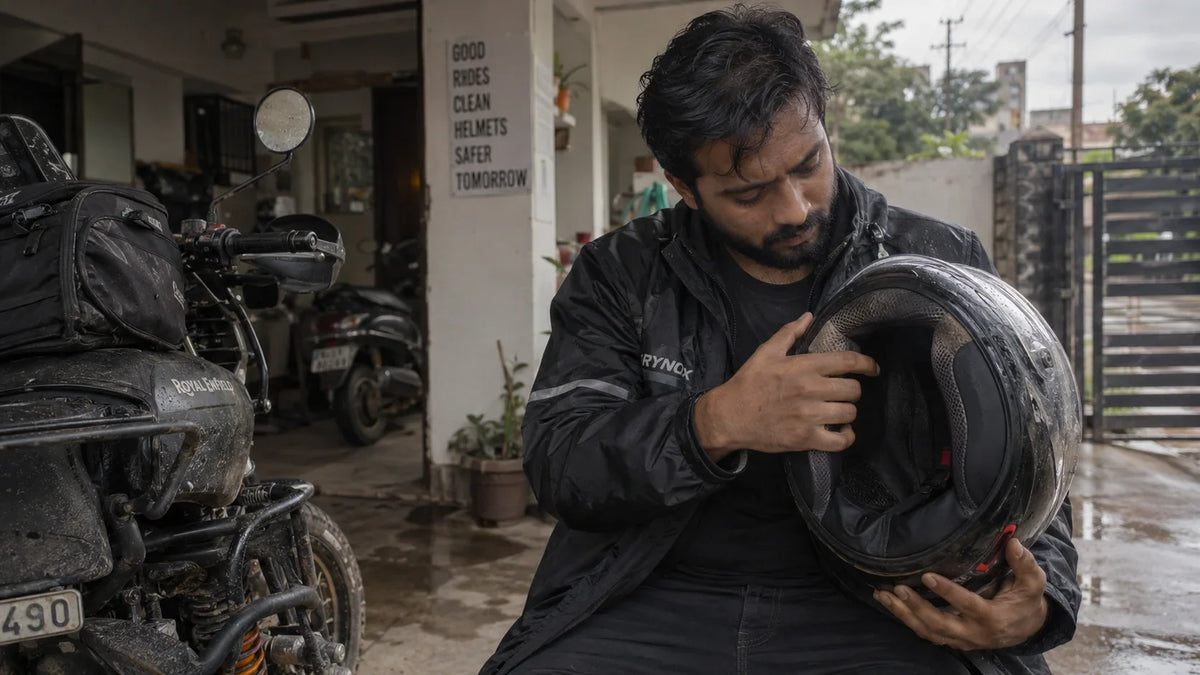
Helmet cleaner Bhilai searches often start with one simple problem: your helmet smells bad after regular rides.
That smell can get worse during Bhilai's hot months and wet monsoon period.
Your liner holds sweat, skin oils, and moisture against your head.
That creates a better setting for microbes to persist between rides.
So, what should a Bhilai rider actually use?
This guide separates cleaning from hygiene, then builds a practical local routine.
- A 2020 study found microbial growth on 130 motorcycle helmets tested in Nepal.
- Bhilai's August humidity averages about 83% in long-term climate data.
- Cleaning removes dirt, while hygiene targets the microbes linked with persistent odor.
- Let the liner dry fully, then use a helmet-specific hygiene product between deeper washes.
What are Bhilai riders doing about helmet hygiene?
Local riding culture makes helmet care a practical habit, not a cosmetic extra.
In 2024, Durg police promoted a 21-day helmet-use campaign across Bhilai-area petrol pumps.
The campaign focused on making helmet use a daily riding habit.
That matters because a helmet worn every day also needs regular interior care.
In June 2024, Durg police reported a 21-day road-safety campaign encouraging two-wheeler riders to wear helmets consistently. Petrol pumps were asked to support the campaign. Source: Bhilai Times, 2024.
Bhilai's rider community also shows interest in casual and weekend group rides.
A May 2026 Bhilai-Durg Reddit thread had riders looking for friends for weekend rides.
That kind of riding means helmets can see repeated use across busy weeks.
Your routine should match that use.
Our finding: Bhilai's helmet-care problem isn't limited to long tours.
Daily commuting can keep the same liner exposed to sweat and moisture repeatedly.
That makes small between-ride hygiene habits more useful than occasional panic cleaning.
For local rider discussions, see the May 2026 Durg-Bhilai riding discussion.
Why does Bhilai's climate make helmet smell worse?
Bhilai's warm and wet season can leave helmet liners damp for longer.
Climate data for 1991–2021 shows August humidity around 83% in Bhilai.
The same dataset records about 358 mm of August rainfall.
Wet liners then need more attention before the next ride.
Bhilai climate data covering 1991–2021 lists August at about 83% relative humidity and 358 mm of rainfall. July is also very wet. These conditions can make moisture management inside frequently used helmets more difficult. Source: Climate-Data.org, 1991–2021 dataset.
May is another problem month for riders.
The same dataset lists an average maximum temperature of about 41.3°C in May.
Heat increases sweating during longer rides and stop-and-go commutes.
Your liner absorbs some of that moisture every time you wear the helmet.
Citation capsule: Bhilai's long-term climate data shows a sharp humidity rise during the monsoon. August averages about 83% relative humidity. The same dataset records about 358 mm of August rainfall. For riders, that makes drying the helmet liner after wet rides especially important.
Read more about helmet hygiene when you want the wider routine.

How does Bhilai traffic affect your helmet liner?
Traffic adds another layer because your helmet stays on while you wait at busy junctions.
A 2026 National Green Tribunal record identifies several Bhilai congestion hotspots.
They include Nehru Nagar, Supela, Chandra Maurya, Power House, and Khursipar.
Repeated stops can extend the time your head stays enclosed and sweaty.
A 2026 National Green Tribunal record identified seven Bhilai congestion hotspots. They include Nehru Nagar, Supela, Power House, and Khursipar. The record links them with high vehicle density and intersection load. Source: National Green Tribunal, 2026.
Traffic also matters because Bhilai-Durg's road environment carries dust and vehicle emissions.
A 2025 study of the Bhilai-Durg region found strong variation in pollutants across road environments.
The researchers linked those variations with traffic, neighbourhood activity, and industrial proximity.
Your helmet still needs to protect your head from the road environment.
Our finding: Traffic care and helmet hygiene should be treated as connected routines.
After a dusty commute, don't put a damp helmet straight into a closed storage space.
Give the liner time to dry before you store it.
Learn how to remove motorcycle helmet smell after a heavy riding week.
What is actually causing the helmet smell?
Helmet odor usually comes from microbial activity around sweat and skin residues.
A 2020 motorcycle-helmet study examined 130 helmets for bacterial and fungal contamination.
The researchers recovered 392 bacterial isolates and 346 fungal isolates.
That doesn't mean every helmet carries the same microbes.
It does show why interior hygiene deserves attention.
In 2020, researchers examined 130 motorcycle helmets and recovered 392 bacterial isolates plus 346 fungal isolates. Helmets with no washing or disinfection showed higher microbial growth than frequently cleaned helmets. Source: International Journal of Microbiology, 2020.
The same study found bacterial growth in 86.7% of helmets with no reported hygiene practice.
It found bacterial growth in 57.1% of helmets that had been washed.
Only five helmets were listed in the disinfected group.
This study was conducted in Nepal, so don't treat those numbers as Bhilai prevalence.
Citation capsule: A 2020 study of 130 motorcycle helmets recovered hundreds of bacterial and fungal isolates. Bacterial growth was reported in 86.7% of helmets without washing or disinfection. The study was conducted in Nepal, so its figures shouldn't be treated as Bhilai-specific prevalence.
A 2023 review also explains how sweat and skin microbiota contribute to odor in clothing.
Fresh sweat itself is not the whole story.
Microbes can break down sweat components and create odorous compounds.
That's why masking the smell doesn't address the source.
See the 2023 iScience review on sweat and odor for the mechanism.
Is a helmet cleaner the same as a helmet deodorizer?
No. Cleaning and hygiene solve different problems inside your helmet.
A cleaner focuses on removing dirt, grime, sweat residue, and visible buildup.
A hygiene product focuses on managing the microbes linked with persistent odor.
You may need both approaches over the life of your helmet.
The 2020 motorcycle-helmet study found lower reported bacterial growth among helmets that were washed or disinfected. The study supports regular interior hygiene, but it doesn't prove that one commercial spray works for every helmet. Source: International Journal of Microbiology, 2020.
Don't use harsh household cleaners just because the keyword says "cleaner."
Helmet liners contain fabrics, foams, adhesives, and comfort materials.
Always follow your helmet maker's care instructions for removable padding.
For Bhilai riders, the practical split is simple:
- Wash removable padding according to the helmet manufacturer's instructions.
- Dry every interior part completely before wearing the helmet again.
- Use a helmet-specific hygiene product between deeper cleaning sessions.
- Don't cover persistent odor with perfume alone.
Follow this helmet padding cleaning guide for the deeper-cleaning side.
What should you use as a helmet cleaner Bhilai riders can trust?
If your main problem is recurring odor, start with hygiene rather than fragrance.
Hygena is built for the inside of your helmet.
It's a bacteriostatic helmet deodorant designed to control odor-causing bacteria.
That makes it different from a general surface cleaner or room freshener.
Hygena is positioned as a rider-focused helmet hygiene product, not a general household cleaner. Its role is interior odor control between deeper cleaning sessions. Product information is available directly from: Hygena's Helmet Deodorant product page.
Use it after your helmet has been aired and dried.
Follow the product label for the correct amount and application method.
Don't soak the liner or replace manufacturer-approved washing instructions.
Want an easier between-ride routine?
Explore Hygena Helmet Deodorant for a rider-specific hygiene step.
For Bhilai's wet months, keep your helmet storage area dry and ventilated.
For hot commutes, give the liner time to breathe after every ride.
Those habits matter even when you're using a hygiene spray.

Helmet cleaner Bhilai: what should you do after each ride?
A simple post-ride routine can stop moisture and odor from building up.
- Open the helmet: Remove it from your bag as soon as you get home.
- Air the liner: Leave the visor open in a clean, shaded area.
- Check moisture: Pay attention to the forehead, crown, and cheek-pad areas.
- Use hygiene care: Apply your helmet-specific product according to its label.
- Store dry: Put the helmet away only after the interior is dry.
This routine becomes especially useful during Bhilai's humid monsoon months.
It also helps after long traffic-heavy rides through busy junctions.
Bhilai's climate data shows August at about 83% relative humidity. High humidity doesn't prove that bacteria will grow inside every helmet. It does explain why moisture can be harder to manage after wet rides. Source: Climate-Data.org, 1991–2021.
When did you last check the inside of your helmet?
If the answer is "I can't remember," start today.
Frequently asked questions about helmet cleaner Bhilai
Does Bhilai humidity make helmet smell worse?
Bhilai's August humidity averages about 83% in long-term climate data. Humidity alone doesn't prove bacterial growth inside your helmet. It can make moisture management harder. Air your helmet after rides, dry wet liners fully, and use a helmet-specific hygiene routine.
Where can I buy helmet deodorizer in Bhilai?
You can check Hygena's official online product page for its helmet deodorant. The product is designed for helmet interior hygiene. Availability, shipping, and delivery options can change. Check the current product page before ordering.
Is a helmet cleaner enough for bad helmet odor?
Not always. Cleaning can remove dirt and residue, while odor also involves microbial activity. A 2020 study found bacterial growth across tested motorcycle helmets. Use manufacturer-approved cleaning plus a helmet-specific hygiene routine.
Should I wash my helmet padding?
Follow your helmet manufacturer's instructions. Removable padding can often be cleaned according to those instructions. The 2020 helmet study found lower bacterial growth in washed or disinfected groups. Never skip complete drying before wearing the helmet again.
Can I use perfume inside my helmet?
Perfume can change the smell without addressing the source. Research on sweat odor shows microbial breakdown contributes to malodor. Use products made for helmet interiors instead of treating the liner like a room freshener.
Conclusion: build a Bhilai helmet hygiene habit
A helmet cleaner search often hides a different problem: recurring interior odor.
Bhilai's heat, monsoon moisture, and busy traffic can make helmet care harder.
The fix starts with drying, regular cleaning, and targeted interior hygiene.
Don't wait until your helmet smells bad before checking the liner.
Use a helmet-specific hygiene product between deeper cleaning sessions.
Hygena gives you a rider-focused step for controlling odor-causing bacteria.
Check Hygena Helmet Deodorant and make helmet hygiene part of your ride routine.
Then explore our motorcycle helmet smell removal guide for the next step.
Sources
- Climate-Data.org, Bhilai climate data, 1991–2021: https://en.climate-data.org/asia/india/chhattisgarh/bhilai-993488/
- National Green Tribunal, Bhilai air-quality and traffic record, 2026: https://indiankanoon.org/doc/14071528/
- Sapkota et al., International Journal of Microbiology, 2020: https://pmc.ncbi.nlm.nih.gov/articles/PMC7803264/
- Chang & Wang, iScience, 2023: https://pmc.ncbi.nlm.nih.gov/articles/PMC10391722/
- Bhilai Times, Durg police helmet campaign, 2024: https://bhilaitimes.com/bike-riders-without-helmets-will-not-get-petrol-in-bhilai/
- Durg-Bhilai rider discussion, Reddit, 2026: https://www.reddit.com/r/DurgBhilai/comments/1tqfkes/weekend_rides/
- Hygena Helmet Deodorant: https://hygena.in/products/helmet-deodorant-100ml
Sources were checked on September 17, 2026. Local climate figures are long-term averages, not a current weather forecast.
Share:
Helmet Cleaner Ranchi: What Riders Actually Need
Helmet Cleaner Shimla: Keep Your Helmet Fresh