
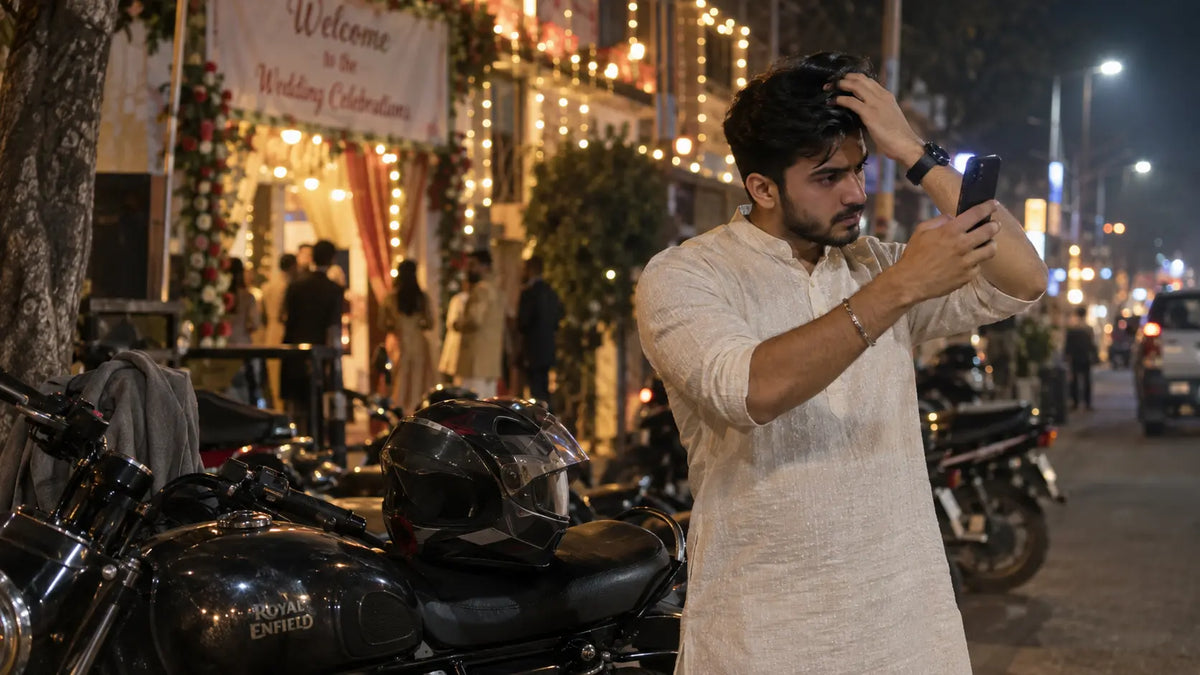
You left home showered and sharp. Ninety minutes on the bike undid all of it.
Shaadi season in India runs mostly through November and December. That's exactly when Delhi-NCR's air turns worst, and most weekends carry two or three functions. If you commute daily by bike, you ride into that mess every day. Then you walk straight into a mandap or a reception hall.
This guide covers what wedding season actually does to your skin and scalp. Then it gives you the routine that undoes it in under three minutes. No extra products to buy, just a smarter order for what you probably already own.
Rider Takeaways
- Wedding season (Nov–Dec) overlaps Delhi-NCR's worst air; PM2.5 hit 391 µg/m³ in 2025 (AQI.in).
- Staph aureus turned up in 22.7% of bacteria isolated from 130 tested helmets (Sapkota et al., 2020).
- A full pre-function routine fits under three minutes.
- Sort your helmet first. Every other step builds on that.
Why Does Wedding Season Hit Daily Riders So Much Harder?
In 2025, AQI.in recorded a winter-onset PM2.5 spike of 391 µg/m³ in Delhi-NCR. That's over four times the year's average of 91.5 µg/m³. That spike lands in November and December, the same months carrying most Indian wedding dates. Daily-commuting riders breathe that air twice a day, then dress for a function.
India's wedding season isn't small. The Confederation of All India Traders estimates 80 to 100 lakh weddings happen across the country every year. November through December is peak booking territory because the weather finally cooperates. Your riding schedule and your wedding-invite calendar overlap almost completely.
That overlap compounds fast. A rider who skips one cleaning step doesn't just carry today's dust. They carry yesterday's too, riding into function after function without a real reset in between.
For a weekend tourer, a bad-air week is annoying. For a daily commuter, it's every single ride. You're layering dust, sweat, and traffic grime on top of each other for weeks. Then you need to look presentable at someone's sangeet.
So what does that actually leave behind on your skin and scalp?
Quick Fact:
The Confederation of All India Traders estimates 80–100 lakh weddings happen across India each year. November and December draw the heaviest bookings. That's also when Delhi-NCR's air is worst. AQI.in recorded a 391 µg/m³ PM2.5 spike during the 2025 winter onset, over four times the annual average. Source: AQI.in, 2025; INDmoney, 2025.
The Confederation of All India Traders estimates 80–100 lakh weddings happen across India each year. November and December draw the heaviest bookings. That's also when Delhi-NCR's air is worst. AQI.in recorded a 391 µg/m³ PM2.5 spike during the 2025 winter onset, over four times the annual average. Source: AQI.in, 2025; INDmoney, 2025.
What's Actually Building Up on Your Skin and Scalp After Every Ride?
In 2020, Sapkota et al. tested 130 motorcycle helmets for the International Journal of Microbiology and recovered 392 bacterial isolates. Staphylococcus aureus made up 22.7% of them, and 33.7% of those isolates were drug-resistant. That's what's sitting against your scalp on function four of five this week.
Sweat alone doesn't smell. It feeds bacteria already living in your helmet liner. Wedding season gives them more to work with. There's more sweat from nervous energy and warmer indoor venues. There's also dust that doesn't wash off skin with water alone.
Your scalp takes the worst of it. Helmet padding traps heat and moisture against your head for the entire ride. That's exactly what bacteria need to multiply.
Wedding functions add another layer riders don't usually deal with. A sehra, pagri, or heavy dupatta adds more heat on top of whatever the helmet left behind.
Ever wondered why your scalp itches more in December than it does in July?
Quick Fact:
Sapkota et al. (2020) tested 130 motorcycle helmets and recovered 392 bacterial isolates. Staphylococcus aureus, linked to boils and skin infections, made up 22.7% of them. 33.7% of those isolates were methicillin-resistant (MRSA). Source: Sapkota et al., International Journal of Microbiology, 2020.
Sapkota et al. (2020) tested 130 motorcycle helmets and recovered 392 bacterial isolates. Staphylococcus aureus, linked to boils and skin infections, made up 22.7% of them. 33.7% of those isolates were methicillin-resistant (MRSA). Source: Sapkota et al., International Journal of Microbiology, 2020.
Unique Insight
Our finding: Riders getting ready for wedding week often clean up their skin and hair. They skip the helmet entirely, since it's out of sight the moment it comes off. The bacteria causing scalp irritation and smell live inside the liner, not on your face.

What Should Your Pre-Function Grooming Routine Actually Look Like?
India's male grooming products market is projected to hit $2.62 billion in 2026. That's up from $2.45 billion in 2025, according to IMARC Group. More riders now treat a quick grooming routine as normal, not vain, especially with functions stacked back to back.
Do it the moment you park, not before you leave home. A damp wipe-down of your face and neck removes the sweat and dust from the ride itself. That's what actually smells and shows.
Keep your hair reset simple: a comb and a light water spritz, not more product piled onto sweat and dust. Spray your helmet interior between rides, not just once a week during a full wash.
If you're stuck in traffic on the way, a quick face-and-neck wipe at a long red light saves time later. Keep the wipes within reach, not buried under your seat.
This is exactly where Hygena fits in. A quick spray into your helmet liner keeps bacteria from building up between rides. That means you're not fighting a smell problem on top of everything else this season throws at you.
Quick Fact:
India's male grooming products market is projected to reach $2.62 billion in 2026, up from $2.45 billion in 2025. Quick grooming routines are becoming standard for Indian men, not an indulgence. Source: IMARC Group, 2026.
India's male grooming products market is projected to reach $2.62 billion in 2026, up from $2.45 billion in 2025. Quick grooming routines are becoming standard for Indian men, not an indulgence. Source: IMARC Group, 2026.
What Should Be in Your Bike's Wedding-Season Grooming Kit?
India's wedding industry is valued near ₹10,79,000 crore, according to a February 2025 INDmoney analysis of CAIT data. That's nearly twice the size of the US wedding market. A ₹599 bottle of helmet deodorant is nothing against that spend. But it changes how you walk into every function on your calendar.
Your under-seat kit doesn't need to be big. It needs to survive heat, vibration, and getting shoved in next to your tool roll.
- Hygena helmet interior spray, for a bacteria-free liner between washes.
- Alcohol-free face wipes, gentler on skin already stressed by dust and sun.
- A small comb, for a fast hair reset without extra product.
- A cotton handkerchief, which handles real sweat better than synthetic ones.
- A compact mirror, so you're not guessing in traffic-stop reflections.
- A small cologne stick, compact enough that it won't add bulk to your seat kit.
Skip heavy hair wax or clay for this kit. It traps more dust than it controls. That's the opposite of what you want after a ride through Nov–Dec air.
Quick Fact:
India's wedding industry is valued at roughly ₹10,79,000 crore, nearly twice the size of the US wedding market. That's per a February 2025 analysis of Confederation of All India Traders data. Source: INDmoney, 2025.
India's wedding industry is valued at roughly ₹10,79,000 crore, nearly twice the size of the US wedding market. That's per a February 2025 analysis of Confederation of All India Traders data. Source: INDmoney, 2025.
Does Your Grooming Routine Change Between a Morning Ceremony and a Night Reception?
TheWeddingFocus's 2026 wedding calendar lists November 21 to 26 and December 1 to 13 as major shubh muhurat windows. Morning and evening events often fall on the same dates. Your routine needs to flex between a daytime haldi and a night reception.
Morning functions mean harsh daylight, which shows oil and shine fast, plus heavier sweat if the ride was already warm. Lean on the face wipe-down and skip anything with shine.
Night receptions are more forgiving on skin under warm venue lighting. But helmet hair is the real issue, since sweat has built up all day. That's where the hair reset step matters more than the wipe-down.
If you're the one getting married, the stakes are higher. You're on camera all day, and a fresh helmet and a two-minute reset matter even more before the baraat.
Quick Fact:
TheWeddingFocus's 2026 wedding calendar lists November 21–26 and December 1–13 as major shubh muhurat windows. Morning and evening functions often fall on the same dates. Source: TheWeddingFocus, 2026.
TheWeddingFocus's 2026 wedding calendar lists November 21–26 and December 1–13 as major shubh muhurat windows. Morning and evening functions often fall on the same dates. Source: TheWeddingFocus, 2026.
Unique Insight
Our finding: Riders heading to morning functions typically need a face wipe-down within 20 minutes of arrival. Riders heading to night receptions lean more on the hair reset. Scalp sweat has had all day to build up under the helmet by then.

Frequently Asked Questions
Can pollution during wedding season cause skin breakouts for riders?
Yes. Delhi-NCR's PM2.5 hit 391 µg/m³ during the 2025 winter onset (AQI.in). Fine particulate matter clogs pores and irritates skin already stressed by helmet sweat, making breakouts more likely through shaadi season.
How often should I clean my helmet during wedding season?
Wipe the interior after every two or three rides and spray it between full washes, since Sapkota et al. (2020) found Staph aureus in 22.7% of bacteria isolated from untreated helmets. Full liner washes should still happen weekly.
What's the fastest way to look presentable straight off the bike?
A damp wipe-down of your face and neck, a quick comb-through, and a helmet spray take under three minutes combined. Together they remove most of the sweat and dust smell before you walk in.
Does traditional wedding wear make helmet hair worse?
Yes. Heavier hairstyles and gel-set looks flatten faster under helmet pressure than everyday hair. Reset with a comb and a light water spritz instead of adding more product on top of sweat.
Is a helmet deodorant spray safe to use right before a function?
Yes. Hygena's spray is dermatologically tested and dries within seconds. A quick spray into the liner right before you leave won't affect your styled hair or clothing.
Should the groom's grooming routine be different from a guest's?
Not by much. The groom needs the same clean helmet and quick reset, just with more repeats across the day. Baraat, ceremony, and reception often happen back to back with barely a break.
Conclusion
Shaadi season doesn't slow down for daily-commute riders. Worse air, more functions, and the same ride to work all land in the same eight or nine weeks. Sweat, dust, and helmet bacteria do most of the damage to your skin and scalp in this stretch. All of it is preventable in under three minutes.
Start with the helmet. A quick spray between rides keeps bacteria from building up. That way, you're not walking into a mandap already fighting a smell problem. The wipe-down, the hair reset, and the kit in your seat all build on that base. Do that much, and shaadi season stops being something you survive and starts being something you actually enjoy.
Sources
1. "Why Winter Suffocates and Monsoon Saves Delhi Air," AQI.in, 2025. Retrieved 2026-09-08.
2. "India's ₹10,79,000 Crore Mega Wedding Industry," INDmoney, 2025. Retrieved 2026-09-08.
3. "Wedding Dates in 2026 by Panchang," TheWeddingFocus, 2026. Retrieved 2026-09-08.
4. "India Male Grooming Products Market," IMARC Group, 2026. Retrieved 2026-09-08.
5. Sapkota, R. et al., "Microbial Diversity and Antibiotic Susceptibility Pattern of Bacteria Associated with Motorcycle Helmets," International Journal of Microbiology, 2020. Retrieved 2026-09-08.
Share:
Helmet Cleaner Jabalpur: Dry Heat to Monsoon Humidity
Helmet Deodorizer Kozhikode: Why Your Helmet Never Dries