
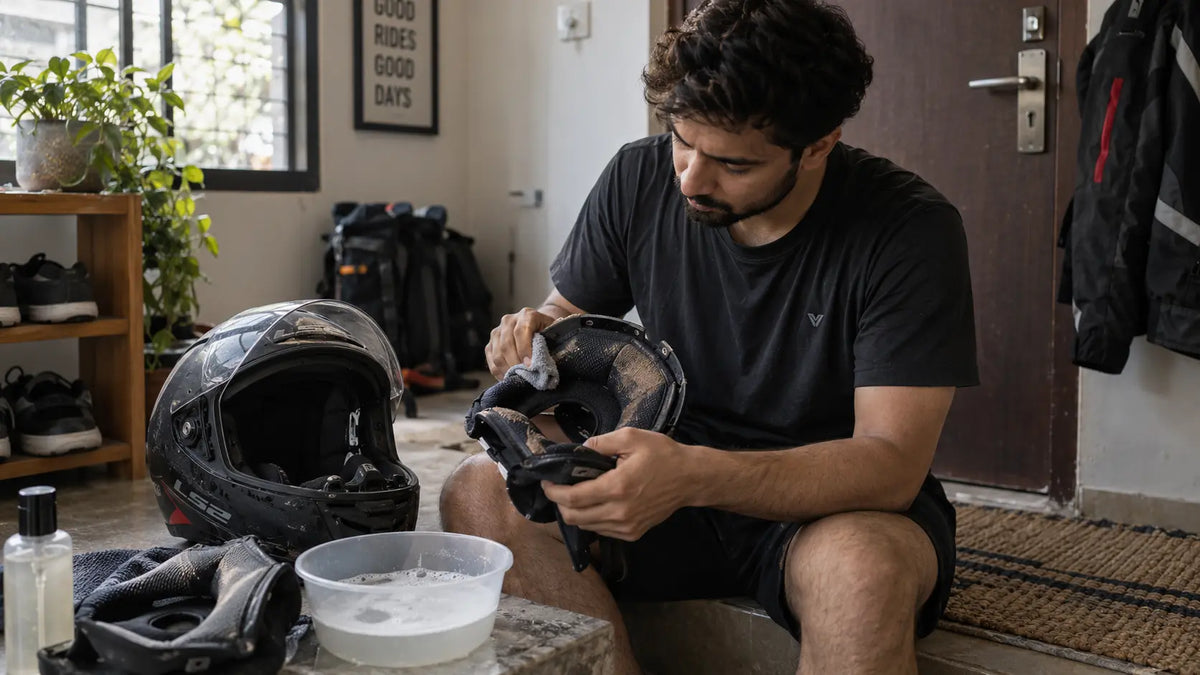
Your helmet gets cleaned, but somehow it still smells two rides later.
That usually means the cleaning routine is missing something. You might be using the wrong cleaner, drying the liner badly, or waiting until the smell becomes obvious.
These motorcycle helmet cleaning mistakes are common because helmet interiors need different care from ordinary fabric. Manufacturers also warn against solvents, harsh chemicals, and excess heat. The fix is usually simpler than the mistake.
Let's break down the five habits that can damage your helmet, leave bacteria behind, or make odor return faster.
Rider Takeaways
- A 2020 study found bacterial growth in 86.7% of helmets with no hygiene routine.
- Use your helmet maker's care instructions before choosing a cleaner or wash method.
- Never soak fixed interiors or expose the helmet to strong heat while drying.
- Cleaning removes buildup. Regular hygiene helps control the bacteria linked with odor.
1. Are you using harsh cleaners inside your helmet?
Harsh household cleaners are one of the easiest motorcycle helmet cleaning mistakes to avoid. In 2020, a study of 130 motorcycle helmets found bacteria and fungi across the sampled helmets. Your cleaning method should reduce buildup without damaging the materials that protect your head.
A 2020 study examined 130 motorcycle helmets and recovered 392 bacterial isolates and 346 fungal isolates. The study also found higher microbial growth in helmets without regular washing or disinfection. Source: International Journal of Microbiology, 2020.
Petrol, glass cleaner, strong solvents, and random disinfectants can be a bad bet. AGV advises using neutral soap and warm water when its approved cleaning method is followed. It also warns against alcohol, solvents, and harsh chemical products.
SHOEI gives similar guidance. Its maintenance instructions say the EPS liner is sensitive to solvents and heat. It recommends neutral detergent mixed with water for approved interior cleaning.
Fix: Check your helmet manual first. For removable liners, follow the stated washing method. For fixed interiors, use only an approved method and avoid saturating the helmet.
Don't assume "stronger cleaner" means "cleaner helmet." In helmet care, material safety matters too.
Our finding: Your cleaning product has two jobs. It must address the buildup you want gone without creating a new material problem inside a safety product.
Learn how Hygena approaches the bacteria and odor side of helmet hygiene science.
2. Are you washing the liner like ordinary clothing?
Removable padding can often be washed, but your helmet isn't a hoodie. In 2020, 57.1% of washed helmets showed bacterial growth. Only 20.0% of the small disinfected group showed growth.
In the 2020 motorcycle helmet study, 42 helmets were reported as washed and 5 as disinfected. Bacterial growth was found in 57.1% of the washed group and 20.0% of the disinfected group. The groups were uneven, so these figures shouldn't be treated as a controlled comparison of cleaning methods. Source: Sapkota et al., 2020.
The important point isn't that every helmet needs the same wash routine. It doesn't. AGV permits hand or machine washing for removable interiors on its helmets, with warm water and neutral soap. Bell gives different instructions for some helmets and recommends hand washing mild-soap interiors.
That difference matters. Your exact helmet model decides whether machine washing is acceptable. A removable liner isn't automatically machine-safe.
Another mistake is scrubbing hard because the padding looks dirty. Aggressive rubbing can wear fabrics, stitching, or attachment points. If the liner has hooks, snaps, or delicate sections, remove it according to the manufacturer's instructions.
Fix:
- Confirm whether the liner is removable.
- Read the manufacturer's washing instructions.
- Use the recommended soap and water temperature.
- Don't use a spin or tumble-dry method unless the manufacturer allows it.
- Refit the liner only after it's completely dry.
For the broader routine, connect this section to why helmet hygiene matters.
3. Are you drying your helmet with too much heat?
Heat feels like the fastest way to dry a wet helmet. It isn't the safest shortcut. In 2020, 89.1% of helmets used over three years showed bacterial growth. The figure was 60.0% for helmets used under one year.
The 2020 study found bacterial growth in 60.0% of helmets used under one year. The rate was 61.1% for one to three years. It reached 89.1% after three years. The study was observational, so helmet age wasn't proven to cause the difference. Source: Sapkota et al., 2020.
Manufacturer guidance is clearer here. AGV says cleaned interiors should air dry at room temperature and away from heat. Arai gives similar advice for its interiors. SHOEI warns that its EPS liner is weak against heat.
So don't put your helmet under a hair dryer. Don't leave a soaked liner against a heater. Don't use harsh sunlight as your default drying system.
Fix: Remove washable parts when the manual allows it. Let them air dry fully in a clean, ventilated place. Give the helmet time. Jaldi karne ke chakkar mein, don't cook the liner.You can also review the Hygena rider hygiene routine before your next ride.

4. Are you cleaning only the padding you can see?
The padding gets most of the attention, but sweat and skin contact don't stop at the crown liner. In 2020, researchers found Staphylococcus aureus in 22.7% of the bacterial isolates recovered from the 130 helmets studied.
Among bacterial isolates in the 2020 study, Staphylococcus aureus accounted for 22.7%. Staphylococcus epidermidis accounted for 19.6%. The study also recovered fungi from the sampled helmets. These findings show why helmet interiors need a complete hygiene routine, not just visible spot cleaning. Source: Sapkota et al., 2020.
That doesn't mean your helmet is dangerous every time you wear it. It means the interior is a real microbial environment. Sweat, skin oils, moisture, and repeated contact give microbes material to live around.
Pay attention to the cheek pads, neck roll, chin strap area, and other removable contact points. Follow your manufacturer's instructions for anything you remove.
There's another trap here. A helmet can look clean while still carrying microbial contamination. The 2020 study reported bacterial growth in 86.7% of helmets where no hygiene practice was reported.
Our finding: "Looks clean" and "is hygienically maintained" are different checkpoints. Your helmet routine should account for both.
Fix: Build one repeatable interior checklist. Crown liner. Cheek pads. Neck roll. Chin strap. Any removable fabric contact points. Then dry everything fully. For the science behind the problem, visit How Hygena works.

5. Are you waiting until the helmet already stinks?
This is the biggest habit to change. Waiting for strong odor means you're reacting to the result instead of maintaining the interior regularly. A 2020 study found 86.7% bacterial growth among helmets with no reported hygiene practice.
A 2020 study examined 130 motorcycle helmets. Bacterial growth appeared in 86.7% of helmets without reported washing or disinfection. The study's authors recommended regular helmet hygiene to reduce microbial contamination. Source: Sapkota et al., 2020.
Odor is also more complicated than sweat alone. Research on skin microbiology shows that microbes can transform odorless compounds into volatile molecules that create malodor. That means perfume can change what you smell without addressing the underlying process.
This is where a hygiene routine earns its place between deep cleans. Clean the liner when it needs washing. Dry it properly. Then use a helmet-specific hygiene product according to its directions between deeper cleaning sessions.
Hygena is designed around that gap. Its current product page says the bacteriostatic formula helps control odor-causing bacterial activity and works within 10 seconds. The brand also states that the formula is designed for daily use on helmet liners.
Hygena currently lists the 100 ml spray at ₹599. Hygena's product page currently reports 4.6/5 from 146 reviews. It says regular rider usage typically gets 45–60 days from one bottle. These are brand claims, not independent study results.
Make helmet hygiene easier between washes with Hygena. If you're still dealing with recurring smell, start with the helmet hygiene basics before adding more products.
Frequently Asked Questions
Can I use perfume inside my motorcycle helmet?
Perfume can mask an odor, but it doesn't replace cleaning or hygiene. Research shows that skin microbes can convert odorless compounds into volatile odor molecules. A 2020 helmet study also found bacterial growth in 86.7% of helmets without a reported hygiene routine. Use helmet-safe products instead of relying on fragrance.
Can I machine wash my helmet liner?
It depends on the helmet. AGV allows machine washing for removable interiors on its helmets, while some Bell models specify hand washing. Always follow your model's manual. Don't assume every removable liner is machine-safe. Dry the liner fully before putting it back into the helmet.
Does washing remove all helmet bacteria?
No cleaning method should be treated as a guarantee of complete microbial removal. In a 2020 study, 57.1% of helmets reported as washed still showed bacterial growth. The same study found 20.0% growth in the much smaller disinfected group. Cleaning and ongoing hygiene serve different roles.
How often should I clean my helmet interior?
Use your helmet maker's instructions and adjust for your riding conditions. Heavy summer commuting, frequent sweating, and long rides can increase the need for cleaning. The 2020 helmet study found higher bacterial growth among helmets without reported hygiene practices. Don't wait for strong odor before starting a routine.
Can I use a hair dryer to dry helmet padding?
It's better to avoid heat unless your helmet manufacturer specifically allows it. SHOEI says its EPS liner is sensitive to heat, while AGV recommends air drying cleaned interiors away from heat sources. Let removable padding dry fully at room temperature before refitting it.
Conclusion
Most motorcycle helmet cleaning mistakes come from treating your helmet like ordinary fabric. Your helmet has safety materials, adhesives, padding, and parts that need model-specific care.
Use the correct cleaning method. Avoid harsh chemicals. Don't rush drying. Clean the full contact area. Most importantly, don't wait until your helmet smells bad.
Deep cleaning handles buildup. A regular hygiene habit helps manage the bacterial activity linked with odor between washes.
Hygena is built for that daily gap. Its current product page says it helps control odor-causing bacterial activity inside riding gear and works within 10 seconds.
Ride often. Clean properly. Keep helmet hygiene in the routine.
Next, read why helmet hygiene matters or explore the science behind bacteriostatic hygiene.
Sources
- Sapkota S, Khadka S, Adhikari S, et al. "Microbial Diversity and Antibiotic Susceptibility Pattern of Bacteria Associated with Motorcycle Helmets." International Journal of Microbiology, 2020. PubMed.
- Sapkota S, et al. Full text and hygiene-practice table, 2020. PMC.
- AGV. Helmet care and maintenance guidance. AGV Product FAQ.
- SHOEI. Helmet maintenance guidance for interiors and EPS liners. SHOEI Maintenance.
- Arai Americas. Interior cleaning and drying guidance. Arai Regent-X specifications.
- Bell Helmets. Interior cleaning guidance for motocross helmets. Bell Helmets.
- Grice EA, Segre JA. "The skin microbiome." Nature Reviews Microbiology, 2011. PMC.
- James AG, et al. "Mapping axillary microbiota responsible for body odours using a culture-independent approach." Microbiome, 2015. PMC.
- Hygena. Helmet Deodorant 100 ml product page, current product claims accessed September 15, 2026. Hygena.
Research note: The motorcycle-helmet microbiology evidence cited here comes primarily from one 2020 cross-sectional study of 130 helmets in Nepal. Its findings support regular hygiene, but they shouldn't be generalized as a universal contamination rate for every helmet or rider.
Share:
Why a Helmet Cleaner Isn't Enough for Cuttack's Riders
Helmet Deodorizer Thrissur: Why It Still Smells By Evening